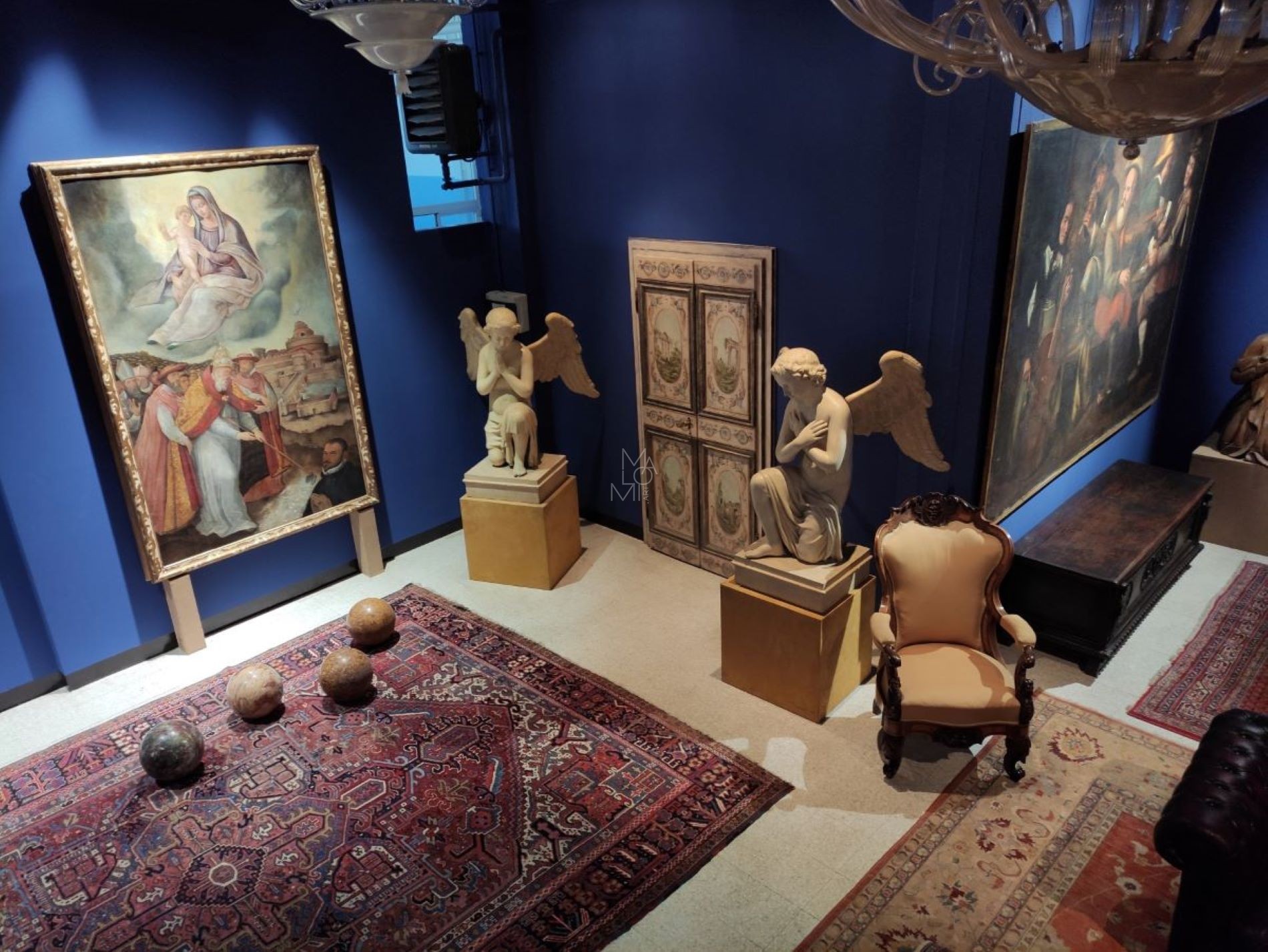
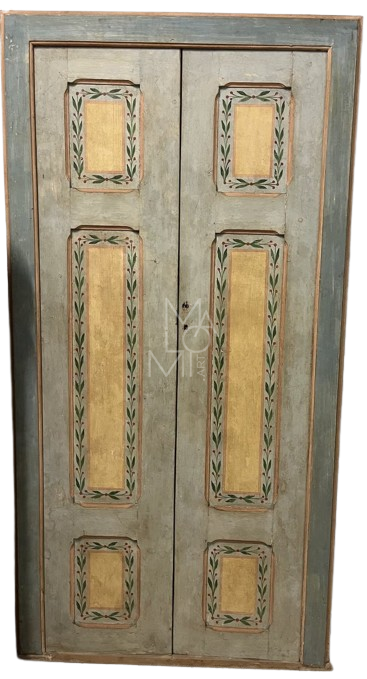
Door double beaten. Venezia seconda metà del diciottesimo secolo misure 219x99 cm
Painted Double-Leaf Doors in Eighteenth-Century Venetian Interior Design
The painted double-leaf door stands as a splendid testament to Venetian artistic production during the second half of the eighteenth century. This typological artifact perfectly reflects the sumptuous yet refined taste characteristic of noble palaces in Settecento Venice.
Stylistic and Decorative Analysis
The work is characterized by a two-valve structure adorned with a background lacquer in delicate tones tending toward sage green and powder blue—a palette highly representative of the contemporary Venetian chromatic repertoire.
- Geometric Partition: Each leaf is divided vertically into three registers of paneling, defined by two smaller quadrangular elements at the extremities and an elongated rectangular section in the center.
- Pictorial Apparatus: The interior of the panels features a warm ochre-gold background, framed by delicate garlands and stylized botanical motifs running along the borders. The slender, lanceolate leaves reflect a transition toward Neoclassicism, while simultaneously preserving the lightness and elegance of the late Venetian Baroque.
- Bifaciality: The double-sided decoration on both fronts was a frequent feature in Venetian residences, where pass-through doors between reception halls had to integrate harmoniously with the distinct cycles of frescoes, stuccowork, or tapestries of both rooms. The structural and decorative evolution of interior doors in Venice and Italy between the Louis XV (Rococo) era and Neoclassicism marks a definitive shift from the triumph of curvilinear, asymmetrical lines to a geometric and rational rigor.
Stylistic Evolution and Historical Context
During the Louis XV period and the Venetian Rococo (lasting until approximately 1760–1770), the interior door in Venice was not a mere transitional divider, but an integral component of the room's total decorative scheme (boiserie). Asymmetry dominated this phase; the profiles of the inner panels (specchiature) were shaped with sinuous lines, C- or S-shaped curves, and rounded or mixtilinear corners. The panels frequently hosted genre scenes, chinoiserie motifs (highly fashionable in Venice), gallant scenes in the manner of François Boucher, or whimsical architectural capricci, all enclosed by protruding, carved, and often gilded frames that generated sharp contrasts of light and shadow across the surface.
The door under analysis fits perfectly into the subsequent transitional phase and early Neoclassicism, which was characterized by a distinct return to order. The general framework reverted to a rigid geometric grid; the panels returned to symmetrical rectangular forms, abandoning the sinuous contours of the Rococo. Despite this structural rigor, remnants of the preceding taste remain evident in the selection of pastel colors and the calligraphic lightness of the botanical tendrils. These elements maintained the grace and luminosity typical of the Venetian idiom, avoiding the monumental austerity that would emerge at the end of the century.
Mature Neoclassicism, spanning from the 1780s to the end of the century, witnessed a further hardening of style. Influenced by the French Louis XVI style and the subsequent Empire style, this period imposed absolute geometric rigor with perfectly squared panels and proportions modeled after the canons of classical architectural orders. The decorative repertoire abandoned spontaneous floral tendrils in favor of motifs derived from Greco-Roman antiquity, such as Greek keys, geometric meanders, rigid festoons joined by knotted ribbons, candelabra motifs, symmetrical grotesques, sphinxes, and central medallions painted or carved with classical profiles or mythological scenes. The chromatic choices shifted as well, replacing pastel colors with sharper contrasts of white and gold, faux marble, or polished dark woods like mahogany, often enriched with gilded bronze appliques instead of fluid pictorial decorations.
Technical Focus: Venetian Specificity and Artisanal Secrets
While the transition to Neoclassicism in France or Rome often manifested in heavy, carved solid-wood doors, Venice maintained a unique specificity based on its preference for painted and lacquered surfaces. To achieve this effect, cabinetmakers utilized soft and affordable woods, such as swiss pine (cirmolo) or poplar. These were worked and assembled by the joiners of the guild, the marangoni, and subsequently refined by woodcarvers.
The true artistry of the artifact resided entirely in the finishing process, which was governed by the powerful guild of the depentori (the Venetian painters and lacquerers). The wooden surface was initially sealed with mestica—a warm compound of plaster and rabbit-skin glue—which was meticulously scraped down until a base as smooth as marble was achieved. Upon this ground, master fioranti (flower painters) painted the tendrils and lanceolate leaves, while figuristi (figure painters) executed anthropomorphic or mythological elements. In many cases, to accelerate production without compromising opulence, craftsmen resorted to lacca povera (or contraffatta), pasting printed paper engravings onto the surface, which were then hand-colored with watercolors.
The final touch involved applying dozens of layers of sandracca, a natural resin dissolved in alcohol that imitated precious Oriental lacquers. This surface was ultimately subjected to puralo, a manual polishing process performed with fine pumice powder and linseed oil. This laborious treatment not only protected the painting but also endowed the door with a vitreous, iridescent luster capable of reflecting and amplifying the fluctuating light typical of rooms overlooking the lagoon.
Historical Comparisons within Lagoon Interior Architecture
To fully comprehend the historical and artistic significance of this type of door, it is essential to juxtapose it with the most celebrated coeval decorative complexes preserved in the palaces of the Serenissima. The most immediate term of comparison is found within the rooms of Palazzo Rezzonico, currently the Museum of the Venetian Eighteenth Century. Inside the Sala dei Pastelli and the passageways adjacent to the Ballroom, lacquered doors are preserved that exhibit the same structural transition. Although some still retain the contoured moldings of the mature Rococo, specimens datable to the 1770s highlight the same rigid geometric tripartition of the leaves. Here, the elongated central panels host fluid, calligraphic decorations rendered against gold or ivory backgrounds, which alleviate their volumetric impact.
Another formal parallel of extraordinary interest is offered by the decorative cycle of Palazzo Pisani at Santo Stefano. In the historical apartments, the connecting doors were updated during the second half of the eighteenth century to conform to the new Neoclassical canons. Within this context, one can observe a rigorous application of the principle of bifaciality: the doors feature blue and sage tones on one front to dialogue with the minute stucco apparatuses of the Ticinese school, while adopting ochre or chalky backgrounds on the reverse, framed by garlands of lanceolate leaves identical to those on the artifact under examination. The pictorial execution of the botanical motifs at Palazzo Pisani confirms the tendency of Venetian fioranti not to immediately freeze their lines into archaeological formulas, preferring instead to maintain a painterly fluidity rooted in the lagoon tradition.
Finally, a significant parallel can be drawn with the doors of the Casino of Pius VI at Palazzo Contarini dal Zaffo. There, the need to decorate smaller spaces intended for leisure led lacquerers to push the delicacy of chromatic palettes to its limit. In this setting, faint greens and powder pinks dominate the squared panels, demonstrating how the geometric grid imposed by Neoclassicism taste was systematically softened by minute, naturalistic pictorial decorations. These museum and palace comparisons isolate the analyzed artifact not as an anomaly, but as the mature fruit of a shared, standardized language utilized by the most sophisticated artisanal workshops of late-eighteenth-century Venice.
Spatial Integration and European Comparison
The bifacial decoration of these doors responded to precise architectural requirements linked to the structure of Venetian palaces, which were historically organized according to the enfilade system. The doors of the reception rooms were aligned in a continuous visual perspective. When closed, each front had to blend seamlessly into the surrounding environment. Consequently, the side facing an intimate boudoir might be painted in sage green to dialogue with delicate stuccowork, while the opposite side could shift toward powder blue or gold to integrate with the monumental frescoes of the adjacent hall.
This decorative approach highlights Venice's artistic autonomy relative to the major Italian and European centers of the era. In Rome, under Piranesian influence, Neoclassicism expressed itself through a monumental architectural rigor, utilizing solid woods alongside insertions of gilt bronze and marble in somber, solemn tones. In Paris, the Louis XVI style imposed an absolute Cartesian symmetry in carved oak, favoring chalky white or Trianon gray. Venice, conversely, chose to domesticate Neoclassicism: while accepting the new geometric grid of the panels, it never surrendered its painterly and lacquered soul, preserving intact that chromatic freshness and visual lightness that immortalized the lagoon civilization of the Settecento.
Reference Bibliography / Bibliografia di Riferimento
Italian References / Fonti in Lingua Italiana
- Alverà Bortolotto, Angelica. Il mobile veneziano del Settecento. Milano: Görlich, 1973.
- Baccheschi, Edi. Mobili veneziani del Settecento. Milano: Gorlich, 1962.
- Chiappini di Sorio, Alvise. Stuccatori e depentori nei palazzi veneziani del Settecento. Venezia: Edizioni della Laguna, 1999.
- González-Palacios, Alvar. Il Tempio del Gusto: le arti decorative in Italia fra classicismo e barocco. Milano: Longanesi, 1984.
- Lorenzetti, Giulio. Ca' Rezzonico: Il Museo del Settecento Veneziano. Venezia: Stamperia di Venezia, 1936.
- Mariacher, Giovanni. Ambienti e arredi del Settecento in Veneto. Torino: Albra, 1972.
- Morazzoni, Giuseppe. Il mobile veneziano del Settecento. Milano: Bestetti e Tumminelli, 1927.
- Pavanello, Giuseppe. L'arredamento nei palazzi veneziani della seconda metà del Settecento: tra barocchetto e neoclassicismo. Venezia: Istituto Veneto di Scienze, Lettere ed Arti, 1989.
English References / Fonti in Lingua Inglese
- Eisner, William. Venetian Lacquer: The Art and Craft of Eighteenth-Century Faux Finishes. New York: Rizzoli, 2004.
- González-Palacios, Alvar. "The Furnishing of Palazzo Rezzonico and Venetian Taste." The Burlington Magazine 123, no. 935 (1981): 88–96.
- Huth, Hans. Lacquer of the West: The History of a Craft and an Industry, 1550–1950. Chicago: University of Chicago Press, 1971.
- Mazzariol, Giuseppe. Eighteenth-Century Venetian Decorative Arts. London: Phaidon Press, 1965.
- Pignatti, Terisio. The Golden Century of Venetian Painting. Los Angeles: Los Angeles County Museum of Art, 1979.
- Thornton, Peter. Authentic Decor: The Domestic Interior, 1620–1920. London: Weidenfeld & Nicolson, 1984.