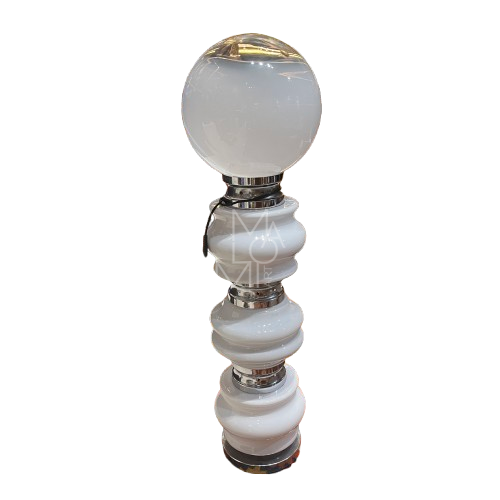
"Birillo" Murano glass floor lamp by Carlo Nason for Mazzega, circa 1970s
Carlo Nason Birillo lamp, Mazzega Murano glass, Space Age floor lamp, mid-century Italian lighting, cased glass lamp, vintage Murano floor lamp, 1970s design.
- Title: "Birillo" Murano glass floor lamp by Carlo Nason for Mazzega, circa 1970s
- Designer: Carlo Nason (Venice, b. 1935)
- Manufacturer: A.V. Mazzega (Murano, Italy)
- Period: circa 1969–1975
- Style: Space Age / Mid-century Italian modernism
- Materials: Hand-blown cased glass (vetro incamiciato in lattimo and shaded crystal), die-cast steel with polished chrome galvanic finish
- Dimensions: Height approximately 120 cm, maximum diameter approximately 36 cm
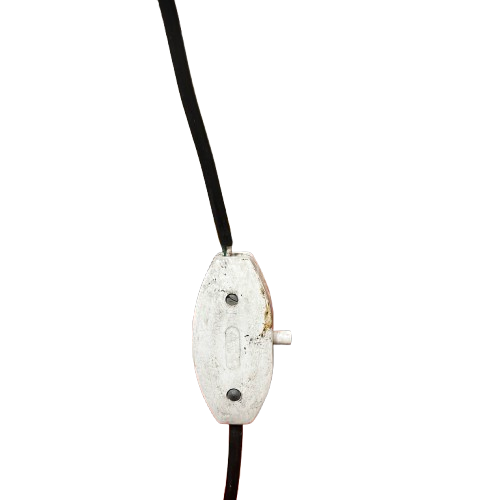
- Technical specifications: Dual-ignition illumination system featuring independent internal circuits; period-correct original electrical apparatus with coaxial wiring and a vintage inline pass-through switch.
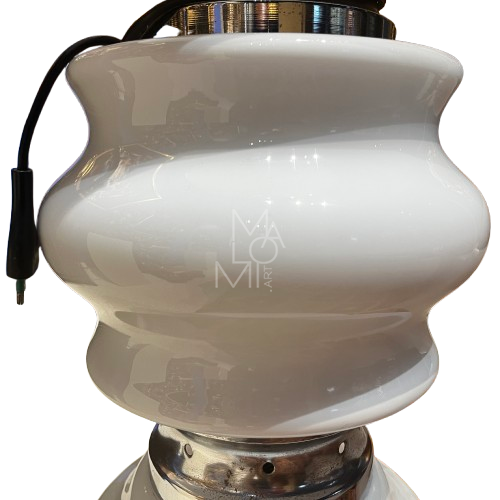
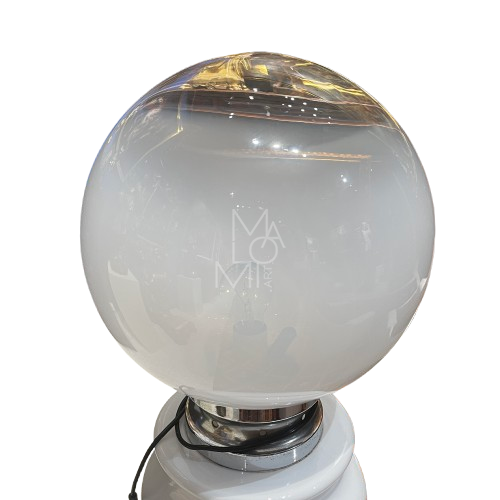
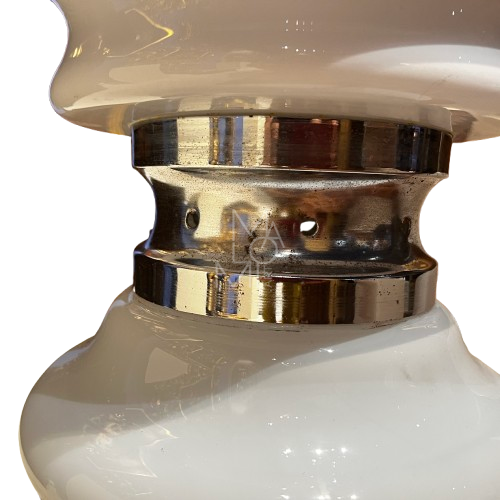
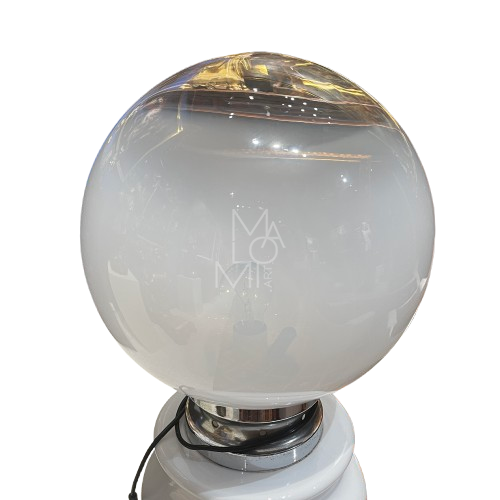
- Description: A prominent and highly sought-after specimen of the "Birillo" floor lamp, representing a seminal milestone in Italian Space Age lighting design. The vertical typology is characterized by a rhythmic, modular superposition of hourglass-shaped cased glass elements in glossy milk-white, separated by chromed metal collars meticulously engineered with peripheral apertures for kinetic heat dissipation. The crowning global diffuser exhibits a masterfully executed artisanal gradient, transitioning seamlessly from an opaque white base to absolute crystal transparency, thereby exposing the upper luminescent source. The artifact remains in pristine structural condition regarding its glass components, while the chrome-plated surfaces display a historically significant patina and minor oxidation blossoms, authenticating its un-restored philological status.
The aesthetics of light in the Space Age: the Birillo lamp by Carlo Nason for Mazzega
The historical and cultural context of a new domestic era
Between the late 1960s and the early 1970s, the international landscape of industrial design was swept by a wave of technological optimism and a widespread sense of wonder toward the cosmic unknown, generated by the epic of the Space Race and the historic Apollo missions. This cultural climate quickly translated into an expressive language known as the Space Age, where the rigorous geometric lines of pre-war functionalism abdicated in favor of fluid, biomorphic, and spherical profiles that evoked the silhouettes of early orbiting capsules and celestial bodies. In this creative ferment, domestic interiors were conceived as futuristic micro-environments ready to welcome avant-garde objects that altered the perception of space. The floor lamp model Birillo, standing approximately one hundred and twenty centimeters tall, was born precisely under the impulse of this utopian drive, positioning itself not as a mere functional tool for vision, but as a three-dimensional plastic manifesto capable of bringing the poetics of the cosmic infinite within the walls of the home. The most fascinating aspect of this period lies in the transition of the home from a traditional bourgeois shelter into a laboratory of visual exploration, where light was no longer meant simply to illuminate a table or an armchair, but to redefine the very architecture of the room, creating atmospheres reminiscent of a spacecraft interior or an untouched lunar landscape.
The profile of Carlo Nason and the revolution of Murano glass
Born in Murano within one of the oldest and most prestigious dynasties of master glassmakers on the island, Carlo Nason manifested from his youth a completely original design attitude that led him to break away from the consolidated formal models of local artistic craftsmanship, historically dominated by Baroque styles and figurative decorativism. Guided by a strong self-taught curiosity and a profound admiration for Scandinavian design, Nason understood that blown glass could be reinterpreted through a unique rationalist cleanliness, transforming it into a pure structural and geometric medium. His long and fruitful collaboration with the historic A.V. Mazzega glassworks led to the birth of lighting fixtures of extraordinary audacity, where Murano craftsmanship was applied to modern and simple forms that captured the trends of the era, even earning early exhibition at the Corning museum of glass in New York by the late 1950s, when his very first designs showed the world an alternative and minimal path to the lagoon tradition. It is said that within the Nason family itself, there was initial resistance toward this geometric turning point, considered by Murano glass purists to be a betrayal of the complex figurative tradition of multi-armed chandeliers; however, the international success of his creations quickly silenced critics, proving that the future of glass lay in its ability to become architecture and pure light.
Formal analysis and characteristics of the cased glass module
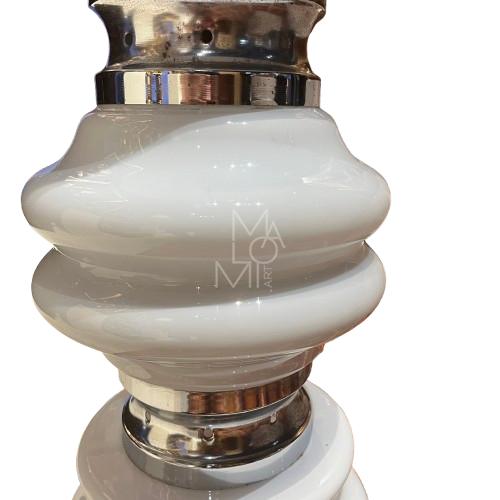
The structural framework of the lamp develops according to a calibrated vertical rhythm that fully exploits the potential of the cased glass technique, a complex Murano process that involves layering a colored or transparent glass mass over a core of opaque white glass, also known as lattimo. This specific workmanship, evident in the sinuous, double-bulbed shaft of the object, prevents direct sight of the internal load-bearing metal frame and electrical wiring, offering the viewer a dense column of light totally devoid of chromatic asymmetries. The glossy finish of the surface behaves like a true environmental mirror, capturing and amplifying external lights in punctiform reflections, while the total absence of imperfections and air bubbles within the glass mass testifies to the exceptional skill of the master gaffers at the Mazzega firm, engaged in a heavy-thickness blowing capable of withstanding the considerable static stress and cumulative weight imposed by the upper parts of the totem. Curiously, to obtain the perfect homogeneity of the lattimo without shading, the silica batch required the addition of special compounds such as arsenic and fluorine, which necessitated meticulous temperature control of the furnaces to avoid variations in opacity that would have rendered the entire batch of glass modules unusable.
The floor base and the optical illusion of levitation
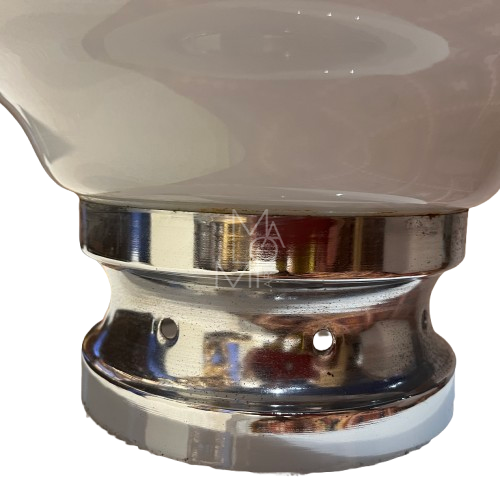
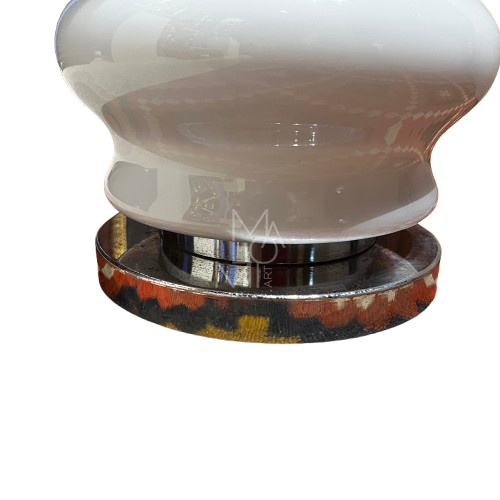
The circular support base in stamped steel responds to a dual requirement that combines engineering stability with the most sophisticated aesthetic research. Having to support a glass column of one hundred and twenty centimeters whose center of gravity is heavily shifted upward due to the large top diffuser, the base was conceived with a low-profile geometric counterweight to ensure perfect anti-tipping stability. From a visual standpoint, the steel is treated with a polished chrome galvanic finish that is interrupted by a reduced-diameter flanged neck or cylindrical collar, useful for connecting the metal to the first section of glass. This structural choice generates an intentional sliver of artificial shadow that visually lifts the entire lamp, while the mirroring nature of the chrome allows the base to absorb and reflect the texture of the surrounding floor and nearby furnishings, creating the optical illusion that the sculpture of light is suspended in the air and detached from its actual material gravity. A minor technical anecdote reveals that in early prototypes the base tended to scratch delicate flooring such as marble or parquet, forcing Nason to design an invisible soft black rubber ring recessed on the bottom, which also acted as a dampener for vibrations caused by people walking through the rooms.
The intermediate connection joints and thermomechanical solutions
Separating and tightening the various modules that make up the body of the lamp are intermediate metal elements in the shape of an hourglass that echo the sinuosity of the glass, avoiding abrupt formal contrasts within the silhouette. The close-up macro shot of these collars reveals small circular through-holes that perform mechanical and functional tasks of primary importance for the integrity of the piece. These holes serve both to house the threaded grub screws or internal screws necessary to securely lock the glass neck to the structure, and to act as indispensable ventilation slots for the thermal dissipation of the heat produced by the internal light bulbs—a fundamental precaution to preserve the Murano glass from risky thermal shocks resulting from prolonged use of the appliance, preventing overheated air from remaining trapped in the modules. In the furnaces of the 1970s, the drilling of these metal rings was performed by hand with drill presses, and the slight millimetric discrepancies in the spacing of the holes between one specimen and another are today one of the distinctive features sought by experts to certify the proto-industrial and non-serial workmanship of these components.
The upper globe diffuser and the mastery of shaded glass
The plastic culmination of the lamp is represented by a large crystal sphere that fully expresses the lighting design genius of Carlo Nason. Indeed, the macro detail of the summit reveals a masterly chromatic transition achieved in the furnace, where the glass passes seamlessly from the opaque milk-white of the base to the absolute transparency of the upper dome. This gradient is calibrated to hide the lamp holder and the light source in the opaque zone, while revealing the bulb and its filament component only in the upper transparent half. The purity of the Murano crystal at this point acts almost like a magnifying lens on the surrounding reflections, giving rise to an optical play that enhances the technical component of the bulb, consistently with the spirit of industrial honesty that animated Italian design of that period, in which the functional mechanism was not concealed but flaunted as a decorative element. A factory legend narrates that to obtain this perfect gradient, known as sfumato or fading, the master glassmakers had to partially extract the cased glass from the furnace and rapidly cool it only on the upper tip by exposing it to calibrated air currents, prior to proceeding with the final blowing inside the cylindrical mold.
The inline switch and philological details of the wiring
A careful analysis of the power supply system highlights a period-correct inline switch in white hard plastic equipped with a lateral snap pin for ignition. This technical component, which bears the signs of time on its surface in the form of small scratches and accumulations of dust in the joints, is essential for understanding the original functionality of the object and the management of energy flows. The Birillo models were in fact structured to accommodate a dual-ignition system that separated the internal circuits, allowing the user to independently control the ambient light of the shaft and the accent light of the upper globe, thus offering different illumination options. In contemporary restoration practices and the vintage design collectibles market, maintaining the coeval round-section cable and switch represents an inestimable added value for the authenticity of the piece, provided that a professional check certifies the perfect insulation of the internal contacts for obvious reasons of electrical safety. A detail often ignored is that these switches were manufactured by historic Milanese firms such as Castiglioni or Relco, which worked in close collaboration with designers to create electrical components that would look appropriate alongside works of glass art.
Anecdotes on the glass furnaces and curiosities on chromatic rarity
Numerous anecdotes revolve around the production of Carlo Nason's lamps for the Mazzega glassworks, linked to the harshness of the work in the furnace and the commercial challenges of the time. It is said that the blowing of the Birillo was feared by young Muranese apprentices due to the enormous pulmonary effort required to inflate such a dense and heavy mass of glass inside the metal molds—an operation that required millimetric precision to prevent the thickness of the casing from distributing symmetrically. Furthermore, although the version in entirely milk-white glass is the most famous for its purist rigor, Nason loved to experiment with color, giving rise to bicolor variants that are extremely rare today and highly contested in international auctions, such as specimens featuring a lower module in glass green, bright orange, or canary yellow—shades produced in very limited batches due to the high stabilization costs of the metal oxides used in the silica batch. In fact, some of these colored variants were produced exclusively as unique pieces for international trade fairs or on special commission for wealthy overseas clients, making every discovery on the antiques market an event of exceptional historiographical relevance.
The phenomenology of diffused light and spatial interaction
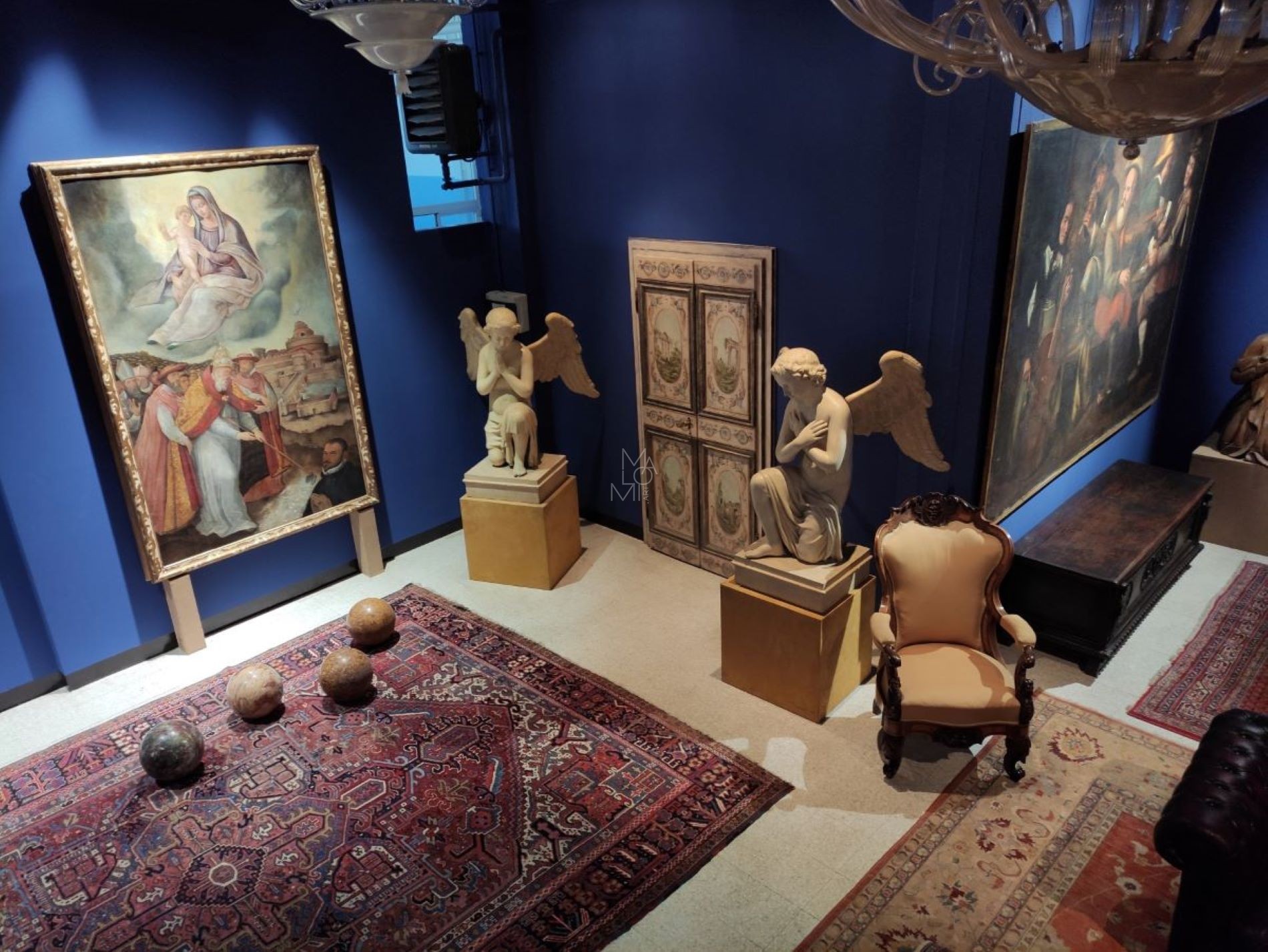
From the perspective of lighting performance, the behavior of the Birillo in human space describes a true phenomenology of light. The lower portion in opalescent glass shields the direct light radiation by deflecting photons in every direction, eliminating glare and generating an isotropic flow that transforms the lamp body into a solid and radiant sculpture. At the same time, the transparent dome projects an energetic zenithal beam toward the ceiling, which becomes a secondary reflective surface. This combination softens shadows in the room and interacts superbly with the surrounding materials, enhancing the texture and saturating the warm colors of the geometric rug below, while gently caressing the dark surfaces of the carved Baroque cabinet in the background, demonstrating how this iconic piece of the Space Age manages to establish a harmonious dialogue and a fascinating dialectical contrast with both contemporary environments and antiques. It is precisely this scenic versatility that has allowed the lamp to outlast passing trends, being rediscovered by modern interior designers not as a nostalgic relic of the seventies, but as a dynamic focal point capable of binding together distant historical eras through the timeless magic of Murano glass.
Reference bibliography
- Aloi, Roberto. Modern Furniture Examples from Around the World: Lighting. Milan: Hoepli, 1972.
- Barovier Mentasti, Rosa. Murano Glass: From Its Origins to the Present Day. Venice: Mondadori, 1982.
- Branzi, Andrea. Italian Design of the Twentieth Century. Milan: Electa, 1996.
- Deboni, Franco. Murano Glass: The A.V. Mazzega Company and the Seventies Avant-Garde. Venice: il Cardo, 1994.
- Ferrari, Fulvio, and Napoleone, Napoleone. Light: Lamps 1968-1973: The New Italian Design. Turin: Allemandi, 2002.
- Nason, Carlo. The Light of Murano: Fifty Years of Designs and Furnaces. Interview edited by G. Moretti. Venice: Marsilio, 2011.
- Pansera, Anty. Dictionary of Italian Design. Milan: Cantini, 1993.