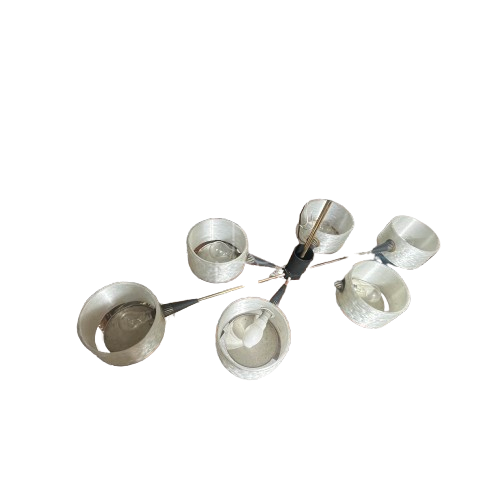
Analysis of a 1950s multi-arm chandelier
The aesthetics of the taut line: a critical-historical and functional analysis of a 1950s multi-arm chandelier
Introduction: lighting in the post-world war II cultural climate
The second post-war period represented a moment of profound refounding for European industrial design. Lighting design of the 1950s definitively detached itself from the geometric monumentality of Art Deco to embrace the tenets of Mid-Century Modernism and organic Rationalism. In this context, the lighting fixture ceased to be a mere apparatus of bourgeois luxury. Instead, it became a plastic-spatial device capable of redefining domestic architectural volumes. The chandelier under analysis faithfully embodies this historical transition. The object fuses structural geometric rigor with the textured transparency and lightweight structure of ambient light diffusion, made possible by a pioneering and pervasive use of polymeric materials.
Morphological analysis and design syntax (120x50 cm)
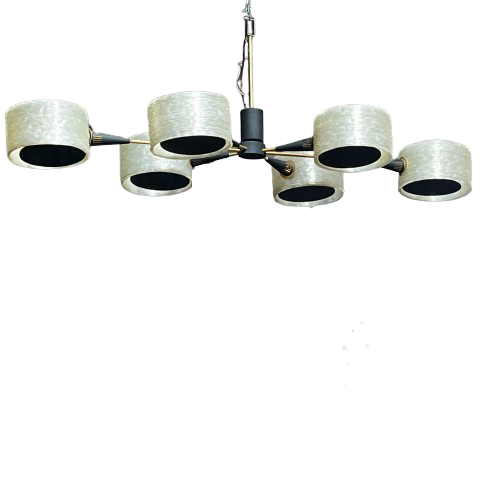
The work develops over a significant planimetric extension, characterized by the dimensions of 120x50 cm. This specific proportion reveals a clear design intent: prioritizing horizontal expansiveness over vertical drop, adapting perfectly to the lower ceilings characteristic of new post-war residential architecture.
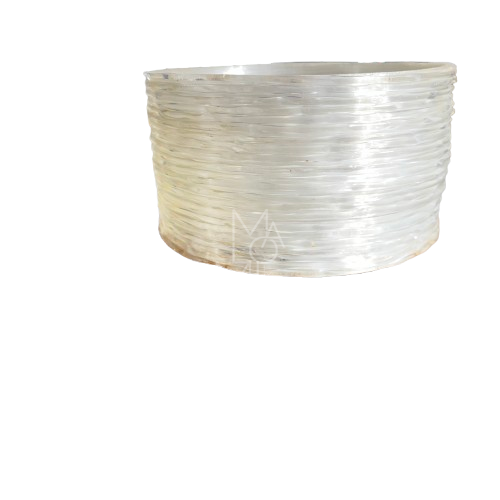
The entire framework articulates from the suspension rod, which engages directly into the generating core, consisting of a baricentric cylinder entirely molded in matte black plastic. From this central pivot, six arms radiate on staggered planes. These arms are not monolithic elements; rather, they alternate polished brass segments with conical joints, also made of black plastic, positioned at the outer extremities just before the diffusers. This specific thermoplastic transition, which governs the entire structural apparatus of the black nodes, functions as a formal juncture and visually lightens the connection. At the end of each arm lies the actual lighting module: a cylindrical drum diffuser that, contrary to the appearance of coeval mineral craftsmanship, is entirely made of thermoformed plastic material. The perimetral arrangement of these cylinders generates a syncopated visual rhythm, elegantly alternating the structural voids of the metallic frame with the volumetric fullness of the polymer bowls, which cleverly imitate the texture of frosted glass or textile coverings.
This compositional layout recalls the coeval formal research of Maison Arlus in France and the early spatial intuitions of Stilnovo or Arredoluce in Italy. In these design workshops, modularity, the integration of new polymers, and the balance of visual weights constituted the core of avant-garde design.
Radial geometry and zenitale configuration: an analysis from above
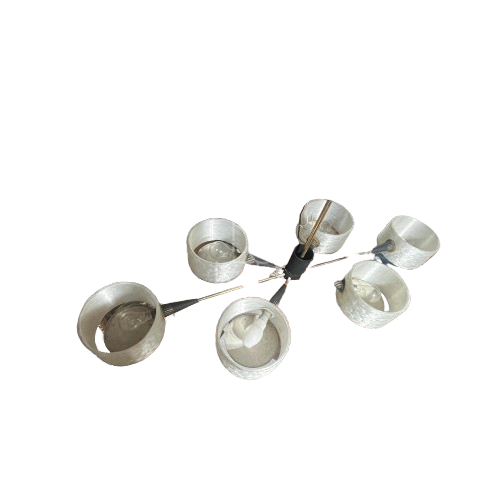
The overhead view uncovers the complex and rigorous geometric architecture of the object, which remains otherwise concealed by a frontal perspective. From this zenithal angle, the chandelier reveals an asymmetric, elongated radial plan, expressly designed to occupy an elliptical or rectangular space coherent with its 120x50 cm dimensions.
The central hub, visible in its entirety as a solid black plastic cylinder, acts as a compression nucleus from which the brass arms radiate, arranged in diverging pairs to maximize the area of illumination. The zenithal observation allows one to appreciate the exact centering of the lamp holders within the large plastic drums. This arrangement is far from accidental: the empty perimetral space between the bare light source and the inner wall of the cylinder guarantees an optimal air chamber for thermal dissipation, simultaneously protecting the surrounding black plastic components and joints from direct heat exposure. Seen from above, the six large synthetic basins behave like open geometric corollas, designed to catch dust and shield the view from below, reflecting a classic 1950s design philosophy where the geometric symmetry of individual components merges with a dynamic, fluid, and distinctly airborne ensemble layout.
Chromatism and material choices: the tripartite contrast and the evolution of polymers
The aesthetic quality of the artifact lies in the calibrated balance of distinct material and chromatic components, each tied to a specific visual function and spatial perception, enriched by the pervasive introduction of synthetic materials typical of the economic boom.
The totality of the visible black elements – both the central hub cylinder and the terminal conical joints – is made of molded plastic material, such as Moplen, high-impact polystyrene, or late-stage bakelite. These components perform a fundamental graphic function: they act as sharp lines of interruption and junction points traced in space, lending rigor and defining the geometric details of the object. The systematic use of plastic for every black node witnesses a precise historical placement in the 1950s, a period when designers enthusiastically experimented with uniting high-craftsmanship materials with serial industrial moldings. This dark rigor is countered by the turned and polished brass of the arms and suspension rod. The golden metal captures room reflections and introduces a bright accent of artisanal preciousness, essential for mitigating the industrial linearity of the synthetic parts. The circle closes with the translucent plastic material of the cylindrical shades, characterized by an enveloping surface finish that allows light to penetrate and refract, ensuring chromatic stability and transforming each cylinder into a highly resilient synthetic light sculpture.
Plastic as a new expressive frontier: molding techniques and the rise of polymers in the 1950s
The second post-war period sanctioned a genuine material revolution in European industrial design, driven by the extraordinary development of the chemical and petrochemical industries. In the 1950s, plastic materials ceased to be viewed as mere cheap substitutes for traditional materials and became absolute protagonists of a new design era. The integration of thermoplastic components into a structured lighting fixture, like the chandelier under examination, demonstrates the speed with which these technologies infiltrated high craftsmanship and furniture manufacturing.
Until the late 1940s, the use of synthetic materials in lighting design was limited primarily to thermosetting resins like bakelite or galalith, employed for their excellent electrical insulation properties. However, these materials presented severe structural and aesthetic limitations: they were rigid, brittle upon impact, and restricted to dark or opaque colorations. Conversely, the decade of the 1950s marked the triumph of thermoplastic polymers, which could be melted and reshaped repeatedly. Among these, polystyrene stood out, widely used for its rigidity and ease of coloring; polyethylene was introduced for its flexibility and chemical resistance; early polyamides were valued for their extremely high mechanical resistance in joints subjected to stress; and isotactic polypropylene, commercially known as Moplen and developed in the mid-1950s thanks to the research of Giulio Natta, revolutionized the production of molded objects with unprecedented lightness and thermal resistance.
The totality of the black joints present on the chandelier – both the central hub cylinder and the terminal cones of the arms – was achieved through injection molding, the iconic technology of the post-war economic boom. The process unfolded in three fundamental phases. First, plasticization, where the polymer, in the form of granules colored with carbon black pigments, was fed into a hopper and pushed inside a heated cylinder until it transformed into a fluid, homogeneous mass. Next came the injection and compression phase, during which the molten mass was injected at very high pressure into a two-part metallic mold, typically made of hardened steel, machined in negative to match the exact conical or cylindrical geometries required. Finally, cooling and ejection took place, where liquid-cooled channels caused the polymer to solidify rapidly, faithfully reproducing the surface details of the mold, including the internal threads or interlocking seats necessary for inserting the brass tubes. Injection molding allowed for millimetric precision and serial repeatability unthinkable with metal turning, drastically reducing the production costs of individual structural nodes.
From a critical-historical perspective, the choice of 1950s designers to leave the black plastic visible, pairing it fearlessly with the body of the diffusers and polished brass, represents an ideological manifesto. Plastic no longer hid behind imitative finishes. In the chandelier studied, the cones and the black cylinder serve a dual role: they provide a visual contrast, interrupting the continuity of the brass to punctuate the rhythm of the horizontal arms, and they guarantee a technical-structural function, electrically insulating the junction points where the conductor wires pass and serving as shock-absorbing clamping bushings between the rigid metal and the cylindrical drums. The systematic adoption of these molded thermoplastic components not only dates the work with absolute scientific precision but also elevates its status as a historical document, making it a perfect example of the transition between workshop metallurgy and the era of mass industrial plastic production.
The manufacturing hypothesis and the origin of the diffusers: the role of Kartell and Italian chemistry
The complete substitution of the glass components in favor of polymeric material raises a fundamental question regarding the manufacturing origin of this chandelier. In the 1950s, integrating large cylindrical plastic drums was not an operation within the reach of just any artisanal workshop, as it required expensive molds and cutting-edge machinery for extrusion and thermoforming. From a critical-historical standpoint, the most plausible hypothesis leads directly to Kartell, founded in 1949 by Giulio Castelli. Castelli, a chemical engineer and student of Nobel laureate Giulio Natta, built the company's mission around the elevation of plastic within the domestic context, collaborating from the outset with top-tier designers like Gino Colombini to create housewares and lighting appliances.
The cylindrical drums of the chandelier exhibit a translucent, slightly opaline or texturized finish, expressly conceived to mimic the visual effect of frosted glass or high-quality perspex. This finish was obtained by mixing polystyrene or acrylic resins (such as polymethyl methacrylate, marketed in Italy as Vilres or Plexiglas) with mineral opacifying agents prior to the extrusion or casting phase. Subsequently, the flat sheet was heated to its softening point and calendered or vacuum-thermoformed to assume its final cylindrical geometry. Kartell, through its lighting division which was taking its first steps during those years before the official launch of the dedicated line in the 1960s, frequently supplied plastic lampshades and diffusers as a subcontractor for historic Milanese firms. It is highly probable that the diffusers of this piece were produced at the Binasco plants, or that the entire chandelier is the result of a collaboration between a Milanese metal workshop and Giulio Castelli's newborn chemical excellence, aimed at demonstrating the aesthetic superiority and impact resistance of polymers compared to fragile, traditional glass.
The dialectic of materials: structural and mechanical integration between thermoplastic components
The close-up and zenithal analysis of the six cylindrical drums captures the core of the 1950s design debate, characterized by the pursuit of total constructive coherence based on the homogeneity of synthetic materials. This union responded to precise structural, lighting, and aesthetic requirements, resolved by period designers through a refined system of mechanical interlocks where the plastic of the joints dialogued perfectly with the plastic of the diffusers.
The cylindrical drums that make up the diffuser apparatus of the chandelier testify to advanced industrial manufacturing. As mentioned, the finish is designed to depolarize the luminous flux of the internal bulb, transforming point-source energy into a soft, warm radiation devoid of harsh shadows on the surrounding walls. The primary technical obstacle in post-war lighting design lay in joining materials with different physical behaviors. However, in this case, the use of plastic for both the conical joints and the large drums eliminates the friction typical of metal-to-glass coupling. Since both components are of a polymeric matrix, they share a similar thermal expansion coefficient and a natural elastic resilience.
The black plastic conical joints step in to guarantee flawless mechanical stability:
- Shock absorption: The plastic of the cones accommodates the rim of the synthetic drum without the risk of generating critical tension points or cracks, allowing for tight fastening of the fixing screws without the need for intermediate rubber gaskets.
- Perfect standardization: The molds for both the plastic cones and the cylindrical drums allowed for error tolerances reduced to a minimum, ensuring a perfect and geometrically repeatable fit across all six arms of the chandelier.
The overhead view highlights an additional geometric arrangement tied to material physics, centered on the exact alignment of the bulb relative to the walls of the drum. In the 1950s, incandescent light sources generated a significant amount of radiant heat. Positioning the plastic joint at the outer end of the arm inevitably exposed it to the thermal flux of the lamp. Designers of the era chose to distance the plastic interface from the focal center of heat by taking advantage of the wide diameter of the glycemic cylinder. The translucent plastic of the drum, formulated to withstand the operating temperatures of domestic light bulbs, served as a protective shield. The hot air generated inside the drum dispersed via convective motion upward, utilizing the open corolla configuration clearly visible from above. This continuous recirculation prevented the temperature near the black plastic joint from exceeding the thermal softening threshold, thereby preserving its structural integrity and deep black color over the decades.
The Italian authorial context: analytical convergences and divergences with Gino Sarfatti and Angelo Lelii
To fully comprehend the critical significance of the chandelier under analysis, it is essential to contextualize its design syntax within the avant-garde landscape of 1950s Italian lighting design, which was dominated by the figures of Gino Sarfatti (founder of Arteluce) and Angelo Lelii (founder of Arredoluce). This comparative evaluation allows one to decode whether the object reflects a logic of pure commercial standardization or if, conversely, it astutely reinterprets the insights of these two Milanese masters.
While Sarfatti grounded his research on extreme formal reduction (as seen in the radial systems of the 2042 and 2068 series), sharing with this specimen a preference for slender brass arms and an expanded plan, he favored lacquered metals or anodized aluminum for structural details and, in most cases, molded glass or paint for diffusers. The piece under analysis takes a different and more radical path: it integrates injection-molded plastic and thermoforming, rendering them explicitly visible in every part, not as a cheap commercial alternative, but as a proud volumetric and insulating manifesto of industrial modernity. Sarfatti himself would only begin experimenting with perspex in specific models, whereas this chandelier applies the polymer to the totality of its plastic elements (nodes and diffusers alike).
In a similar vein, the work engages in a dialogue with Angelo Lelii’s masterpieces for Arredoluce (such as the well-known Triennale series), borrowing the millimetric precision in the static balance of its diverging arms. However, where Lelii relied on sophisticated spherical joints turned by hand from solid brass and bowls made of ultra-precious acid-etched Murano glass, this piece introduces a construction philosophy completely devoted to industrial seriality. The choice of translucent plastic drums that mimic glass directly challenges the mineral classicism of Arredoluce. This chandelier replaces the artisanal nobility of crystal with the democratic nature and lightness of avant-garde plastic, finding an ideal point of convergence between the chemical seriality of the structural bones and the functionality of the diffuser. Consequently, this 120x50 cm fixture acts as an excellent, sophisticated work of transition, capable of ferrying the peaks of Milanese modernism into the definitive era of plastic design.
Lighting engineering and spatial function
From a strictly functional standpoint, the use of plastic in the drums solves one of the crucial challenges of 1950s domestic living: breaking down light to create a diffused, uniform atmosphere completely free from the danger of accidental breakage. The texturized finish of the polymer shields the bulb, eliminating the direct glare phenomena that characterized older fixtures with bare lamps. The luminous flux is thus softened along the lateral walls of the cylinders, while it propagates zenithally to enhance the ceilings and the surfaces below. The intrinsic lightness of the plastic diffusers drastically reduces the overall weight of the chandelier, placing less strain on the suspension rod and ceiling mount. The elongated geometry of 120x50 cm makes this piece ideal for hanging over large rectangular dining tables or for being placed at the center of regularly structured living rooms, acting as the visual anchor of the entire space.
Conclusions and critical placement
The philological analysis, the evidence of the adjusted structural measurements, the total absence of glass components, and the pervasive use of molded and thermoformed plastic across all joints and diffusers allow for the definitive attribution of this work to the context of 1950s lighting design, conclusively ruling out traditional Art Deco influences. The structural combination of brass and polymer details represents the perfect manifesto of a transitional era, in which the Italian chemical industry provided new formal and material solutions to master designers. The state of preservation of the entire plastic apparatus and the extruded drums elevates the documentary and historical value of this suspension lamp, making it a piece of exceptional collector interest, witnessing the dawn of the synthetic materials era in international design.
Appendix: the dawn of the synthetic patent – technological evolution and industrial filings by Kartell in the 1950s
The inclusion of polymeric diffusers and structural components in the chandelier under analysis is not merely a stylistic choice. Rather, it belongs to a precise framework of legal protections and scientific discoveries that, during the 1950s, transformed Italy into the global epicenter of industrial chemistry. Understanding the genesis of these artifacts requires an exploration of the early industrial patents filed by Kartell, alongside the strategic alliance between its founder, Giulio Castelli, and the research laboratories of Montecatini, where Professor Giulio Natta operated.
Giulio Castelli and the scientific approach to furniture patenting
When Giulio Castelli founded Kartell in 1949, the use of plastics in the domestic environment was hindered by a strong cultural prejudice that associated polymers with cheap, perishable substitutes. Thanks to his background as a chemical engineer, Castelli understood that dismantling this perception required reversing the manufacturing paradigm: plastic should not imitate the shapes of glass or wood; instead, it had to generate its own formal syntax based on the chemical specificity of the material.
To achieve this, Kartell became one of the first design firms to establish an internal research and development laboratory dedicated exclusively to experimenting with the physical tolerances of new polymers. Every piece introduced to the market—starting with the first car accessories and housewares designed by Gino Colombini in the very early 1950s—was preceded by the filing of utility and ornamental patents. These legal documents did not merely protect the company from competition; they codified, for the very first time, the technical parameters of flexibility, thickness, and thermal resistance suitable for daily life, laying the groundwork for the future lighting division.
From bakelite to high-impact polystyrene: the protection of translucent finishes
During the early years of the decade, Kartell’s research focused on replacing glass and ceramics through the deployment of modified polystyrene and acrylic resins. The company's first key patents concerned the injection molding of high-thickness objects and the calendering of translucent polymeric sheets. It was during this period that the manufacturer registered innovative solutions to stabilize polymers against the yellowing caused by ultraviolet rays and the radiant heat of incandescent bulbs.
The cylindrical drum diffusers of the chandelier under examination benefit directly from these early patent protections. The chemical formula required to achieve an opaline plastic capable of emulating the refraction of frosted glass—without displaying molding streaks—was the subject of rigorous industrial filings. Kartell patented controlled cooling systems within two-part metallic molds. This technology prevented the structural collapse of the cylinder walls during the ejection phase and guaranteed uniform thickness, which was crucial for preventing localized overheating areas in contact with the lampholder.
The turning point: Giulio Natta and the Moplen patent (1954)
The milestone that revolutionized Kartell's entire output, and consequently Italian lighting engineering, occurred in March 1954. Working in the laboratories of the Politecnico di Milano funded by the chemical giant Montecatini, Giulio Natta successfully isolated isotactic polypropylene. This breakthrough, which earned Natta the Nobel Prize in Chemistry in 1963, culminated in the patenting of Moplen, the commercial furniture rights of which were immediately acquired by Giulio Castelli.
Moplen boasted extraordinary characteristics compared to previous polymers: remarkably high thermal resistance (exceeding 100 °C), formidable chemical inertness, and an elasticity that allowed for the creation of snap-fit joints and couplings without the risk of cracking. The black conical joints and the central hub of this 120x50 cm chandelier represent the direct application of this patented revolution. The intrinsic elasticity of polypropylene enabled the patenting of structural nodes with programmed deformation, capable of receiving the brass arms while ensuring absolute electrical insulation and a flawless mechanical lock. This patent appendix demonstrates that the object of this study is not merely a vintage lamp, but the physical materialization of an era when Italian chemical patents redrew the boundaries of global industrial design.