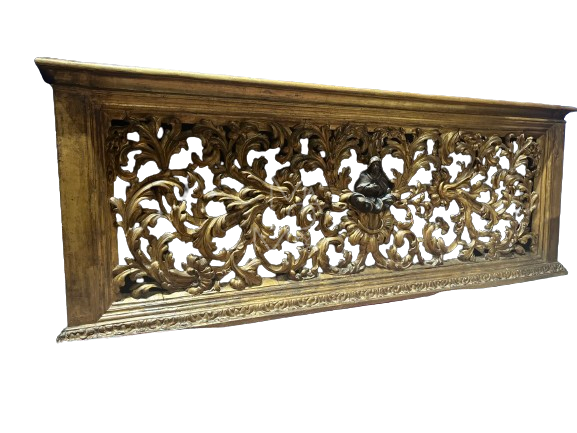
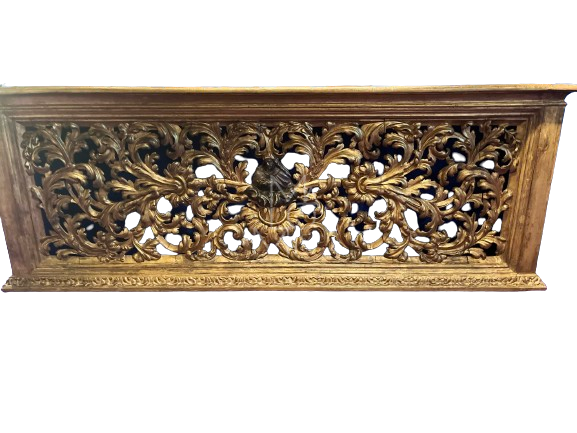
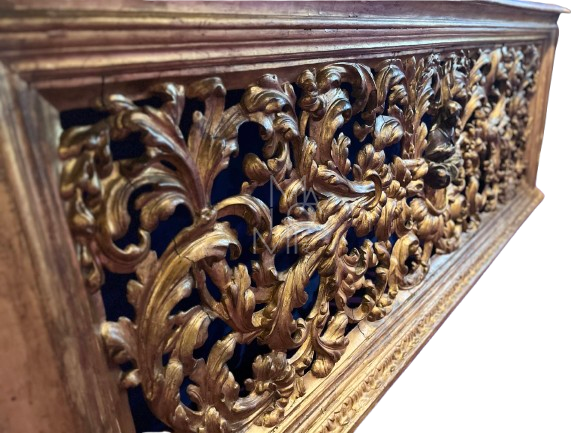
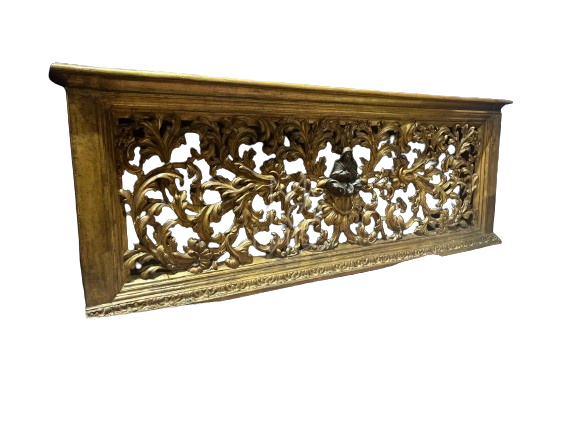
An important late 17th-century lombard baroque carved and gilded wood altar balustrade
- Typology: Altar balustrade / Monumental liturgical furnishing façade
- Period: Late 17th century (Lombard Late Baroque, c. 1690–1700)
- Cultural & Geographic Context: Lombardy, premier manufacture of the Bergamasque school (circle of the Fantoni workshop of Rovetta)
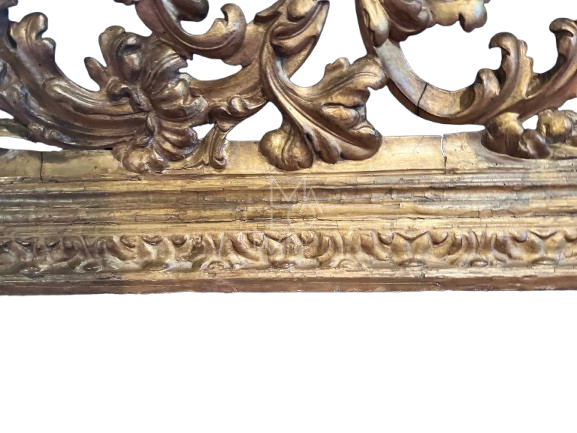
- Materials: Finely carved and pierced wood (openwork), gilded in 24-karat gold leaf using the a guazzo (water gilding) technique over a red bole ground
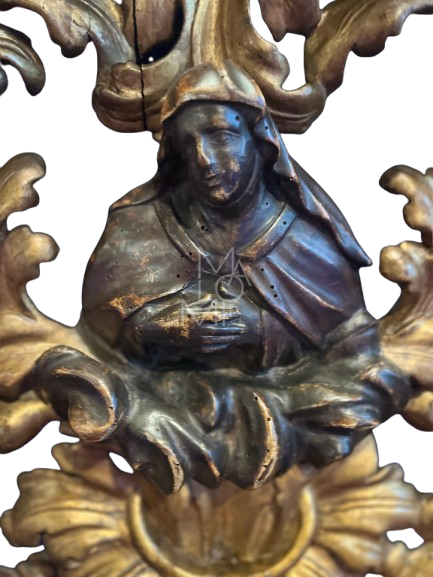
- Figural Elements: Central sculptural bust finished in faux-bronze / ebonized wood patina
- Dimensions: 278 cm (length) x 37 cm (depth) x 100 cm (height)
- State of Conservation: Excellent overall condition; features a rich, original period patina with minor, physiological evidence of historical woodworm activity (xilofago sfarfallamento) and superb structural integrity.
The eloquence of wood and gold: a monumental lombard altar balustrade from the late seventeenth century
Introduction and historical-cultural framework
Within the landscape of Italian Baroque decorative arts and wood sculpture, late seventeenth-century Lombardy occupies a position of singular and fruitful centrality. The artifact under consideration—a monumental altar balustrade in finely carved, openwork (traforato a giorno), and gilded wood, boasting the imposing dimensions of 278 cm in length by 100 cm in height—stands as an extraordinary visual document, reflecting an era poised between scenic opulence and doctrinal rigor.
In this specific chronological crucible, liturgical furnishings ceased to be mere functional objects, evolving instead into rhetorical and theatrical apparatuses. The presbytery, the absolute focal point of the Eucharistic celebration, was isolated and simultaneously glorified by dividing structures that functioned as visual filters. Conceived according to a rigorous specular symmetry, this balustrade was originally destined to dialogue with the surrounding sacred architecture. By capturing the faithful's gaze and projecting it toward the mystery of the altar, the work achieves a flawless synthesis of master cabinetmaking and high visual theology.
The socio-political and religious dontext in Spanish Lombardy
To fully comprehend the genesis and magnificence of such a furnishing, one must ground the work within the dense socio-political fabric of late seventeenth-century Lombardy. At the time, this region was under the dominion of the Spanish Crown, comprising the Duchy of Milan and its neighboring territories, which included the Domini di Terraferma (Mainland Dominions) of the Most Serene Republic of Venice, such as Bergamo and Brescia. This period, often superficially dismissed by past historiography as an era of economic decline, was conversely a season of extraordinary artistic fervor, driven by precise dynamics of power and social self-representation.
On one hand, the landed aristocracy and the affluent merchant bourgeoisie of Lombardy sought political redemption through religious patronage. Unable to vie for the splendors of the court in Madrid, local noblemen and powerful lay confraternities, such as the Scuole del Santissimo Sacramento (Confraternities of the Blessed Sacrament), invested substantial capital in embellishing parochial churches and sanctuaries. Funding a monumental altar or a gilded balustrade like the one examined here was not merely an act of devotion, but a definitive status symbol—a means to permanently intertwine a family’s lineage with the prestige of ecclesiastical institutions.
On the other hand, the Catholic Church, propelled by the spirit of the Counter-Reformation and meticulously guided in Lombard lands by the spiritual and normative legacy of the saintly archbishops Carlo and Federico Borromeo, utilized art as a Biblia pauperum (Bible of the poor) and a tool for mass persuasion. The arts were mandated to move, astound, and instruct. The magnificence of pure gold leaf was not an end in itself; it was designed to evoke divine light and the splendor of the Heavenly Jerusalem, standing in stark visual opposition to the austerities of transalpine Protestantism. Structures like this balustrade were thus born at the intersection of Counter-Reformation propaganda strategies and the prestige-seeking aspirations of local élites, effectively transforming artisan workshops into executive branches of spiritual and temporal authority.
Formal analysis and decorative syntax
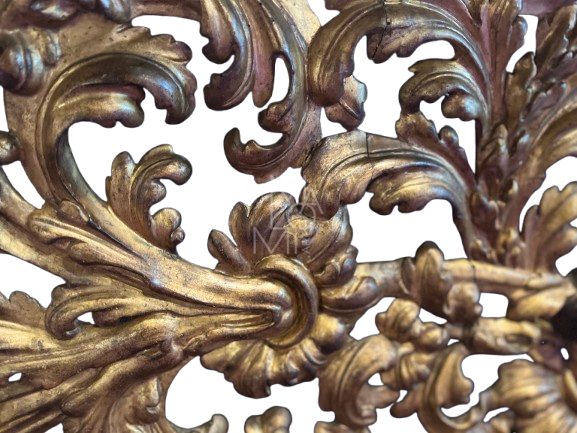
From a formal perspective, the work expresses a mature Baroque style transitioning toward the elegant lightness of the early eighteenth century, while fully retaining its seventeenth-century volumetric and plastic robustness. The central register of the balustrade unfolds through a dense grid of acanthus scrolls, tendrils, and foliate volutes executed entirely in openwork (a giorno). The undercutting of the wood is exceptionally deep, carved in high relief (altorilievo), lending the artifact an almost architectural three-dimensionality. The acanthus leaves are dynamic rather than static, seemingly animated by an internal undulating motion, culminating in characteristic "snail-shell" curls (a chiocciola) that trap shadow in their recesses while projecting light across their outer ridges.
The finish in pure gold leaf, applied via the intricate a guazzo (water gilding) technique over a foundation of red bole, acts as a multiplier of light. Within seventeenth-century naves, illuminated predominantly by the flickering light of candles and votive lamps, the surface—alternating between burnished gold (polished with agate stone) and matte gold—created an effect of constant vibration. This optical quality made the balustrade appear not as a heavy wooden structure, but as an ethereal embroidery of precious metal suspended in space.
The iconographic core: the central faux-bronze bust
The geometric, conceptual, and theological focal point of the entire composition is the sculptural bust nestled within the central cartouche of the carving. Characterized by solemn and understated features, the figure depicts the Virgin of Sorrows (Mater Dolorosa) or the Virgin Annunciate in a contemplative posture, her head covered by a heavy veil (maphorion) and her hands piously clasped to her chest in a gesture of absolute submission to the divine will.
The executive execution of the bust is the element that, above all others, reveals the intellectual sophistication of the piece: the sculpture is finished in a dark patina that masterfully imitates faux-bronze or ebonized wood. This stark chromatic divergence from the overflowing gilding around it answers precise demands of devotional legibility. Isolated from the golden reflections, the sacred effigy emerges with dramatic force, commanding the viewer's attention as the vanishing point of the entire composition and inviting silent meditation.
The manufacturing excellence of the bergamasque school
A close analysis of the foliate morphology, the nervous tension in the drapery folds, and the pathetic emotional intensity of the Virgin's countenance firmly directs the critical attribution to the premier master workshops of the Bergamasque school, with a direct reference to the celebrated Fantoni workshop of Rovetta. This dynasty of carvers, led during this period by the genius of Andrea Fantoni (1659–1734), was renowned throughout Lombardy for its unique capability to fuse the monumentality of grand sculpture with the millimetric precision of sacred cabinetmaking.
The Fantoni family, much like their contemporaries the Caniana family, structured their workshop as a true artistic enterprise, capable of collaborating directly with architects and theologians. The balustrade under examination displays all the stylistic hallmarks of Fantonian production from the turn of the eighteenth century: the robust, rounded central ribbing of the plant stems, the deployment of polymaterial textural contrasts (such as faux-bronze juxtaposed with gold), and that signature pathetic gravity of the human figures, imbued with an intimate, profound devotional sentiment quite distinct from the purely decorative exuberance of Roman or Venetian Baroque models.
Bibliographical references and critical sources
- BORROMEO, C. (San), Instructionum Fabricae et Supellectilis Ecclesiasticae Libri Duo (1577), edited by S. Benedetti, Milan, Diocesi di Milano, fac-simile reprint 1990.
(A foundational text for understanding the liturgical-architectural dictates of the Counter-Reformation applied to the sacred barriers of the presbytery). - DELLA PERUTA, F., Società e istituzioni nella Lombardia spagnola del tardo Seicento, Milan, FrancoAngeli, 1988.
(An essential historical study on the economy of the Duchy, the commissions of the Confraternities of the Blessed Sacrament, and the furnishing patronage of the élites). - CASCIARO, R., La scultura lignea lombarda del Rinascimento e del Barocco, Milan, Skira, 2005.
(A seminal manual traceing the evolution of openwork carving, water gilding techniques, and textural contrasts in Lombard cabinetmaking). - ALFIERI, L., & SPINELLI, L. (Eds.), I Fantoni: Quattro secoli di scultura in legno e marmo, Bergamo, Bolis Editore, 1978.
(A monumental reference work for the stylistic mapping of acanthus leaves, ribbing, and raceme morphology unique to the Val Seriana school). - SPINELLI, L., Andrea Fantoni (1659-1734), Milan, Edizioni di Comunità, 1982.
(A scientific monograph on the master; indispensable for the stylistic comparison of faux-bronze busts and the analysis of pathetic pathos in Marian countenances). - BOSSAGLIA, R. (Ed.), I Caniana: Una dinastia di architetti e intagliatori, Bergamo, Monumenta Bergomensia, 1981.
(A key text to isolate the graphic models and structural designs that linked the major Bergamasque workshops to architectural frameworks).
Conclusion
In conclusion, this monumental altar balustrade stands as a masterpiece of supreme artistic craftsmanship, capable of encapsulating the aesthetic, spiritual, and political tensions of late seventeenth-century Lombardy. The perfect harmony between the solid, external architectural cage, the exuberance of the foliate openwork, and the dramatic focal point of the central sculpture elevates this work to a museum-grade specimen—an exceptional witness to a golden age when wood carving proved itself a masterful interpreter of the sacred.