An eighteenth-century Genoese barocchetto holy water font in statuary marble and Polcevera green
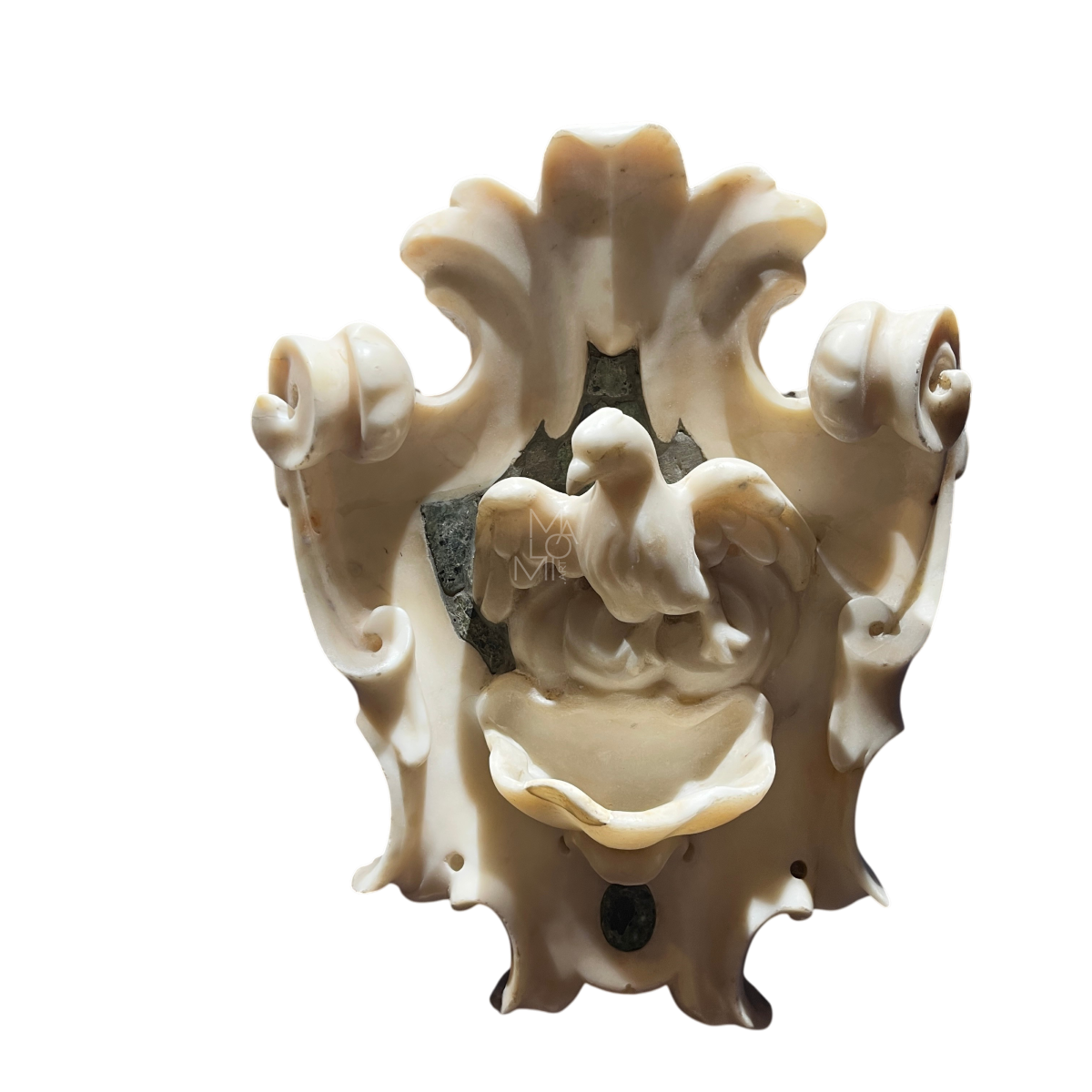
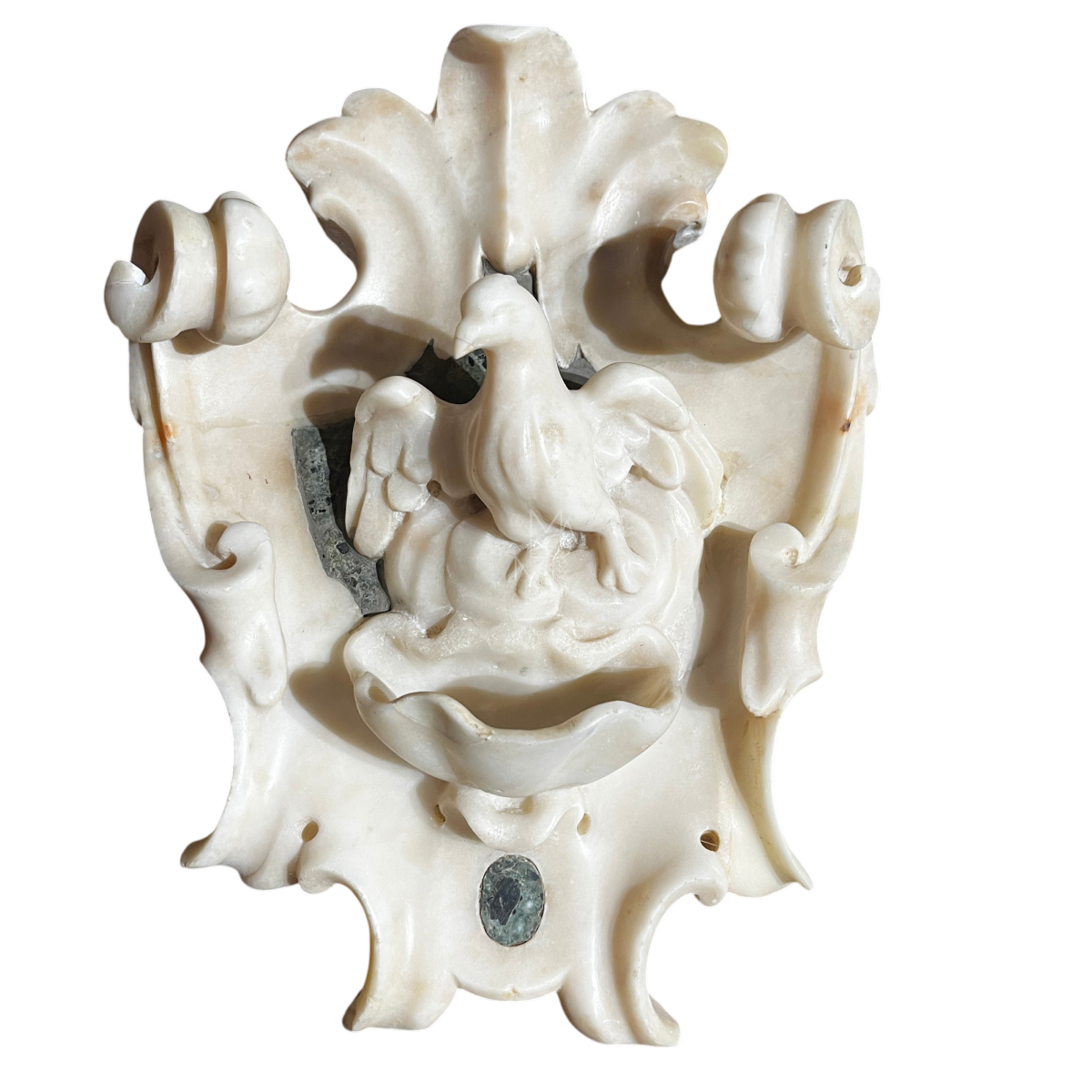
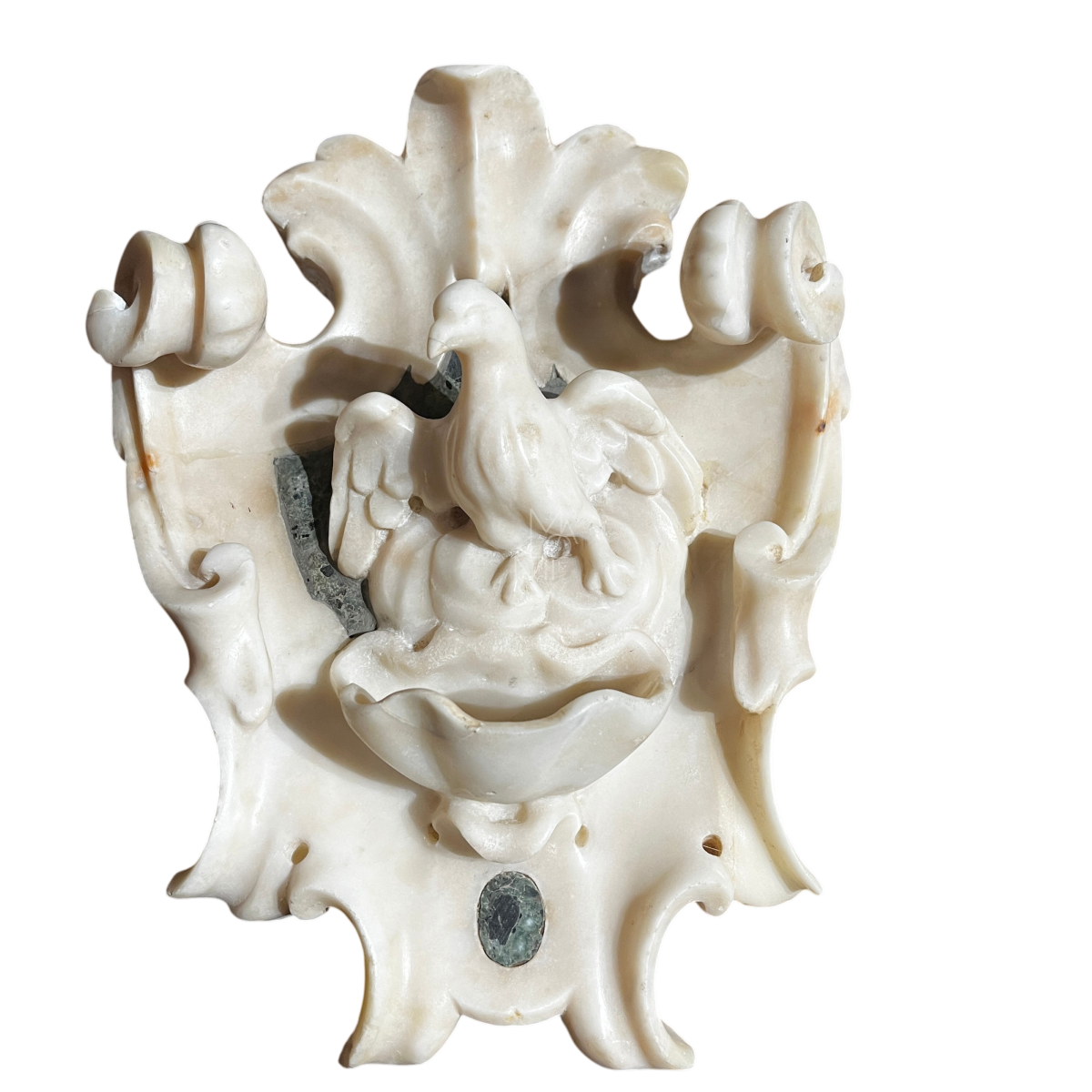
An eighteenth-century Genoese bedroom holy water font carved from a single block of Carrara statuary marble with Polcevera green marble inserts, featuring a high-relief Holy Spirit dove.
- Object: bedroom holy water font (bedside font)
- Date: 18th century (circa 1740-1760)
- Cultural sphere: Ligurian barocchetto (Genoese school)
- Material and technique: monobloc Apuane statuary marble, hand-carved; Polcevera green marble inserts embedded within blind cavities on the frontal surface
- Dimensions: height 30 cm; width 22 cm
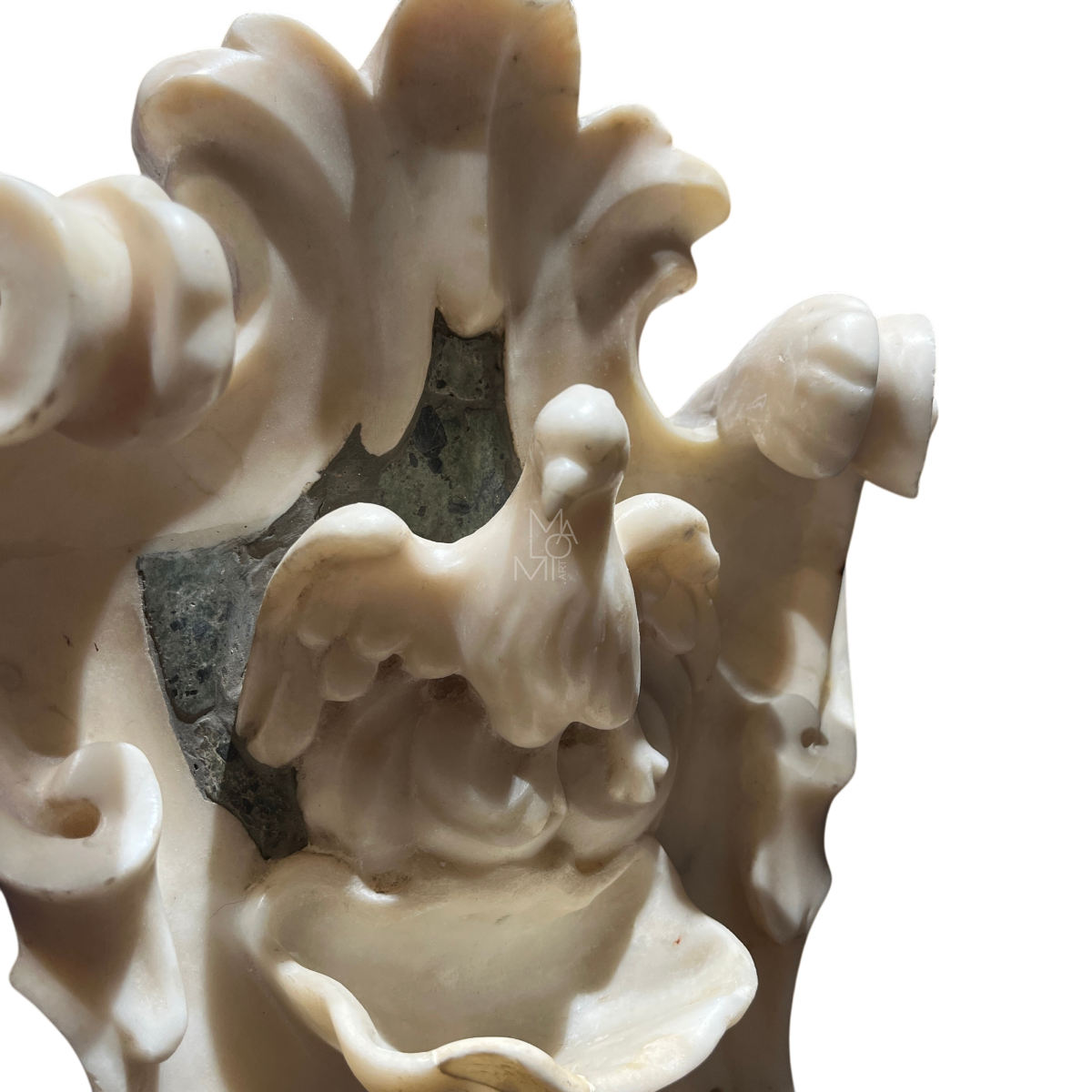
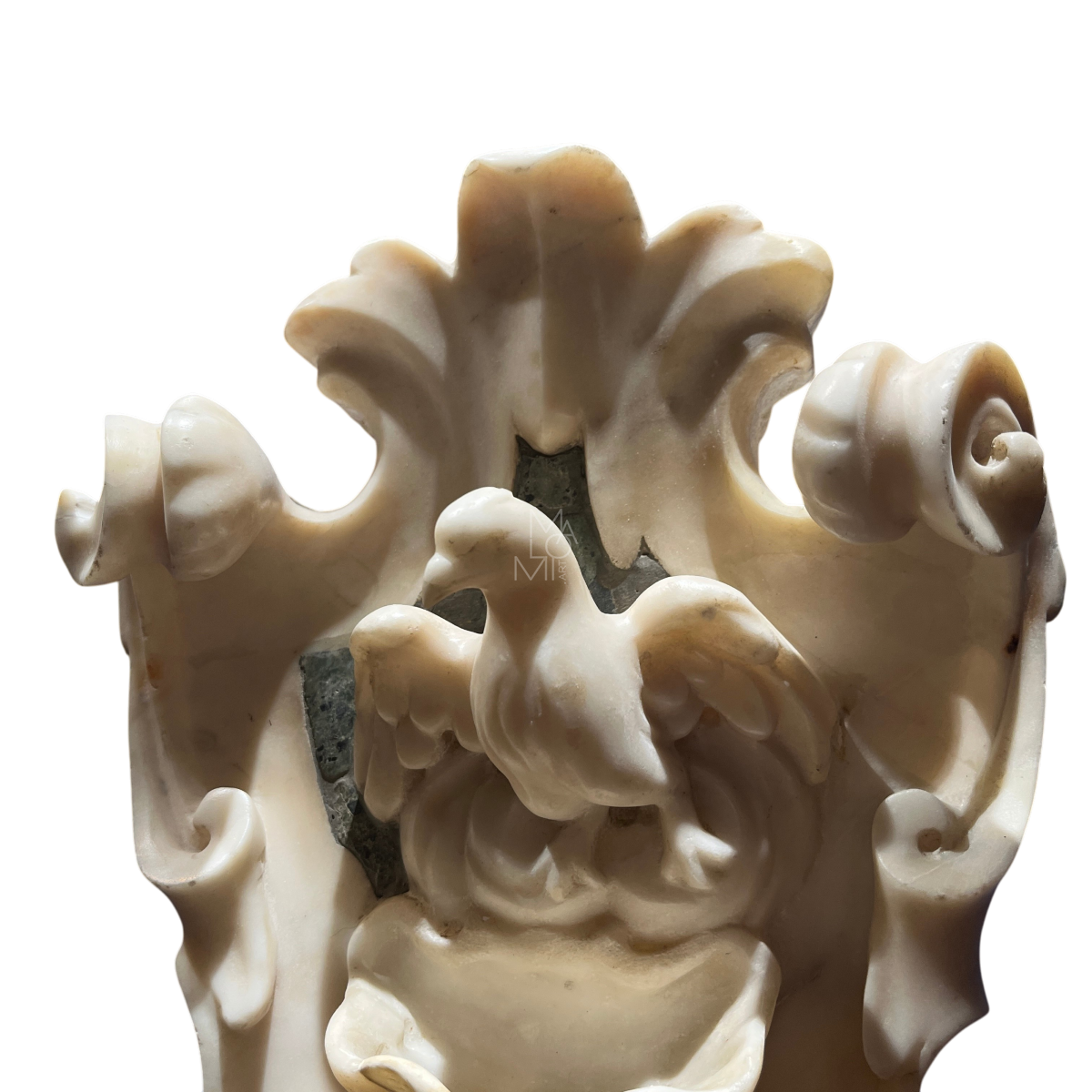
- Iconography: the dove of the Holy Spirit sculpted in high relief hovering above stylized clouds, placed over an asymmetric, fluted shell-shaped basin
- Stylistic analysis: scroll-shaped perimeter frame embellished with rocaille volutes and an overturned acanthus leaf crest; pronounced plastic dynamism and sharp chiaroscuro contrast influenced by the models of Filippo Parodi and Francesco Maria Schiaffino
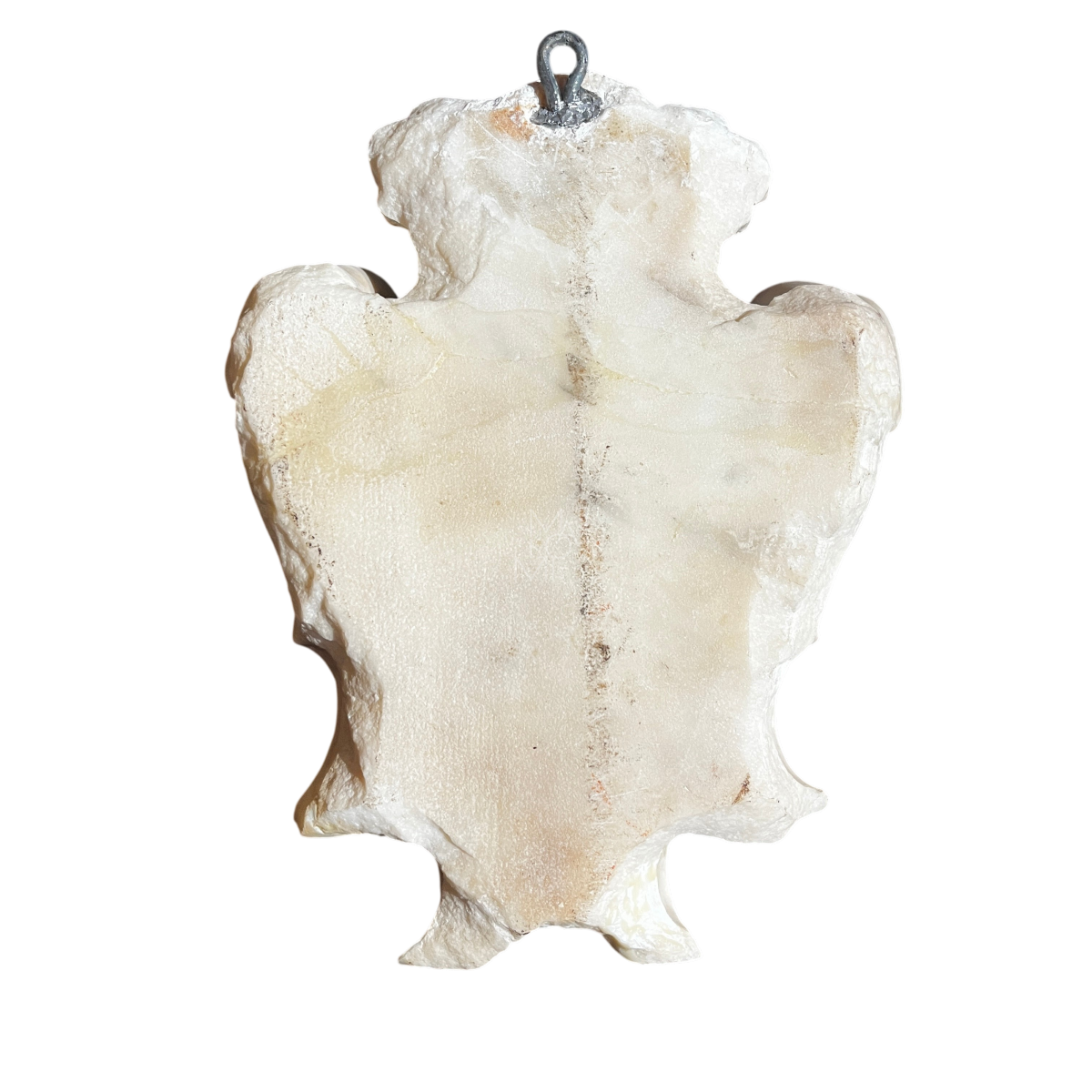
- Condition report: the front surface has undergone a recent protective polishing that accentuates the mirror-like finish of the statuary marble; the reverse remains in its raw, uncleaned archaeological state, preserving the original wrought-iron hanging loop sealed with molten lead.
The statuary marble and green marble in domestic sacred lithic sculpture: a historical-artistic, technical, and iconographic analysis of a Genoese bedroom holy water font
Introduction and typological framework
Within the vast and varied landscape of devotional plastic production in the modern era, the bedroom holy water font occupies a singularly prominent position, standing at the ideal intersection between the solemnity of grand public liturgical structures and the deeply intimate dimension of domestic prayer. The specimen under examination, characterized by harmonious and compact dimensions measuring thirty centimeters in height by twenty-two centimeters in width, belongs precisely to this successful tradition of micro-sculptural furnishings. Objects of this quality and refinement were not intended for the grand naves of parish churches, but rather found their perfect placement on the walls of aristocratic bedrooms, often right at the bedside, or within the private oratories of patrician palaces and the cells of high prelates and abbesses. The choice to combine the immaculate whiteness of Apuane statuary marble with the deep, dark hue of green marble fulfills precise aesthetic and semantic requirements, aimed at exalting the sacredness of the holy water through material luxury and a skillful use of chromatic contrast. A curious anecdote related to this type of furnishing concerns the archival inventories of great Genoese families, where these holy water fonts were often described not merely as objects of devotion, but as genuine wall jewels, explicitly included in wills to be passed down through generations among the most precious assets of the dowry succession line.
Rococo morphology and the syntax of sinuous lines
A frontal examination of the artifact allows it to be assigned with certainty to the most mature phase of the Genoese barocchetto, which flourished during the height of the eighteenth century. This was an era in which Ligurian sculpture definitively broke free from the strict geometric constraints and rigid symmetries of the Tuscan-Roman tradition to embrace a formal fluidity of extraordinary lightness and dynamic asymmetry. The perimeter structure of the work abandons every straight line to transform into a plastic organism that appears to move along the wall. The outer profiles are entirely dominated by wide, scrolled volutes and large, richly ribbed acanthus leaves that develop with a three-dimensional rhythm, imitating the celebrated decorative motifs of the French-Genoese rocaille. At the bottom, the basin intended to collect the holy water is integrated seamlessly into the main block and takes the naturalistic shape of an asymmetric, fluted shell. The lip of the basin juts forward sinuously, almost physically offering itself to the touch of the believer's fingers upon waking or before nightly rest, while the terminal part of the foot closes with a stone droplet of exquisite elegance.
Executive technique and the blind cavity of the monobloc
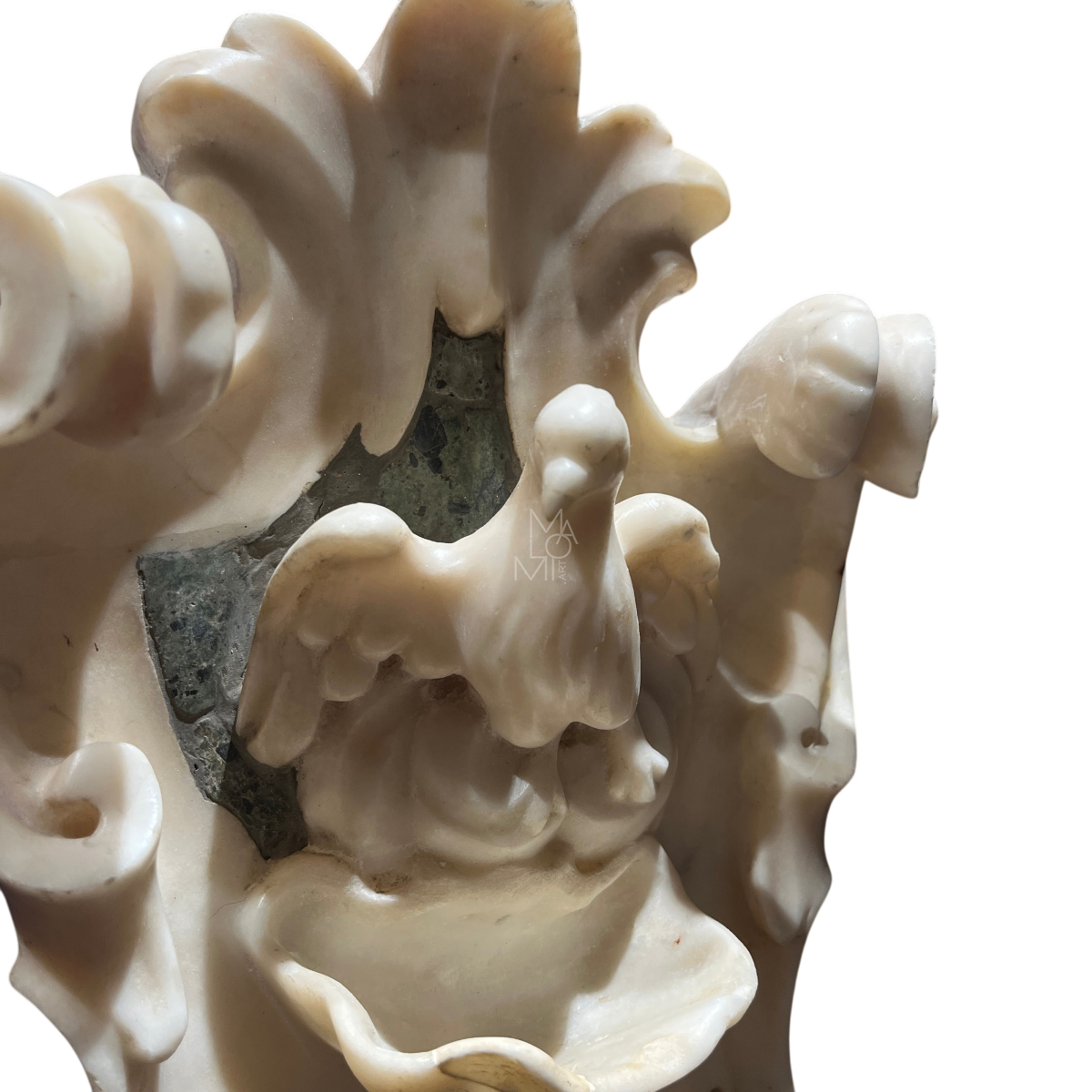
Contrary to what one might hypothesize at a careless first glance, and contrary to the common practice of assembling furnishings in overlapping layers or upon a flat backing plate, this holy water font was entirely carved from a single, massive monobloc of statuary Carrara marble. The sculptor worked by carving away material on the front, patiently hollowing out blind cavities, resembling small protected alveoli, directly into the heart of the white stone. Within these hollows carved on the front side, two shaped sections of green marble, identifiable with the local variety of Verde Polcevera or Verde d'Alpi, were inserted and glued with millimetric precision. A larger section was placed to serve as a theatrical backdrop for the central figure, while a second, smaller oval section was embedded like a gemstone into the foot of the frame. This highly laborious technique allowed the structural core of the white marble to remain intact. Indeed, the back of the artifact presents a continuous, rough surface left raw from chisel blows, revealing the raw substance of the original Apuane stone and bearing still intact at its uppermost part the original wrought-iron ring hook, securely welded into a blind hole through a pouring of molten lead.
Pneumatic iconography and the dove in high relief
At the center of the composition stands the figure of the dove, the universal iconographic representation of the Holy Spirit and the third person of the Trinity, which emerges from the dark green marble background with extraordinary plastic strength. Sculpted in a pronounced high relief that challenges the boundaries of the round, the animal is caught in the dynamic moment of landing or hovering above a cluster of soft, stylized clouds. The wings, spread wide and rich with feathered details, were finished by exploiting deep undercuts that visually detach them from the green background, amplifying the optical illusion of an aerial floating in mid-air. Under a strictly theological and liturgical profile, the dove creates a direct link to the sacrament of baptism and the evangelical episode of the baptism of Christ in the waters of the Jordan. A curiosity related to the daily use of these works lies in the fact that the holy water, collected within the purity of the white basin, was ideally consecrated by the perpetual presence of the Holy Spirit floating upon the wall, turning the holy water font into a genuine machine of spiritual protection against nightly perils, according to Counter-Reformation doctrines that remained deeply alive during the eighteenth century.
Comparative analysis and the role of Verde Polcevera in Genoese architecture
To fully grasp the chromatic selection of this artifact, it is necessary to undertake a targeted analysis of the cultural and identity-defining role of Verde Polcevera, a stone that has defined the visual horizon of the Republic of Genoa since the Middle Ages. Historically known as Pietralavezzara marble, named after the primary quarrying village situated in the upper Polcevera valley, this material is not a marble in the strict geological sense, but rather a serpentinitic rock characterized by an intense, dark green background network intersected by white calcite veins and occasional blackish gradations. While its use during the medieval and Renaissance periods was predominantly confined to the execution of imposing patrician portals or alternating bicrome architectural bands alongside white Carrara marble, the advent of the Baroque transformed Verde Polcevera into the absolute protagonist of a precise strategy involving spatial illusion and dynastic magnificence.
The palaces of the Superba and its Baroque churches evolved into active laboratories for experimentation with polychrome stones. Driven by a desire to emulate the splendor of papal Rome without renouncing local natural resources, the Genoese nobility elevated Verde Polcevera to a position of distinction within grand liturgical decoration commissions. The distinctive value of this stone resides in its extraordinary capacity to accept a mirror-like, almost vitreous polish that accentuates its deep, shimmering quality. When juxtaposed with white Apuane statuary marble, Verde Polcevera ceases to operate as a mere structural component and transforms into a painterly device, functioning as an artificial darkness from which the sculpted figure emerges by way of a luminous epiphany. This combination became an authentic hallmark of the local artistic culture, so much so that it was exported by Ligurian workshops across Europe as a synonym for Genoese luxury. Within the miniaturized scale of the bedroom holy water font, the sculptor successfully condenses this complex urban architectural dialectic. The integration of Verde Polcevera into the blind cavity of the statuary marble is not a simple decorative whim; rather, it encapsulates and evokes, within the restricted space of the domestic wall, the identical monumental ostentation and symbolic density that worshippers admired in the city's most magnificent patrician chapels.
Comparative analysis and refined models in eighteenth-century Genoa
The expressive language of this micro-sculpture does not arise in a cultural vacuum, but rather reflects and condenses the major stylistic innovations brought to monumental Genoese construction sites by masters of the caliber of Filippo Parodi and Francesco Maria Schiaffino. From the former, the celebrated Roman pupil of Gian Lorenzo Bernini, the workshop that executed this font inherited a sensitivity for violent chromatic contrasts and the theatrical use of colored marbles. Parodi was accustomed to using dark backdrops to bring out the blinding whiteness of his immaculate figures, a solution visible, for instance, in the famous statue of the Immacolata in the church of San Luca in Genoa or in the altar of the Pietà in the basilica of Santa Maria di Carignano. This holy water font reduces that magniloquence to a domestic scale, exploiting the small window in Verde Polcevera as a miniature shadow theater. The fluidity of the scrolled frames and the naturalistic grace of the dove belong instead entirely to the influence of Francesco Maria Schiaffino, who introduced the softness of the rococo into Liguria. The supple volutes that seem to bend almost like wax closely recall the decorative details of the chapel of Nostra Signora del Carmine in the church of the Carmine in Genoa and the asymmetric motifs of the celebrated fountain with shell and dolphin in the palazzo Centurione Cambiaso. The work thus configures itself as the product of a highly specialized workshop of Genoese marmorari from the mid-eighteenth century, capable of translating the splendor of the Palazzi dei Rolli into a private devotional jewel.
Conservation diagnostics and considerations on the surface
Finally, a close visual analysis allows for the highlighting of two completely antithetical conservation states between the front and the back of the artifact. The frontal surface of the statuary marble was affected by a polishing intervention carried out in recent times, an operation that while having partially removed the original protective beeswax finish applied in the eighteenth century to soften the shadow transitions of the flesh tones, has nonetheless restored to the stone its original vitreous and porcelain-like brilliance. This modern treatment causes the projecting white surfaces to reflect light sharply, exalting the graphic contrast with the deep green marble. Fortunately, within the narrowest and most protected recesses of the feathers and acanthus leaves, modern tools did not penetrate, thereby preserving microscopic traces of the period patina and historical sediments caused by candle smoke. The back of the holy water font, by contrast, was appropriately spared from any kind of invasive conservation cleaning. It preserves intact its ancient limestone crust, the natural gray veins of the stone, and the excavation irregularities that testify to the archaeological authenticity of the object, offering modern art historians a precious palimpsest for deciphering ancient quarrying and workshop techniques.
Bibliografia / Bibliography
- Gavazza, E., Magnani, L., Pittura e scultura a Genova nel Seicento e nel Settecento, Fondazione Cassa di Risparmio di Genova e Imperia, Genova, 1998.
- Franchini Guelfi, F., Il Settecento a Genova. Spettacolo e cultura nelle arti decorative, Genova, 1982.
- Manzitti, C., Filippo Parodi, Umberto Allemandi, Torino, 2001.
- AA.VV., Francesco Maria Schiaffino (1689-1765) e la scultura tardobarocca a Genova, catalogo della mostra, Genova, 1995.