A Pair of Polychrome and Gilded Wooden Angel Torchbearers in Late Sixteenth-Century Sienese Sculpture
THE LIGHT AND THE CARVING
A Pair of Polychrome and Gilded Wooden Angel Torchbearers in Late Sixteenth-Century Sienese Sculpture
1. Historical and Artistic Contextualization: Counter-Reformation Liturgical Demands
Within the artistic landscape of late sixteenth-century Tuscan sculpture, Siena occupied a culturally complex position. Following the dramatic fall of the Republic in 1555 and its definitive absorption into the Medici Grand Duchy, the city did not abdicate its centuries-old visual identity; rather, it reconfigured it through the rigorous, theatrical tenets of the Counter-Reformation. The Council of Trent (1545–1563) mandated a profound restructuring of liturgical spaces, placing unprecedented emphasis on the Eucharistic cult and the centrality of the tabernacle.
It is precisely within this historical framework that the monumental production of sacred furnishings in carved, polychrome, and gilded wood must be understood. The demand by confraternities, religious orders, and parishes for pairs of angel torchbearers (angeli cerofori) measuring approximately 120 centimeters in height—the ideal scale for placement on altar steps or flanking monumental ciboria—experienced an exceptional surge. These figures transcended mere ornamentation: they functioned as scenographic agents designed to reflect the flickering light of liturgical candles off their water-gilded vestments, translating the theological concept of Lux Divina (Divine Light) into tangible, plastic terms.
2. Iconographic Analysis and the Logic of Specular Composition
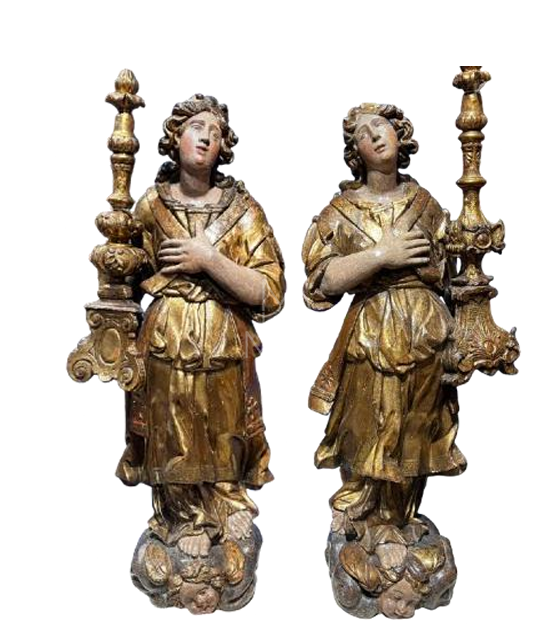
The two angel torchbearers under examination constitute an exemplary manifestation of Counter-Reformation liturgical symmetry. Prodesigned to visually frame the altarpiece or tabernacle, the figures are conceived according to a strict principle of chiasmic specularity.
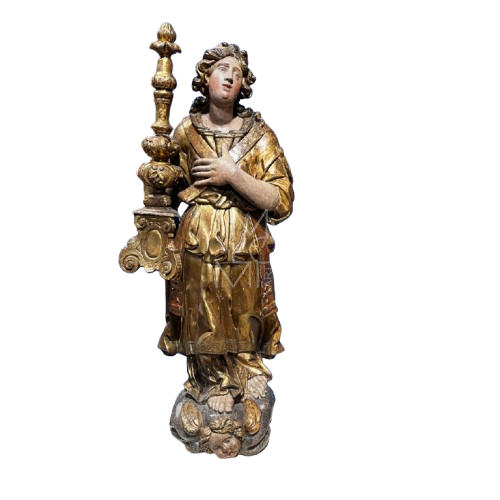
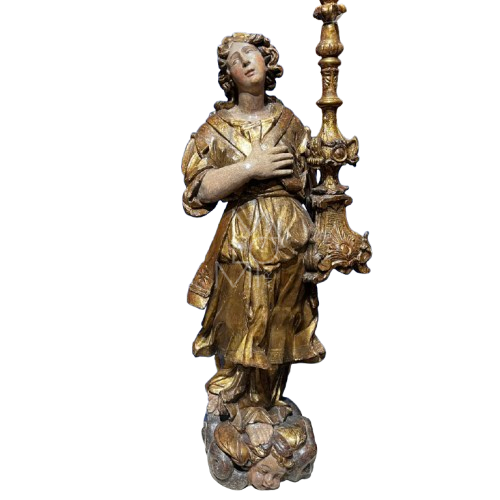
The First Angel: Exhibits a pronounced torsion of the torso, with the left arm flexed and the hand resting softly against the chest in a gesture of profound humility and devotional submission. With the right hand, it clasps the shaft of a monumental pricket candlestick. The Second Angel: Standing in mirror opposition, it inverts the distribution of weights and motor functions. It is the right arm that is brought to the heart, while the left supports the identical twin of the monumental candlestick.The candlesticks themselves warrant specialized analytical attention: the carving deploys a late-Renaissance repertoire of high cabinetmaking, structured through the vertical superposition of baluster nodes, gadrooning, classical moldings, and elegant acanthus leaves wrapping around the base. The millimeter precision and correspondence of the ornamental motifs and dimensions confirm the execution from a single preparatory workshop drawing (disegno d'ateliers).
3. Stylistic Focus: Physionomy and Ecstatic Pathos
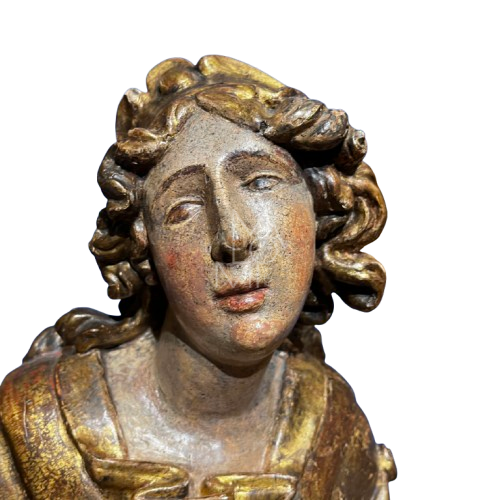
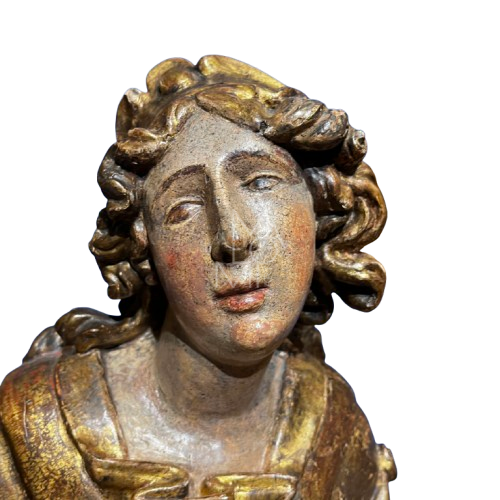
A close-up examination of the angel’s countenance reveals the extraordinary expressive mastery of the master carver. The neck undergoes a pronounced lateral torsion that connects seamlessly with the pathetic inclination of the head. The physiognomic features are sharp and elongated: the nose is straight and slender, the mouth is small with the lips imperceptibly parted to capture a moment of mystical sighing, and the rounded chin juts forward prominently.
The eyes, framed by heavy eyelids, are directed obliquely upward. This rapt, ecstatic gaze constitutes a deliberate formal choice aimed at striking the emotional chords of the worshipper, guiding them toward the contemplation of the invisible. From a purely stylistic perspective, this psychological rendering heavily reflects contemporary late-Cinquecento Sienese painting, which was dominated by the sinuous, spiritualized figures of Francesco Vanni and Alessandro Casolani.
The treatment of the hair is resolved with an almost Baroque plastic vigor: the gouge deepens into the wood to create large, volumetric curls that lift away from the nape of the neck. This device breaks the static rigidity of the figure, generating a powerful chiaroscuro dynamism where the gilded surfaces catch the ambient light while the deep recesses of the carving plunge into shadow.
4. The Cloud Base: Iconography and Structural Integration of the Cherub
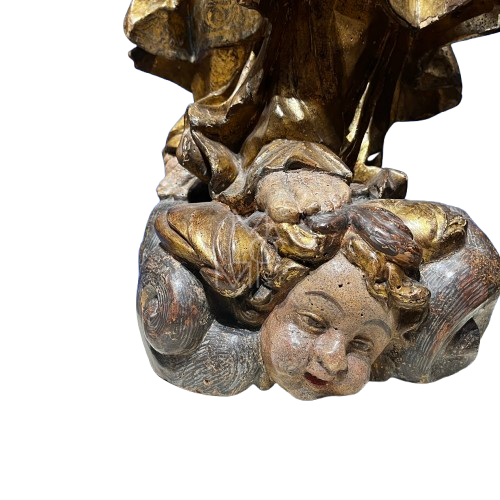
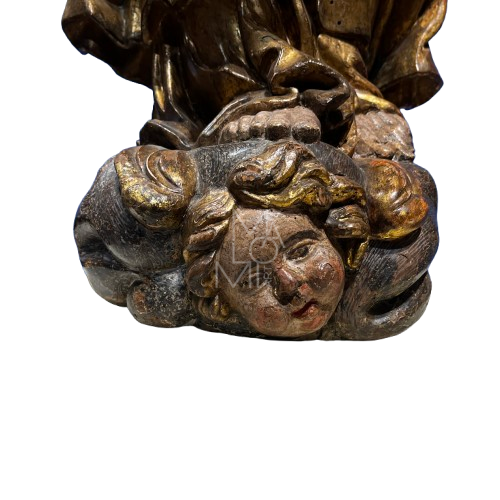
Another passage of supreme artistic quality is found in the lower register of the sculptures, where the bare feet of the angels rest upon a mixtilinear plinth. Here, the carver has materialized a portion of the heavens, sculpting a cumuliform mass simulating a cloud. Emerging frontally from the coils of this cloud is the winged head of a cherub.
The insertion of this winged putto satisfies two distinct programmatic needs:
Theological: It establishes the celestial status of the primary figure, detaching it from the earthly realm and locating it within a paradisiacal atmosphere. Architectonic-Structural: The face of the cherub—characterized by full cheeks, fleshy lips, and short gilded curls—functions as a plastic buttress. It physically supports the weight of the angel's foot and transfers the volumes down toward the supporting base, ensuring the static stability of the entire 120-cm sculpture.Subtle variations in execution are detectable between the two cherubim of the pair: in one specimen, the putto's head is slightly more inclined; in the other, it is more frontal. This controlled asymmetry demonstrates the entirely manual execution of the work and rules out the use of mechanically replicated molds.
5. Construction Technique, Polychromy, and Estofado
The two sculptures are the result of a highly sophisticated, sequential workflow that required close collaboration between the sculptor (carver) and the painter-gilder (gilder).
Joinery and Carving: The main torso, head, and base were generally carved from a single, large log of soft, homogeneous wood (typically linden or poplar). The protruding arms and the candlesticks were carved separately to follow the natural grain of the wood and prevent structural splitting, then joined to the central core using wooden dowels and hot animal hide glue. The Ground and Bole: Over the finished carving, multiple layers of coarse chalk and fine chalk mixed with animal glue (tailoring) were applied and meticulously smoothed. In areas destined for garments and hair, a layer of Armenian bole—a fluid, reddish-brown clay typical of the Tuscan tradition—was applied to act as a cushioning bed for the gold. Gilding and Flesh Tones: Pure gold leaf was applied a gouache (water-gilding) and subsequently burnished with an agate stone to achieve a mirror-like metallic luster. For the fabrics of the tunics, the use of the estofado technique is highly probable: the gold was entirely covered with paint and then sgraffitoed with a stylus to reveal the underlying metal in the form of damask-like patterns. Conversely, the flesh tones (skin tone) of the face, hands, and feet received a matte or satin oil finish, applied in thin glazes to simulate the translucency of human skin.6. Conservation Status and Diagnostic Protocol
Both angels exhibit the compelling marks of a long material history within sacred spaces, fortunately remaining free from aggressive modern restorations. The surface is protected by a valuable historical patina. Within the deep recesses of the carving—particularly around the orbital cavities of the angel and the cherub, and between the curls of the hair—one finds cohesive deposits of historicized dust and bituminous residues linked to centuries of burning wax and incense.
The polychrome surface of the flesh tones displays a dense, widespread network of age-related cracking (craquelure), caused by the natural hygroscopic movement of the underlying wooden support over the centuries. At the points of highest relief (the angel's nose, the cheeks of the putto, the edges of the drapery), the gilding is partially abraded due to anthropogenic contact during periodic liturgical cleaning, revealing the warm hue of the underlying red bole.
CONCLUSIONS
The pair of Sienese angel candle bearers analyzed in this study represents an exceptional combination of post-Tridentine liturgical functionality and late-Mannerist artistic skill. Using a precise measurement standard of 105x45 cm, the workshop created a composition that is both highly stable and vertically dynamic, perfectly suited to the spatial realities of late 16th-century altar architecture. By understanding their material nature — from the internal carpentry of the linden trunks to the complex layering of the estofado decoration — we gain a valuable insight into a workshop culture dedicated to transforming light and wood into a physical manifestation of sacred theater.
A correct future conservation intervention must limit itself to the consolidation of lifting paint flakes, a selective cleaning of incoherent surface deposits, and a strictly minimalist, in-paint or Subdued reintegration of small gesso losses, thereby preserving intact the extraordinary and austere spirituality impressed upon the wood by the ancient Sienese master.