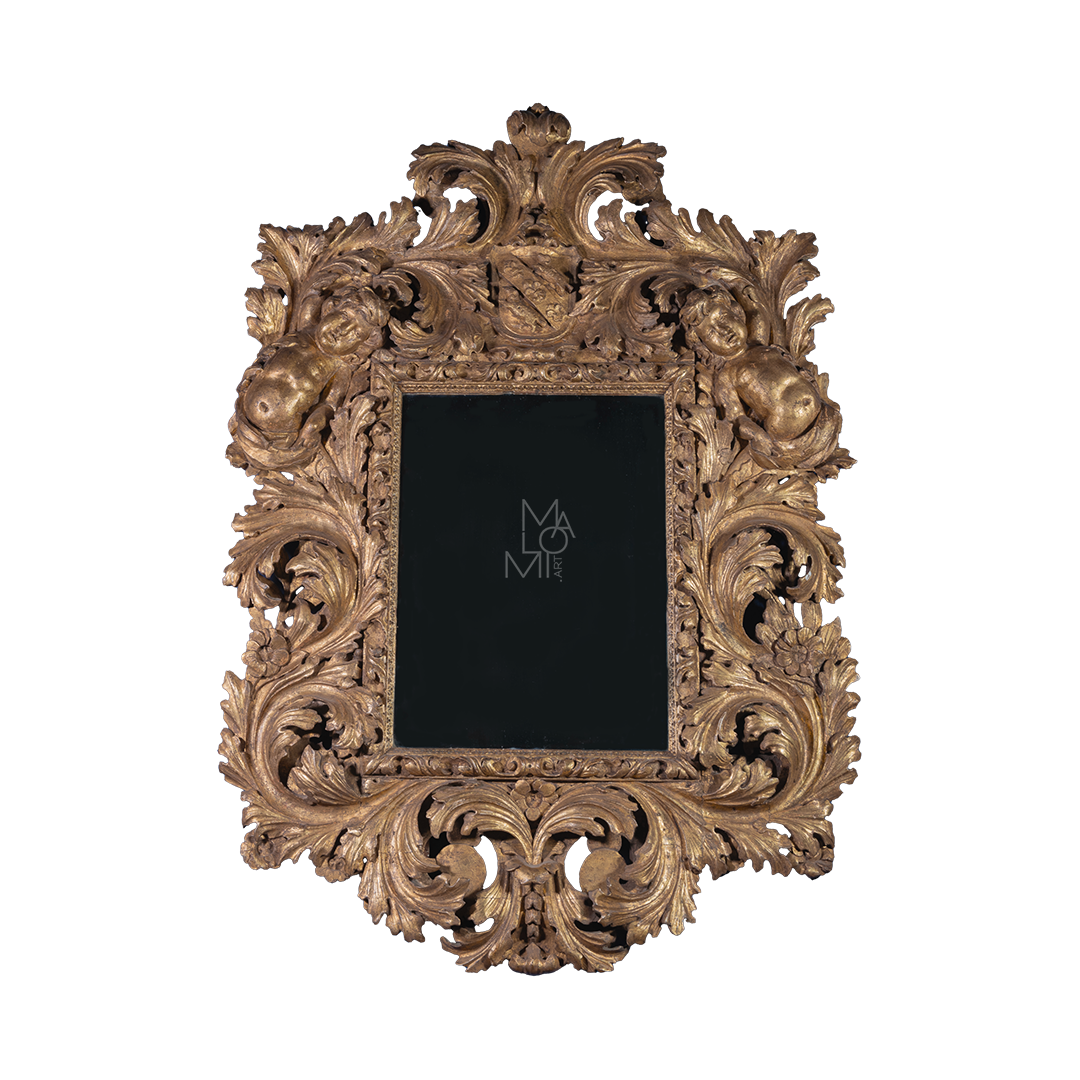
A monumental sixteenth-century Lombard cartoccio mirror with the Arienti / Arieti of Bergamo and Brescia coat of arms
Rare 16th-century monumental Lombard wall mirror (170x125 cm). Hand-carved cartoccio frame, water-gilded over red bole featuring cupids, swags, and the heraldic coat of arms of the Arienti (or Arieti) family of Bergamo and Brescia. Intact, original period
- Object type: Monumental wall mirror
- Period: 16th century (High Renaissance / Late Mannerism)
- Origin: Lombard school of wood carving (Milan / Cremona)
- Provenance: Noble Arienti (or Arieti) family from the Bergamo and Brescia territories (heraldic coat of arms on the cymatium)
- Materials: Finely carved wood, water-gilded with genuine gold leaf over a red bole preparation; original antique mercury-amalgam glass plate
- Condition report: Excellent historical condition, untouched period mirror plate, coeval gilding with authentic age patina
- Dimensions: Height 170 cm, width 125 cm
The captain's mirror: art, prestige, and patronage of the Arienti family between Bergamo and Brescia
The reflection of the soul and power in Renaissance dwellings
In the heart of the sixteenth century, the domestic environment of Italian noble palaces underwent a radical metamorphosis, transforming from a place of pure utility into a sophisticated theatre of self-representation. In this context, furniture ceased to be a mere utensil and became a true political, philosophical, and social manifesto. Among all the objects that populated the reception rooms, the mirror occupied a role of absolute privilege, configuring itself as a magical and technological artifact at the same time. Before large reflecting surfaces became commonplace, the mirror was considered a prodigy of science and technique, a fragment of light captured and imprisoned by human wisdom. Looking at oneself in the mirror was not a trivial gesture linked to daily vanity, but an almost ritual act. According to the Neoplatonic treatises of the time, the mirror returned the image not only of the body, but of the very soul of the beholder, recalling the concepts of prudence, self-knowledge, and moral truth.
A monumental mirror of Lombard origin, standing an impressive one hundred and seventy centimeters high and one hundred and twenty-five centimeters wide, was therefore not a simple ornament, but a center of visual gravity. To possess an object of such dimensions meant declaring to the world one's ability to master matter and light. Late sixteenth-century Lombardy, although crushed by the political tensions of Spanish rule in Milan and protected by the borders of the Republic of Venice in the territories of Bergamo and Brescia, was experiencing a season of extraordinary artistic fervor. The residences of the nobility competed to surpass each other in magnificence. The large wall mirror thus became the cornerstone of the spatial composition of galleries and salons, dialoguing directly with the gilded coffered ceilings and with the frescoes that celebrated the glories of the lineages. A curiosity linked to the custom of the time reminds us that these furnishings were often strategically positioned opposite the main windows not only to multiply the daytime illumination, but to capture the external landscape and bring it inside the room, creating an illusionistic play that dissolved the boundaries between the masonry architecture and the natural space.
The alchemy of mercury and the secret of the master glassmakers
The reflecting heart of this monumental work consists of an antique and untouched mercury mirror glass, a feature that elevates the artifact to a historical document of extraordinary rarity. In the sixteenth century, the production of large glass panes was an operation that bordered on alchemy and required an almost superhuman technical skill. The secret of this technology was jealously guarded in the Venice lagoon, particularly on the island of Murano, where master glassmakers who attempted to flee abroad to sell the secrets of the trade risked the death penalty by order of the Council of Ten. The manufacturing process involved blowing a cylinder of glass which, while still incandescent, was cut longitudinally and flattened on a metal plate. Once cooled, the pane was entrusted to the mirror makers, who spread a very thin sheet of tin on the rear surface, onto which liquid mercury was poured. Through constant pressure exerted with lead weights and woolen cloths, the mercury amalgamated with the tin, fixing itself to the glass.
This technique, although unfortunately lethal for the craftsmen who inhaled the toxic vapors of the heavy metal, gave the mirror an inimitable aesthetic quality, radically different from the cold and sharp precision of modern chemically silvered mirrors invented in the nineteenth century. The mercury mirror possesses a deep, warm, slightly silvery-gray luster, capable of absorbing candlelight and returning it softened, creating a soft and suggestive atmosphere. The fact that the glass of this mirror has come down to us untouched is a small conservative miracle. Over the centuries, the mercury amalgam inevitably tends to oxidize, to slide downwards due to gravity, or to stain, creating areas of opacity. A reflecting surface that has remained intact not only preserves the original optical quality, but testifies to how the object was kept in dry environments protected from the injuries of time, preserving intact that sixteenth-century reflection that showed the faces of dukes, ladies, and knights of the Renaissance.
The metamorphosis of wood: the cartoccio carving and Lombard sculpture
If the glass represents the technological soul of the mirror, the majestic carved and gilded wood frame constitutes its three-dimensional and expressive body. The structure develops according to the typology known as cartoccio, one of the most successful and fascinating morphological inventions of international Mannerism. The motif of the cartoccio evokes the image of a sheet of parchment or sturdy paper that crumples and curls under the action of heat or time. This formal solution allowed wood sculptors to break the geometric rigidity of the rectangular frame, transforming the edges of the mirror into a plastic organism in continuous evolution, where straight lines gave way to sinuous curves, volutes, and counter-volutes. Lombard carving distinguished itself in this period by an executive fury and a volumetric density that had no equal in the rest of Italy. The wood was hollowed out deeply, creating true high reliefs that emerged from the structure with extraordinary dynamic force.
The visual narrative of the frame is articulated through a complex ornamental syntax that finds its culmination in the upper crest. Here, the cymatium is dominated by carved festoons, laden with fruits and turgid leaves, which recall the themes of abundance and prosperity. At the sides of the crest, two cupids emerge with plastic vigor, supporting further festoons that blend with organic motifs. These putti are not graceful and two-dimensional figures, but show muscular bodies, dynamic torsos, and an expressiveness that is deeply influenced by the lesson of Michelangelo and the great Po Valley Mannerist painting. The bodies of the putti seem to struggle to free themselves from the vegetative entanglement that surrounds them, a formal expedient that gives a sense of vital tension to the entire artifact. In the lower part of the frame, the apron echoes the same decorative density, guaranteeing a perfect symmetrical and monumental balance. The presence of such a pronounced dynamism emphasizes the almost aquatic fluidity, the sinuous and asymmetrical appearance of the cartocci, highlighting how late sixteenth-century Lombard wood sculpture already contained in nuce those seeds of theatricality that would explode in the Baroque.
Gold and light: the secrets of water gilding
The visual magnificence of the mirror is amplified by the splendid gilding that covers every millimeter of its carved surface. To achieve this effect of shining and imperishable metal, craftsmen used the technique of water gilding, a long, expensive process that required a monastic discipline. The work began with the preparation of the wooden support, usually linden or walnut wood, soft essences free of knots, ideal for being sculpted without chipping. On the bare wood, the ammanitura was spread, a warm compound of Bologna gypsum and rabbit-skin glue applied in numerous successive layers. This preparation inevitably tended to fill the finesses of the carving, erasing the veins of the leaves or the details of the cupids' faces. The carver therefore had to intervene with special iron scrapers to revive the design, re-sculpting the details directly on the dry plaster.
On the perfectly smooth surface, the bolo was then applied, a very fine clay originating from Armenia or France, tempered with a very light protein binder. Lombard workshops preferred a deep red or carmine tone of bolo. The color of the ground was fundamental, since the genuine gold leaf applied on top was so thin that it allowed the underlying shade to transpire, giving the gold a warm, deep, and coppery vibration. The gold leaf was laid using water, wetting the bolo with water and alcohol; the clay, reactivated by the moisture, held the gold by molecular attraction. The final phase, burnishing, was what decreed the success of the work. Using a burnisher with an agate stone tip, the craftsman vigorously rubbed the gold on the relief parts, such as the crests of the cartocci or the cheekbones of the putti, compacting the metal until it became as shiny as a mirror. The parts in shadow were instead left matte, creating a dramatic chiaroscuro contrast. A technical curiosity of the time reveals that craftsmen avoided breathing directly on the gold during application so as not to blow away the precious sheets, working in completely sealed rooms free of drafts, in an almost mystical silence.
The identity revealed: the heraldry of the Arienti and Arieti families in the Orobic and Brescian territories
At the highest point of the mirror, set in the center of the cymatium like a royal seal, is the heraldic coat of arms of the patrons. The shield, also modeled according to an accartocciato shape to blend harmoniously with the rest of the frame, features a precise and noble configuration: a transverse bend loaded with three fleur-de-lis, flanked by two rampant rams, both rivoltati, meaning with their heads oriented towards the observer's left. This specific and highly fascinating figurative combination belongs to the historical Arienti family, also recorded in local documents under the phonetic variant of Arieti, a patrician and mercantile house of great importance rooted in the territories of Bergamo and Brescia. The insertion of the rams constitutes a classic and refined example of canting arms, where the graphic symbol directly recalls the phonetic name of the family, a practice widely spread among the nobility of Northern Italy to make their lineage immediately recognizable to anyone observing the artifact.
The identification of the coat of arms transforms the mirror from a simple art object into a speaking historical document, linking the work to the family's strategies of prestige and self-celebration. The presence of the three fleur-de-lis within the bend represents an element of exceptional political interest, testifying to honorary concessions or ties of faction and loyalty that united the Arienti family to the power circuits of Venetian and Padan Lombardy. In the sixteenth century, placing one's noble arms on the crest of a mirror meant creating an indissoluble bond between the dynastic identity of the lineage and the image of anyone who stood before the reflecting surface. Furnishings marked with the family arms became part of the inalienable assets covered by fidecommesso, intended to be passed down intact from generation to generation to preserve the decorum of the family name. An archival anecdote linked to Lombard patrician palaces reminds us that the mirror, due to its immense economic and symbolic value, was often listed among the most valuable assets in marriage contracts and wills, considered a true family treasure on par with jewels and silver tableware.
Territorial proximity and artistic circulation between western Lombard workshops and Orobic palaces
The attribution of the patronage to the Arienti or Arieti family of Bergamo and Brescia definitively resolves the geographic and logistical coherence of the artifact, eliminating the need to hypothesize long and risky trans-Apennine journeys. In the late sixteenth century, the territories of Bergamo and Brescia, despite being under the political rule of the Serenissima Republic of Venice, culturally and artistically gravitated within the orbit of the neighboring Milanese and Cremonese carving schools. The great patrician families of the two Lombard cities regularly turned to the celebrated master carvers of the Duchy of Milan and Cremona to commission ceremonial furnishings intended to decorate their city palaces and country villas.
The shipment of a monumental mirror of these dimensions could take place along the internal waterways or the plain routes of western Lombardy, minimizing trauma to the precious mercury glass. Unlike shipments directed toward central Italy, the circulation of artifacts within the Lombard basin was a rapid and daily operation, managed by guilds of couriers specialized in luxury furnishings. The arrival of the Lombard mirror in the Arienti palace marked a moment of extraordinary stylistic updating for the local environment. This artifact configures itself as a wonderful point of intersection between the technical skill of Northern carvers and the dynastic pride of a great Orobic and Brescian family, an object that after five hundred years continues to exercise its ancient visual magic.
The light of the Serenissima: mirror collecting in the Mainland provinces
During the sixteenth and seventeenth centuries, the territories of Bergamo and Brescia experienced an exceptional era of splendor concerning art and furniture collecting. While picture galleries represented the core of the intellectual investment of major houses, the introduction of large monumental mirrors in state rooms became the definitive symbol of achieved social and economic prominence. The Serenissima held a global technological monopoly over the production of mercury plates on the island of Murano, rendering crystal an absolute luxury item accessible only to immense fortunes. The transition from the sixteenth to the seventeenth century marks the decline of the Renaissance studiolo in Orobic and Brescian abodes, and the concurrent birth of the gallery or the salon of honor, designed specifically to astonish guests and celebrate the family's magnificence.
Period inventory records reveal that large mirrors were placed in pairs or alternating series along the major walls of the gallery, positioned precisely in the spaces between windows or opposite grand paintings. This met a precise aesthetic related to optical illusion: the mercury mirror, with its deep and silvery-gray refraction, canceled the static nature of the masonry, artificially expanded the room's space, and multiplied the candlelight during nocturnal receptions, transforming the salon into a luminous theatre of intersecting reflections. In valuations drawn up by art appraisers of the time, a large mirror with a carved cartoccio frame and water-gilded finish could achieve estimates higher than those of significant contemporary painting cycles. Seventeenth-century judicial chronicles in Brescia show heated inheritance disputes focused exclusively on the allocation of parade mirrors, bearing witness to how the glass sheet was considered a true liquid treasure to be guarded with the same care reserved for real estate.
Reference Bibliography
- Alberici, Clelia. Il mobile lombardo [Lombard Furniture]. Milan: Görlich, 1969.
- Bacchi, Andrea, and Luciana Giacomelli, eds. Scultura in Lombardia: Il Cinquecento [Sculpture in Lombardy: The Sixteenth Century]. Milan: Electa, 1997.
- Belotti, Bortolo. Storia di Bergamo e dei bergamaschi [History of Bergamo and the Bergamasques]. Vol. 4, Dal principio del secolo XVI al termine del secolo XVIII. Bergamo: Edizioni Bolis, 1959.
- Colle, Enrico. Il mobile rinascimentale in Italia: Costume e stile dal XIV al XVII secolo [Renaissance Furniture in Italy: Costume and Style from the 14th to the 17th Century]. Milan: Electa, 2002.
- Lualdi, Roberto. Il mobile lombardo dal Rinascimento al diciannovesimo secolo [Lombard Furniture from the Renaissance to the Nineteenth Century]. Milan: Leonardo Arte, 1999.
- Morazzoni, Giuseppe. Le cornici bolognesi, veneziane e lombarde dal Rinascimento al Barocco [Bolognese, Venetian, and Lombard Frames from the Renaissance to the Baroque]. Milan: Luigi Alfieri, 1953.
- Mottola Molfino, Alessandra. Il mobile in Italia: Dal Medioevo al Settecento [Furniture in Italy: From the Middle Ages to the Eighteenth Century]. Novara: Istituto Geografico De Agostini, 1985.
- Praz, Mario. An Illustrated History of Interior Decoration: From Pompeii to Art Nouveau. London: Thames and Hudson, 1982. [Important for the spatial placement of mirrors and galleries].
- Spreti, Vittorio. Enciclopedia storico-nobiliare italiana [Historical-Noble Encyclopedia of Italy]. Vol. 1, A-B. Milan: Edizioni Enciclopedia Storico-Nobiliare Italiana, 1928.
- Thornton, Peter. The Italian Renaissance Interior, 1400–1600. New York: Harry N. Abrams, 1991.