A Historical-Artistic, Formal, and Conservational Study of a Late Medieval Musical Assembly
A Historical-Artistic, Formal, and Conservational Study of a Late Medieval Musical Assembly
- Introduction: The Flourishing of Woodcarving in Fifteenth-Century Brescia
Within the landscape of fifteenth-century Lombard wooden sculpture, the territory of Brescia represented a cultural crossroads of extraordinary vitality. Protected by the geopolitical stability of the Republic of Venice and permeated by Milanese artistic currents, the school of Brescian ebanisti (cabinetmakers) and woodcarvers developed an autonomous idiom. This style successfully synthesized the rigorous verticality of late Gothic International style with the emerging, groundbreaking naturalistic impulses of the early Renaissance.
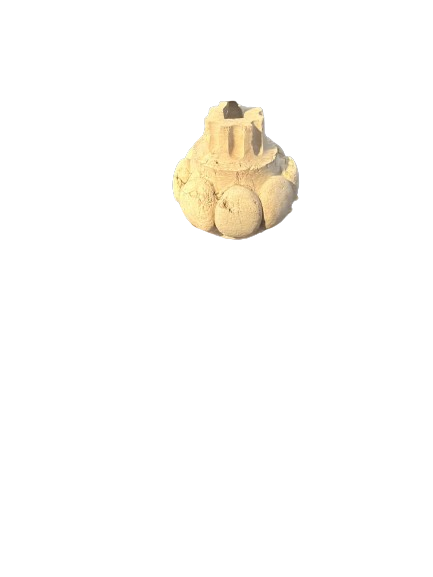
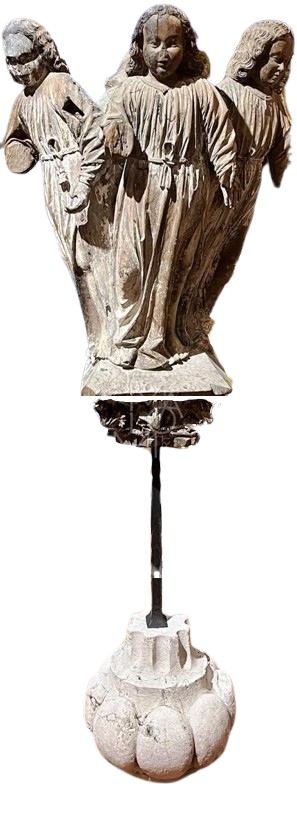
The sculptural group under examination—comprising four freestanding figures carved from solid wood, each standing approximately 110 cm in height—perfectly embodies the pinnacle of this monumental production. Originally conceived for full three-dimensional viewing, the sculptures are currently presented on an elegant, vertical exhibition display consisting of a metal rod anchored to a bulbous, lobed stone base. The figures engage one another in a dense visual and postural dialogue, vividly evoking the complex musical, liturgical, and devotional practices of the late Middle Ages.
- Formal Analysis and the Dimension of Musica Ficta
The narrative and aesthetic core of the group lies in the spatial arrangement and dramatic gesturing of the four figures. Modeled with a robust yet slender volumetric presence, the statues are positioned back-to-back, generating a dynamic circular tension. This configuration invites the viewer to circumambulate the artifact, capturing infinite chiaroscuro variations from every vantage point.
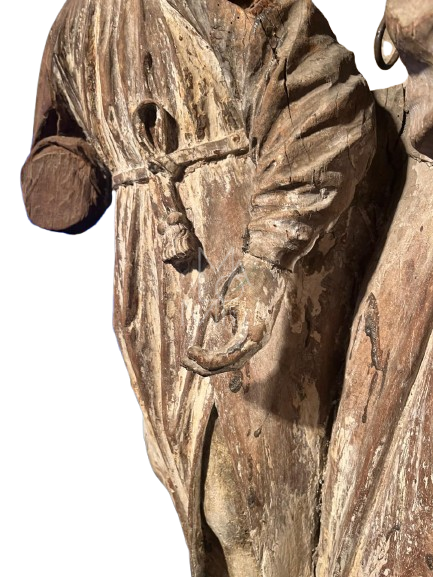
The posture of the arms, the inclination of the torsos, and the partial loss of the hands and forearms are not accidental; rather, they indicate the loss of the sculptures' original iconographic attributes. The hands were meticulously modeled to receive and support musical instruments or choir books, which are now lost. In the liturgical context of the fifteenth century, sacred music was not mere embellishment but the earthly translation of celestial harmony.
Through the carved bodies, the viewer perceives a musica ficta—a silent concert. One figure likely held a stringed instrument (such as a lute or psaltery), another a wind instrument (a portative organ pipe or a shawm), while a third held a membranaceous missal or choir book. This specific iconography strongly suggests that the work originally adorned the upper register of a cantoria (choir loft), a monumental organ casing, or the crowning crest of a monumental wooden altarpiece.
- Physiognomy of the Sacred and Stylistic Transition
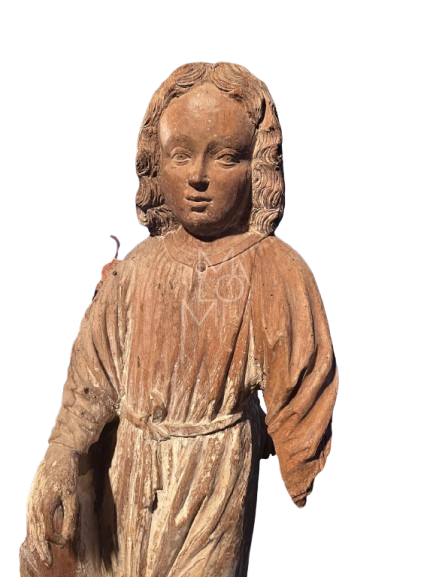
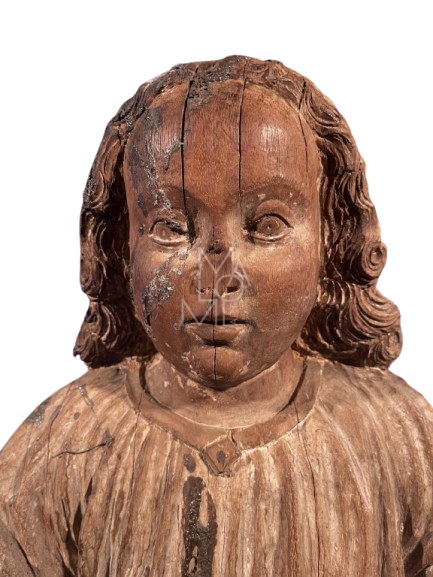
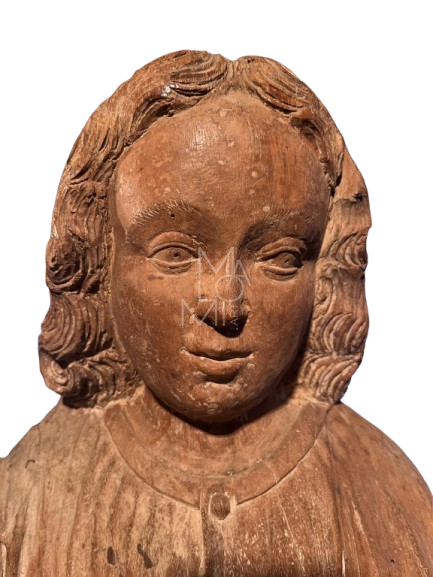
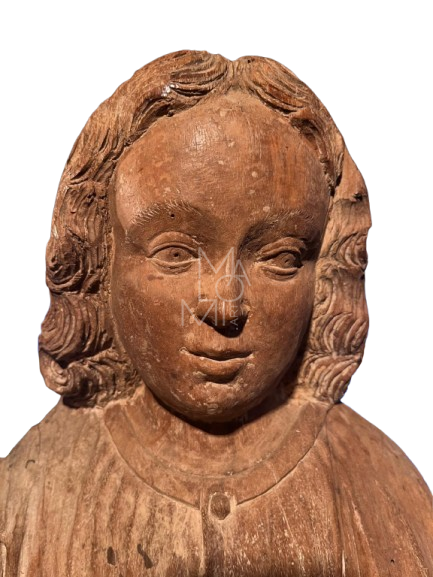
A close examination of the visage of the central figure reveals the extraordinary psychological acuity of the carver, testifying to the transition from archaic, static medieval typologies toward a delicate humanization of the sacred.
- The Facial Oval: The face features a full, smooth oval, defined by soft cheekbones and a rounded chin. This modeling imparts a sense of idealized, eternal youth, entirely consistent with angelic hosts or young liturgical choristers.
- The Hieratic Gaze: The eyes, framed by thin, geometrically arched brow ridges, exhibit thick, well-defined eyelids and a concentrated, downcast gaze. This expression is characteristic of a cantor completely absorbed in the execution of sacred monophony or early polyphony.
- The Parted Lips: The lips are finely carved and slightly parted. This anatomical detail is not merely a display of naturalistic virtuosity; it simulates the physical act of vocal emission, permanently binding the sculpture to its original acoustic dimension.
- Virtuositic Coiffure: The hair, divided by a central parting, cascades in symmetrical waves along the temples before resolving on the shoulders into dense, volumetric corkscrew curls. The sharp chiaroscuro contrast between the smooth flesh tones and the geometric volume of the hair was calculated to ensure facial legibility from a significant distance under the flickering light of liturgical candles.
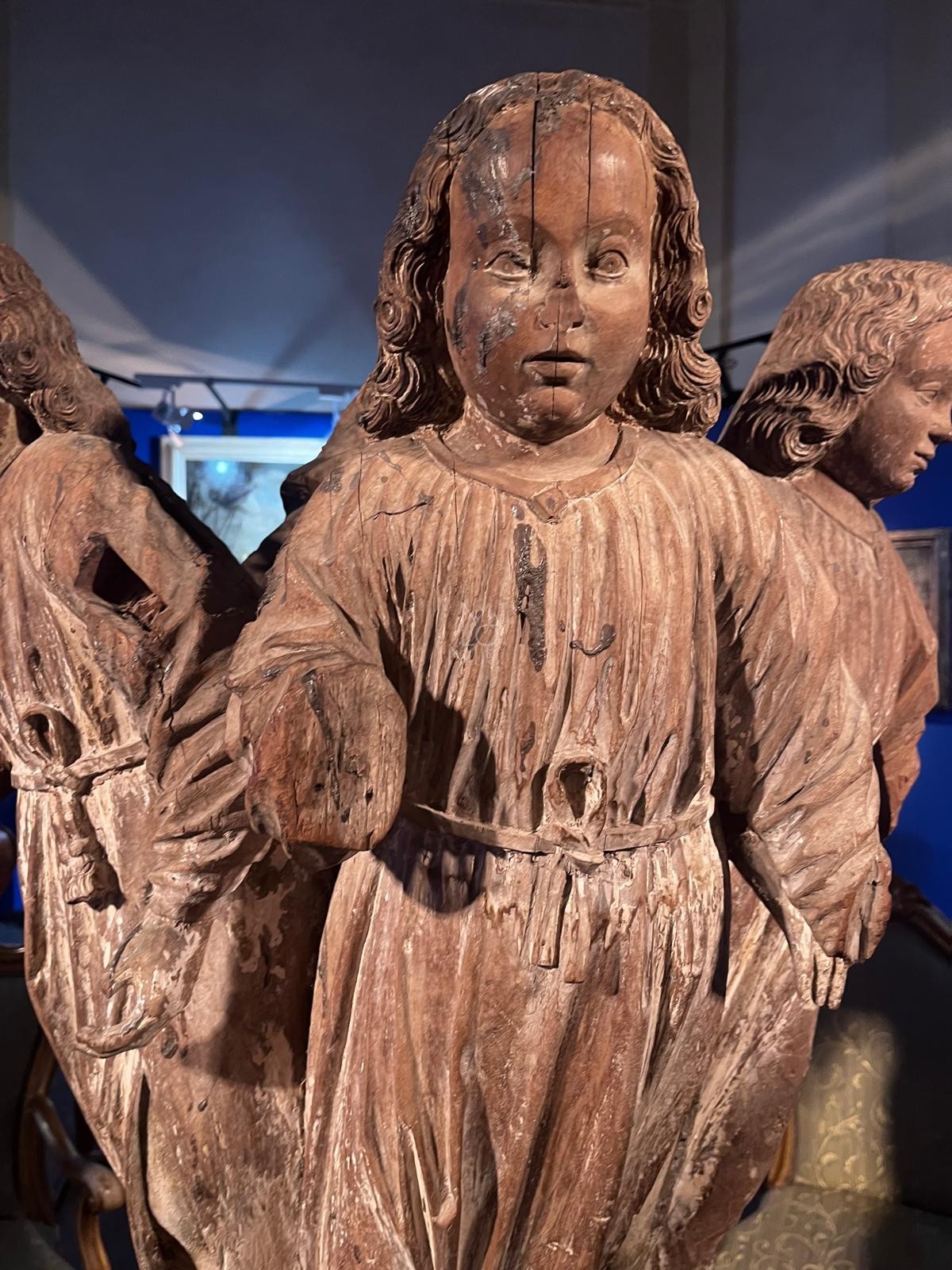
- The Technical Aperture: At the base of the tunic’s simple circular neckline, a perfectly calibrated circular bore-hole is visible. This aperture originally accommodated a wooden or metallic dowel designed to secure an ornamental brooch, a separately carved sacred attribute, or a structural anchor for heavy gilding.
- Morphology of the Drapery and Vestments
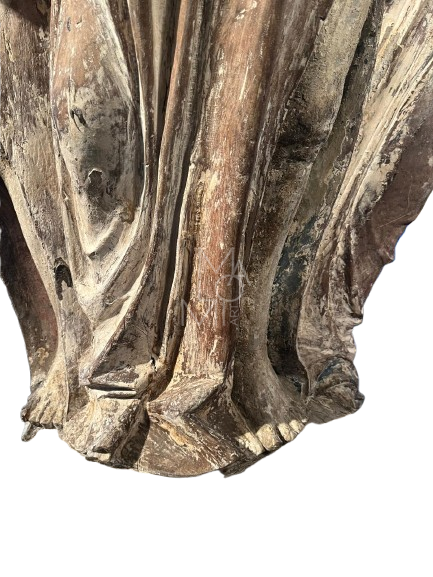
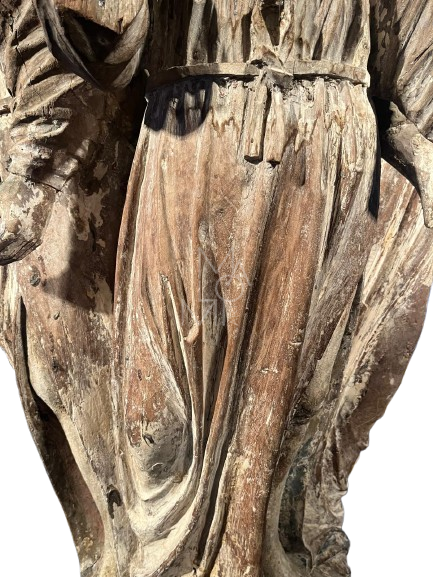
Descending along the bodies of the figures, the carving becomes highly structured and architectural. The tunic is cinched at the waist by a smooth girdle, fastened by a central geometric knot from which two rectilinear lappets suspend. Above the belt, the fabric blousons slightly before falling into dense, deep vertical folds that echo the fluting of a classical column.
While the primary figure adopts a more fluid, longitudinal drapery scheme, the adjacent figures display fractured "V"-shaped folds and deep concavities reminiscent of Late Gothic mannerisms. Despite the abundance of the vestments, the master craftsman demonstrates an advanced understanding of anatomy: the protrusion of the knee and the slight shifting of the hip are clearly perceptible beneath the wooden surface, granting the bodies a weight and posture fully compliant with the laws of gravity.
- The Base and Supporting Architecture
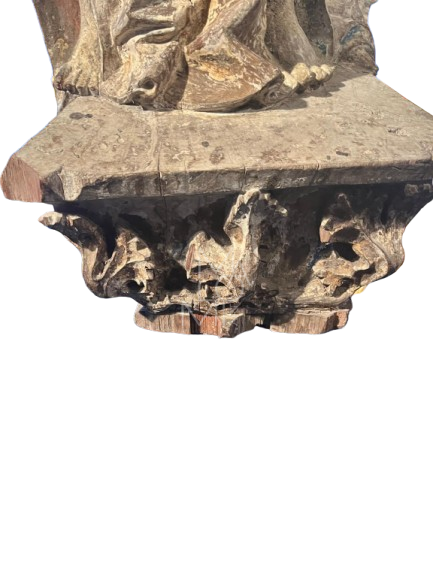
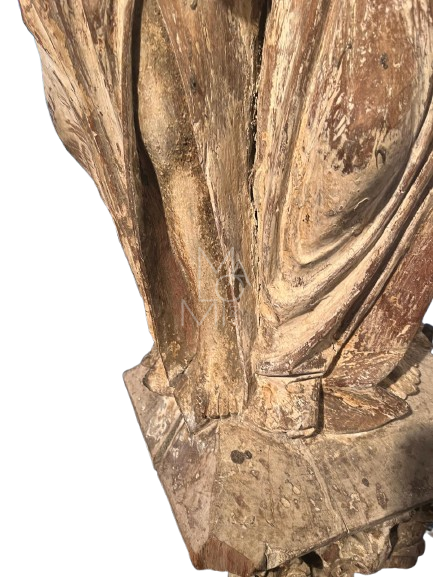
A fundamental element for reconstructing the original architectural context of the work is the lower plinth upon which the bare feet of the figures rest. The statues stand on a molded hexagonal platform, which serves as a transitional element connecting to an inverted capital or corner corbel decorated with foliage.
This supporting element is adorned with deeply undercut, pierced acanthus leaves, which are characteristic of the Renaissance decorative repertoire in Lombardy. The profound hollows carved into the wood of the capital indicate that this section was explicitly engineered to be viewed from below (di sotto in su), confirming that the group was originally installed in an elevated position relative to the nave or the choir stalls.
- Archeology of Color: Traces of Polychromy and Conservational State
What appears today as a evocative, monochrome sculpture in bare wood was, in the fifteenth century, a brilliant display of gold, silver, and vibrant pigments. A microscopic examination of the surfaces reveals the artifact's original stratigraphy:
Within the deepest recesses of the girdle, between the toes, and inside the undercuts of the foliated capital, small whitish fragments of gesso and animal glue (ammannitura) have survived historical cleanings, alongside residues of Armenian bole (a reddish clay that served as the bed for gold leaf gilding). On the ankles and feet, subtle ochre and earth-toned residues persist, offering evidence of the original naturalistic incarnato (flesh tones).
From a conservational standpoint, the near-total loss of the original paint film—largely due to aggressive historical stripping—exposes deep longitudinal checking across the wood. This checking represents a natural hygroscopic movement of the solid timber, which has reacted over centuries to ambient relative humidity fluctuations. Furthermore, small flight holes scattered across the surface indicate past infestations by xylophagous insects (woodworms), which have since been chemically eradicated and stabilized.
- Conclusion
This sculptural group by fifteenth-century Brescian woodcarvers represents a historical and artistic document of exceptional significance. Through the synthesis of structural joinery and refined physiognomic modeling, the work encapsulates the very spirit of Renaissance devotion. Though stripped of their original musical instruments and polychrome vestments, these four monumental cantors continue to articulate, through the raw medium of timber, the solemn and eternal harmony for which they were originally carved.