18th Century Marble Sculpture
18th Century Marble Sculpture
Antiquarian Discovery: An 18th-Century White Statuary Marble Masterpiece
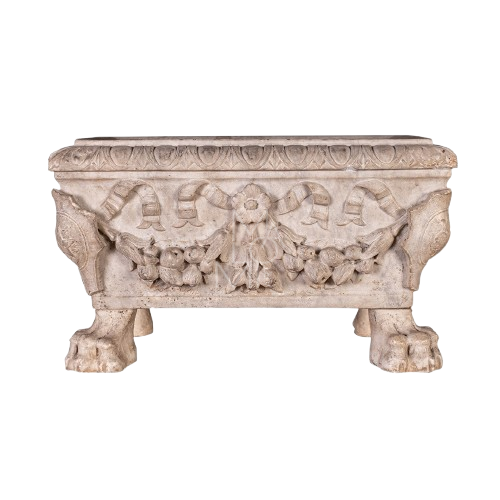
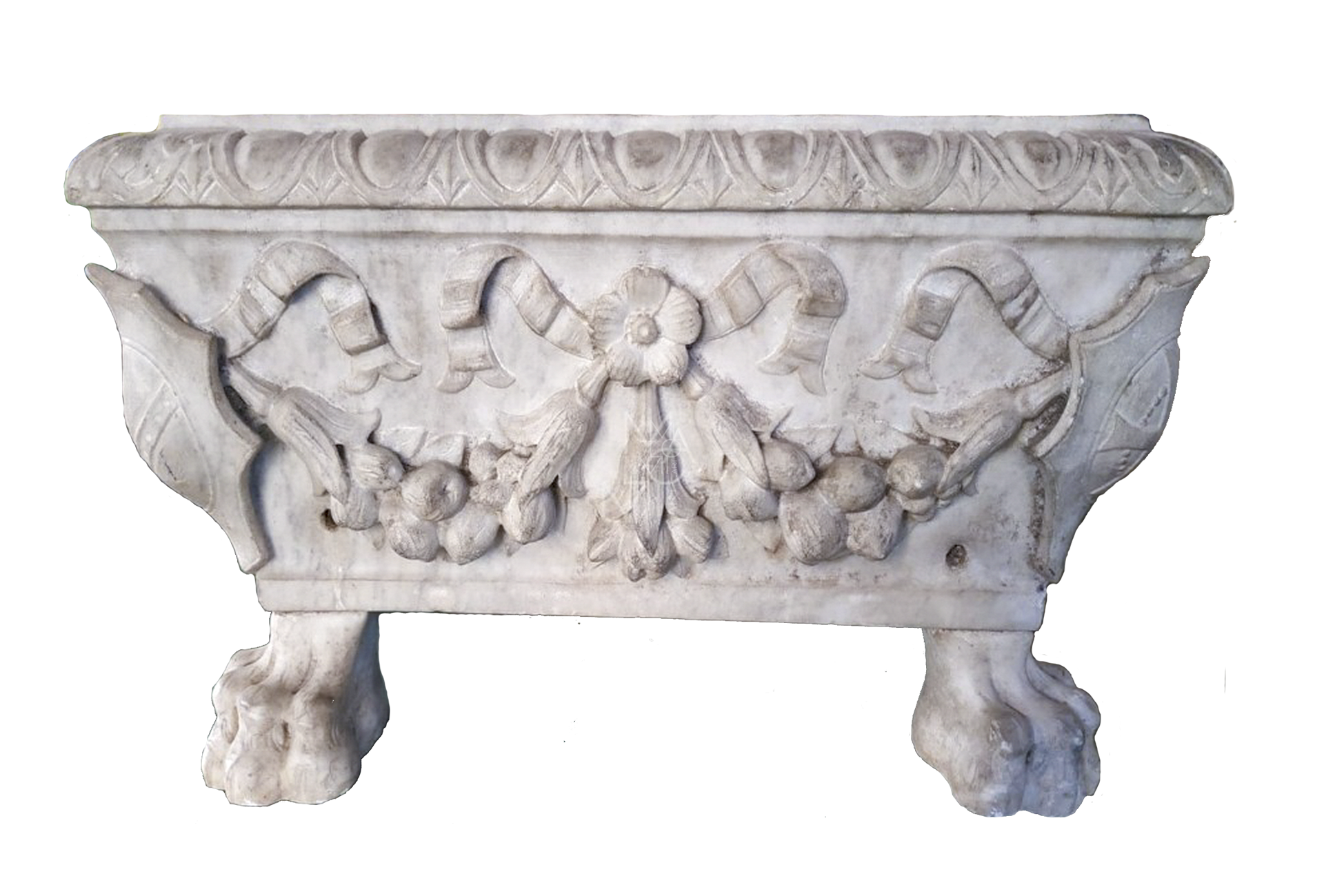
Emerging from the prestigious sculpture workshops of 18th-century papal Rome, this refined monumental state basin is carved from a single, monolithic block of precious Carrara marble, beautifully reinterpreting the solemnity of Roman sarcophagi à l'antique.
Key Features:
- Dimensions: Height 28 cm, Width 47 cm, Depth 28 cm.
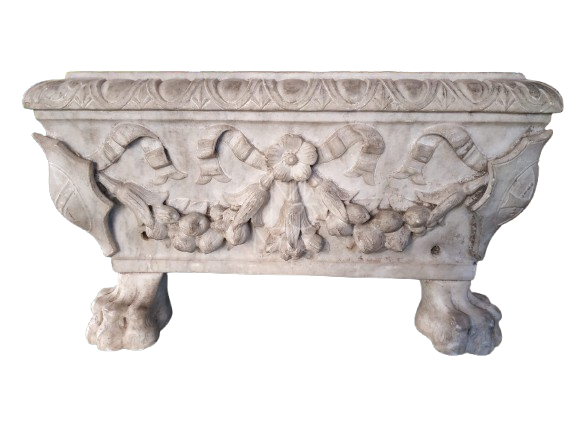
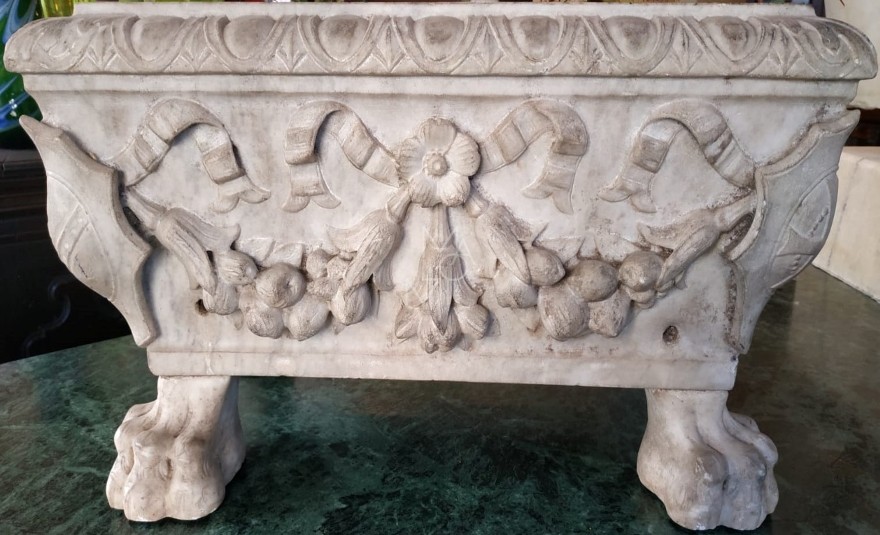
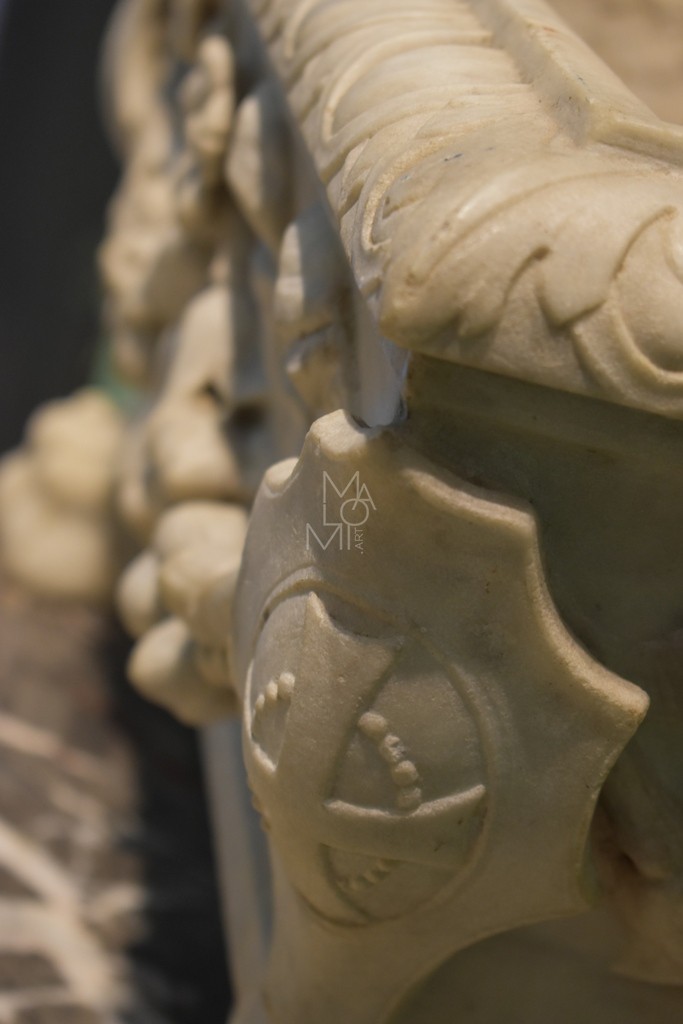
- Ornamental Syntax: A rich cascading phytomorphic festoon of fruits and leaves unites four scrolled corner shield-cartouches.
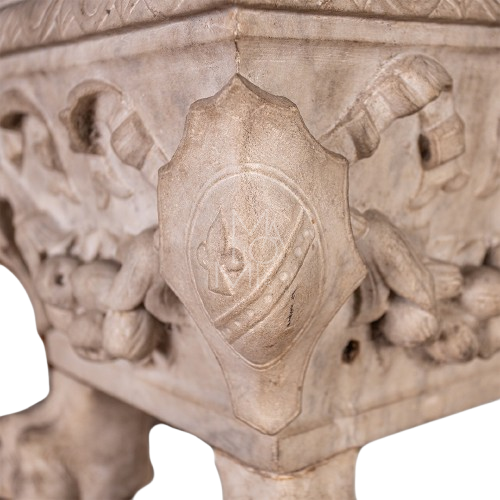
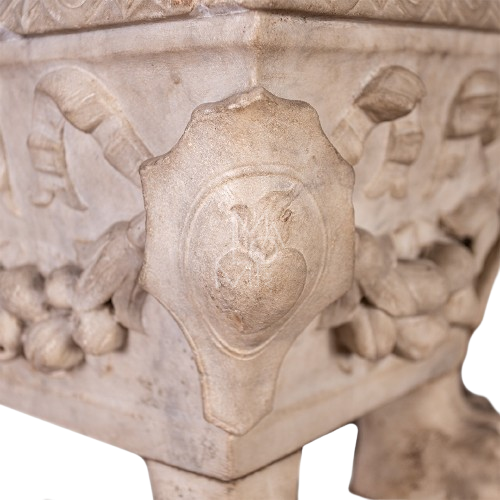
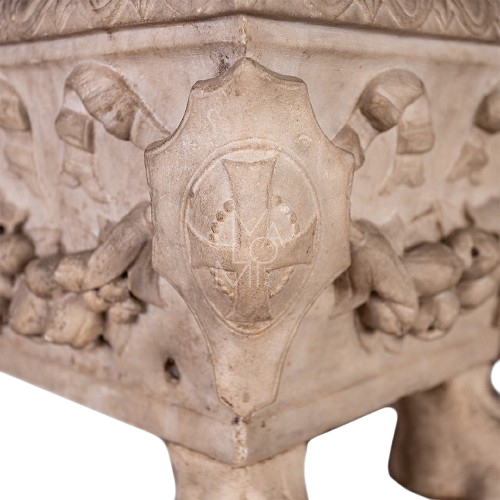
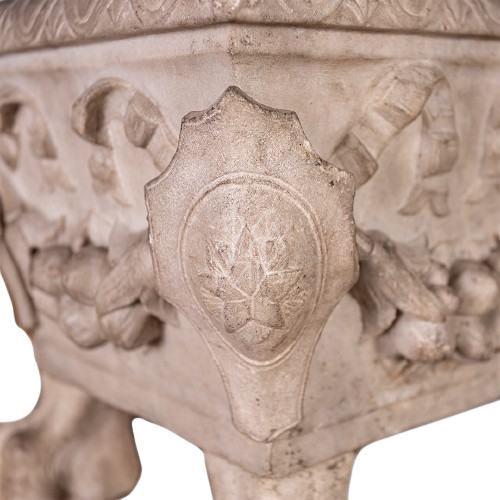
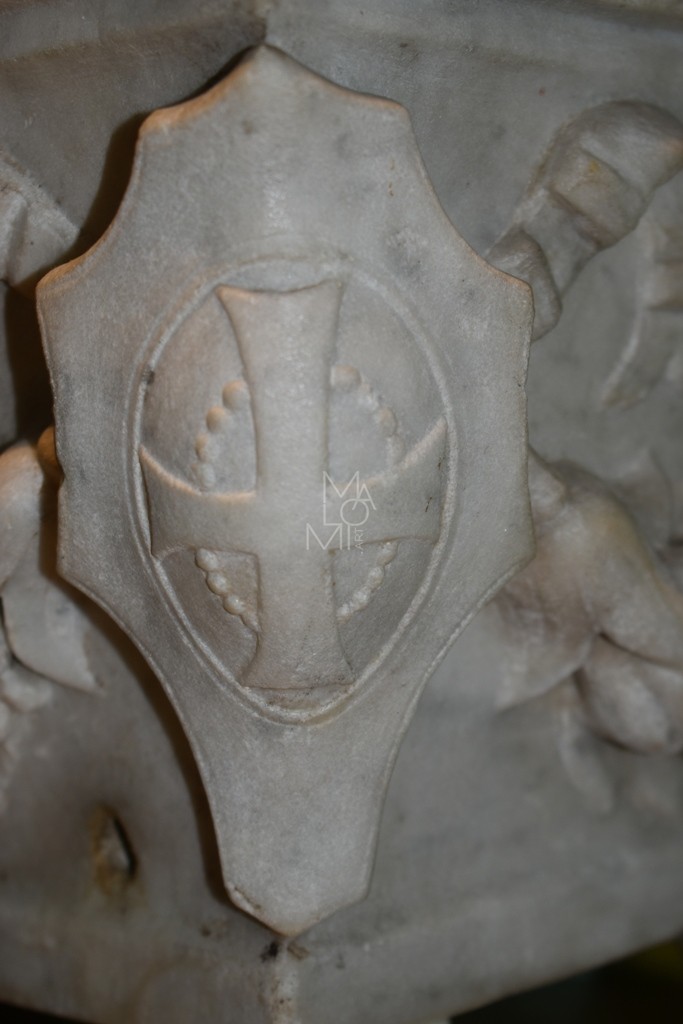
- Dual Iconography: A sophisticated visual program blends faith (the cross patente with a crown of thorns and the flaming Sacred Heart, a symbol of Jesuit alignment) with papal lineage (the coats of arms of the historic Chigi and Farnese families).
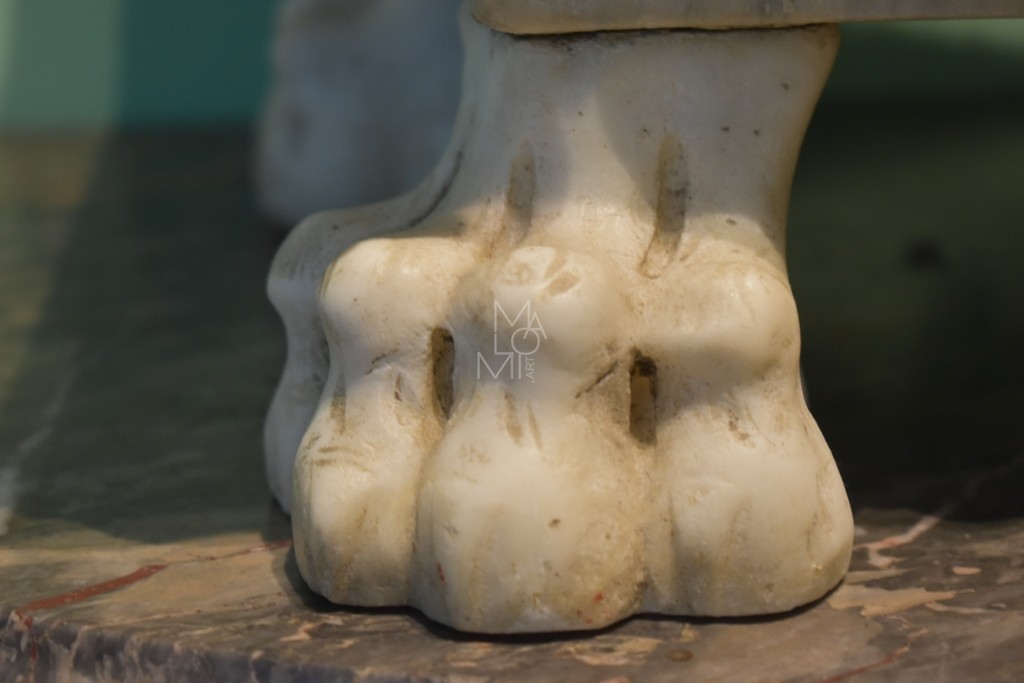
- Period Engineering: The base rests on powerful feline paws and features two specular hydraulic holes on the front, originally intended for twin faucets and an overflow system.
A centuries-old masterpiece that perfectly embodies the aristocratic splendor and profound devotion of the Ancien Régime.
The Lapidary Elite Between Faith and Lineage: A Historico-Artistic Essay on an Eighteenth-Century White Statuary Marble Basin
1. Introduction and Typological Framework
The artifact under examination is a refined parallelepipedal basin in white statuary marble, measuring 28 cm in height, 47 cm in width, and 28 cm in depth. From a morphological and exegetical perspective, the work is fully integrated into the prestigious production of private liturgical furnishings or font elements for sacristies dating to the height of the 18th century.
The combination of a rigorous geometric framework with a supple, organic decorative apparatus bears witness to a late-Baroque figurative culture that already reflects the first strict influences of Neoclassicism. Within this specific chronological horizon, the revival of anthological models of high art — such as Roman sarcophagi with festoons — was reinterpreted through a vibrant plastic sensibility, driven by profound symbolic, devotional, and dynastic values.
The object should not be considered a mere domestic container, but rather an arredo d'apparato (state furnishing) intended to mediate between the functional requirements of contemporary hydraulics and the needs for self-representation of a high-ranking patron. Its genesis is intrinsically linked to an environment in which architectural decorum and the choice of lapidary materials served as an immediate status manifesto, placing the work at the center of a dense network of historical, artistic, and cultural meanings.
2. The Socio-Economic and Political Context of the Eighteenth Century
To comprehend the magnificence and the financial investment underlying a work of such proportions, it is necessary to contextualize the artifact within the socio-political fabric of 18th-century Italy. The 18th century was an era of profound geographical and dynastic transitions, marked by the transfer of many territories from Habsburg to Bourbon rule, the stability of the Papal States despite a progressive erosion of temporal power, and the flourishing of ducal courts that perpetuated Renaissance patronage as a tool for political legitimization.
Within this chessboard, pontifical and noble institutions cooperated closely, moving along two parallel tracks. On one hand, a politico-celebratory value was expressed through the self-glorification of lineage, the attestation of papal loyalty, and the conspicuous funding of monumental sacred furnishings.
On the other hand, this patronage drove a massive eco-mercantile value, strictly linked to the control of the Apuan quarries, the monopoly over rare marbles, and the employment of a highly specialized sculpting workforce.
The Church and the aristocracy responded to Enlightenment and jurisdictionalist pressures by intensifying the commission of sacred artworks. The furnishing of the sacristy or the private family chapel was not a mere practical detail, but an extension of the representational space of aristocratic-ecclesiastical power.
Investing in a monolithic block of precious marble meant reaffirming the financial stability of the family or religious order at a time of major fiscal reforms and secularization. The applied arts and ornamental sculpture thus became the privileged terrain for subtle political propaganda, where visual magnificence compensated for the uncertainties of a constantly shifting geopolitical balance.
3. Material Analysis: White Statuary Marble and Lapidary Craftsmanship
From a strictly eco-manufacturing standpoint, the choice of white statuary marble represents the pinnacle of 18th-century lithic luxury. This specific variety, extracted exclusively from the deepest and most protected deposits of the Apuan Alps (Carrara), was distinguished in European markets by the absolute purity of its milky background and the homogeneity of its grain, which was almost entirely free of gray or parasitic veining.
The extraction and transportation of statuary marble in the 18th century incurred exorbitant costs. The block had to be extracted by hand using the "mutilation" technique and lowered down the mountain through the hazardous practice of lizzatura, before being shipped from the ports of Marina di Carrara or Livorno. Purchasing this marble implied possessing a financial liquidity precluded to the contemporary middle class.
From a technical point of view, the extremely fine grain allowed 18th-century sculpture workshops to achieve a fully painterly plastic rendering. Carvers could push the relief to millimetric thicknesses, creating transparency effects in flower petals and deep undercuts in fruit festoons. These details were capable of catching the dim light of candles or apse windows, offering chiaroscuro patterns impossible to obtain with commercial marbles.
4. Historico-Geographical Analysis: Provenance and Workshops of Production
Determining the exact geographical area of the artifact's production requires a cross-analysis between the plastic style of the relief and the heraldic palimpsest of its corners. The attributive debate inevitably fluctuates between two of the most important macro-areas of 18th-century lapidary sculpture: the Tuscan sphere, linked to Carrarese or Florentine manufactures, and the Roman sphere of pontifical workshops.
An attribution to Tuscany is supported primarily by the immediate availability of the raw material. The workshops of Carrara and the laboratories of the Grand Duchy of Tuscany, ruled by the House of Habsburg-Lorraine in the 18th century, specialized in the production of garden furnishings and sacred art of a sophisticated, cultivated standard.
The style of the festone, featuring a large central corolla flower, echoes the formal composure of the Florentine Renaissance, which was never entirely forgotten in Tuscany, serving as a bridge toward Neoclassicism. Furthermore, the heraldic lily, if interpreted as a civic symbol or one tied to Tuscan territory, could suggest a commission from within the Grand Duchy or destined for one of its historic archdioceses.
However, the overall heraldic evidence overwhelmingly shifts the balance toward Rome and the papal curial environment. The coexistence of dynastic symbols linked to prominent popes and cardinals in the Lazio region is an element found almost exclusively in the collecting and patronage of the Eternal City.
The vigorous carving of the leonine paws, combined with the sinuous and almost turgid movement of the fruits in the festone, reflects the grand lesson of the Roman Baroque (from Bernini to Algardi), which persisted in 18th-century decorative arts through the works of architects and sculptors active for Capitoline palaces and churches.
The fusion of the coats of arms of great past patrons with mystical symbols is typical of Roman archconfraternities or private chapels within high-ranking palaces on Via del Corso or in the Parione district. In Rome, sculptors in papal workshops routinely paid homage to the pontifical protectors of the patron's house by uniting their historical coats of arms into a single celebratory iconographic program.
In conclusion, the historico-geographical analysis allows for the identification of the work as a product of a Roman-culture workshop from the mid-18th century. Although the block of statuary marble was certainly extracted in the Apuan basin, the execution of the relief, the complex conceptual articulation of the coats of arms, and the Baroque monumentality of the feline supports belong unequivocally to the refined and celebratory language of master sculptors active in Rome for the papal aristocracy.
5. The Sacred Heart and the Chigi Family: Diffusion of the Cult in 18th-Century Rome
A crucial chapter for a profound understanding of the commission resides in the mystical axis of the basin, made explicit by the flaming Sacred Heart. The inclusion of this symbol on the front of the basin is not merely a generic act of Christian piety, but is anchored to specific historical events and spiritual alliances that inflamed Rome during the 18th century, with the Chigi family occupying a position of absolute and militant prominence.
Although the mystical origins of the cult trace back to the 17th-century revelations of Saint Margaret Mary Alacoque at Paray-le-Monial, its formal dogmatic institution and widespread devotional diffusion found their political epicenter within the Papal States during the 18th century. The primary promoters of the cause were the fathers of the Society of Jesus, who identified the image of the Heart of Christ as a formidable theological and pastoral antidote against the cold, pessimistic rigorism of Jansenism.
The debate was fierce: Jansenists accused devotion to the Sacred Heart of "cardioclasty" and heretical sentimentalism, attempting to ban it. Conversely, the Roman curia and the great papal aristocratic families adopted it as a banner of Catholic orthodoxy and unconditional loyalty to the Pope's directives. In 1765, Pope Clement XIII finally granted the first formal liturgical approval for the Feast of the Sacred Heart, decreeing victory for the Jesuit and curial faction.
In this context, the Chigi family distinguished themselves as one of the greatest vectors of the cult in Rome and within their regional fiefs. The family's devotion, rooted since the pontificate of Alessandro VII Chigi, found militant 18th-century interpreters in high prelates of the family, such as Cardinal Flavio Chigi the Younger (1711-1771), an influential protector of religious orders and a staunch supporter of the Jesuits during the heated phases preceding their suppression.
The Chigi family financed altars, chapels, and liturgical furnishings bearing the Sacred Heart precisely to visually reaffirm their theological stance and their proximity to the most uncompromising papal line. The coexistence on the basin of the coat of arms featuring the star over the trimonzio alongside the flaming Sacred Heart graphically demonstrates this binomial.
The state basin thus becomes an instrument of subtle religious militancy and dynastic display: by washing his hands prior to the eucharistic sacrifice, the high Chigi prelate reaffirmed the purity of his faith against the Jansenist drifts of the century, placing his historic lineage under the direct protection of the Heart of Christ.
6. The Decorative Apparatus: Ornamental Syntax and Antiquarian Citation
The Upper Rim with a Geometric Motif
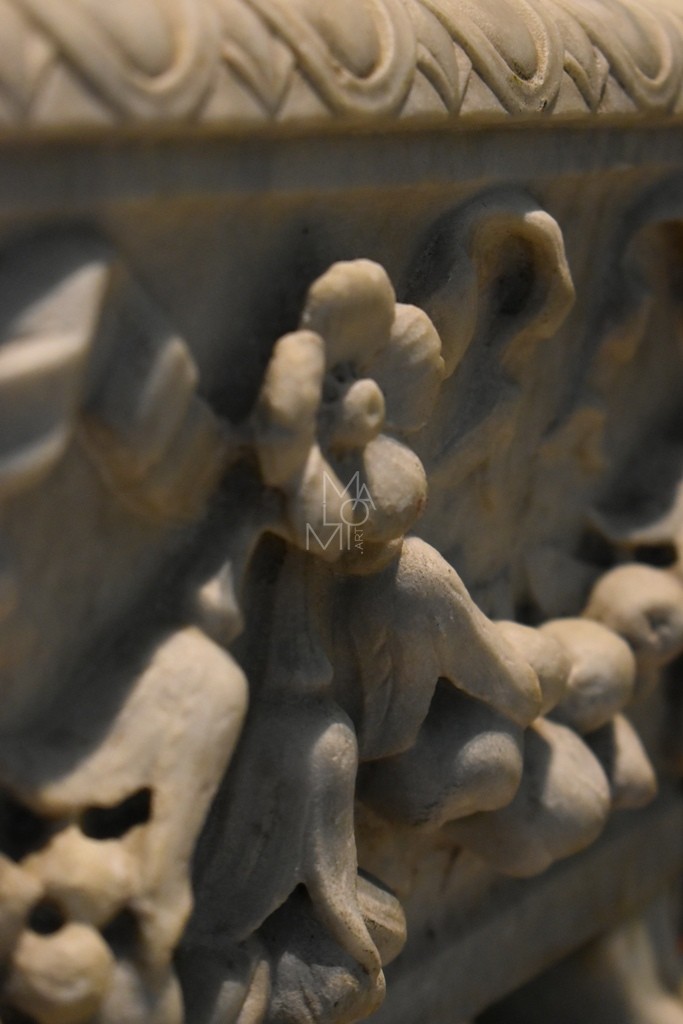
The uppermost portion of the basin is traversed by a projecting moulding carved with a geometric motif of stylized waves. This cornice functions as a visual anchor and architectural stabilizer for the entire composition. Its rhythmic, regular cadence establishes a deliberate contrast with the underlying plastic freedom of the vegetal decoration, recalling the classical division of architectural orders rediscovered with vigor by 18th-century antiquarian culture, which was heavily influenced by the excavations at Herculaneum and Pompeii and the writings of Winckelmann.
The Festone and the Floral Motif
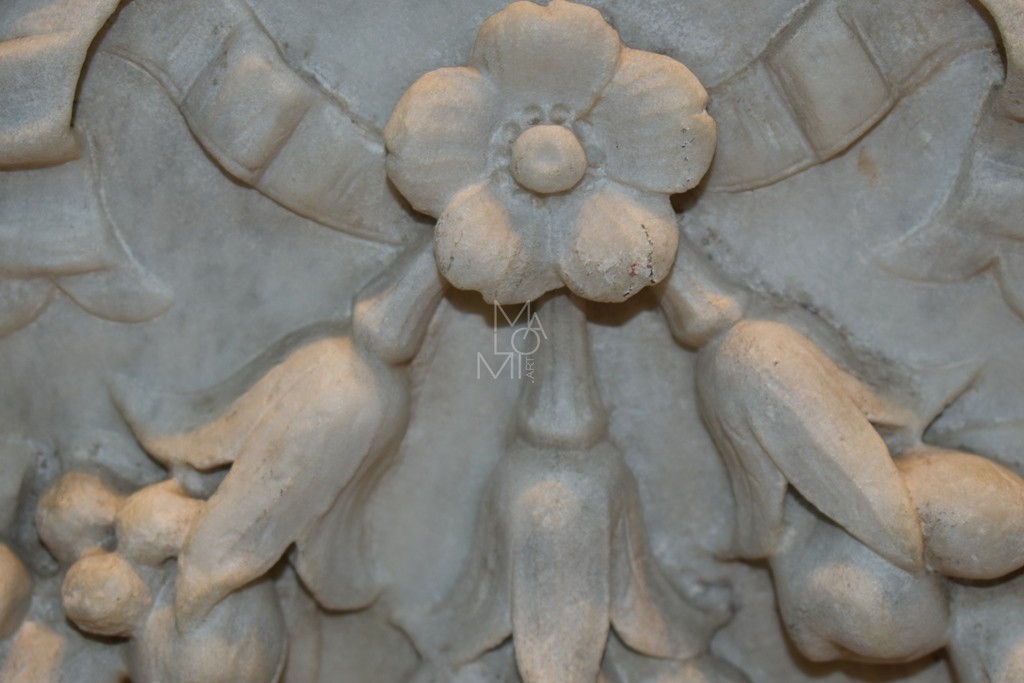
The central body of the basin hosts a rich phytomorphic garland defined as a festone. The festone, tied at the upper sides by fluttering ribbons (vittae) that terminate in a central flower with an expanded corolla, develops into a sinuous cascade rich in vegetal elements, fruits, and floral motifs.
Iconographically, this scheme is rooted in Roman art of the Augustan era, as seen in the interior reliefs of the Ara Pacis. In the 18th century, this motif experienced a powerful revival due to the taste à l'antique, symbolizing the fertility of nature, abundance (ubertas), and, in a sacred context, regeneration and the rigourous flow of divine grace.
The linear progression of the composition structures the decorative apparatus so that it converges visually toward the center, where the large flower unites the two grand cascades of the undulating garland, while the upper corners serve as the anchoring points for the ceremonial ribbons.
7. The Iconographic Program of the Corner Shield-Cartouches: Faith and Nobility
The presence of four corner shields inserted within elegant late-Renaissance and Baroque scrolled cartouches constitutes the narrative core of the work. Direct analysis reveals that this is not a serial repetition, but rather a well-structured binary iconographic program, typical of 18th-century ecclesiastic and patrician commissions, which distributes the symbols symmetrically.
The decorative scheme of the facade and corners articulates a rigorous and harmonious alternation between sacred and secular elements. At the upper left corner, the spiritual axis opens with the profound Christological value of the cross patente associated with the crown of thorns. Moving across to the opposite side, at the upper right corner, the narrative shifts toward the secular celebration of noble power, displaying the farnesiano lily accompanied by the studded band.
Similarly, the lower portion and the remaining corners replicate this calculated conceptual specularity. On the lower left side, the work reinforces the aristocratic prestige of the patron by showing the eight-pointed star on the Chigi trimonzio. Finally, the lower right corner symmetrically closes the devotional circle, returning the viewer's gaze to the sacred plane, where the plastic carving of the flaming Sacred Heart commands attention.
This deliberate coexistence suggests a work commissioned by a high prelate or a cardinal of the Chigi family who intended to visually celebrate his bonds of blood or political alliance with the great pontifical houses of the past, indissolublemente uniting his lineage with the affirmation of his spiritual mission.
8. Hydraulic Architecture and Historical Executional Discrepancies
An element of exceptional interest for the historico-technical study of the basin is the presence of two pierced holes on the main facade, positioned in correspondence with the feline feet. Their placement attests that the artifact was originally conceived as an active hydraulic work, in all probability a sacristy lavabo for the ritual ablutions of priests (lavabo inter innocentes).
An autoptic inspection reveals a calculated specularity of the holes, which nevertheless exhibits a slight height asymmetry: the left piercing is located in a slightly elevated position relative to its right counterpart. Far from constituting a crude mistake, this feature documents 18th-century manufacturing practices and responds to precise requirements of pre-industrial hydraulic engineering.
The manual drilling of solid marble was performed using a bow drill (trapano a volano). Minor millimetric deviations in inclination or manual marking were common and serve today as an unmistakable certificate of authenticity of the period.
Functionally, the height discrepancy indicates that the lower right hole housed the main drainage valve or faucet, while the upper left hole served as an overflow aperture (safety weir). In the event that the water inflow was left unattended, the excess water would drain through the left channel before it could overflow the upper rim, thereby protecting the statuary marble and the underlying festone reliefs from prolonged contact with moisture.
The heavily irregular edges and the chipping with evident traces of chisel work bear witness to a subsequent extraction trauma. Upon the decommissioning of the lavabo, the metal pipes and faucets (often in precious gilded bronze or brass), which were originally sealed into the thickness of the marble using pours of molten lead, were forcibly removed. The workmen, utilizing chisels, pried out the metal, tearing the surrounding stone and leaving an anthropogenic imprint that today historicizes and enriches the biographical trajectory of the object.
9. The Supports: Feline Paws and Ground Anchorage
The base of the basin rests on four sturdy supports modeled as clawed feline paws. This morphological element derives directly from classical trapezophoi and the feet of monumental Roman sarcophagi.
In the 18th century, the feline foot was reinterpreted with a vigorous yet elegant plasticity: the paw elevates the body of the basin, lending it impetus and lightness, acting as a perfect Baroque connection between the solid mounting surface and the undulating decoration of the chest. From a structural standpoint, these supports allowed the substantial weight of the marble and water to be transferred onto a console or a base, ensuring the stability of the entire wall-mounted apparatus.
10. Concluding Considerations
The comprehensive stylistic and structural examination — in particular the vibrant progression of the festoons, the typology of the corner cartouches, the precise and motivated iconography of the Sacred Heart linked to Chigi militancy, the attribution to the horizon of Roman workshops, and the hydraulic layout with offset specular holes — allows the artifact to be confidently assigned to the height of 18th-century Italian sculptural production.
The extremely fine patina of time, the natural aging of the statuary marble, and the accumulation of historical deposits within the deepest undercuts confirm a secular authenticity, ruling out any hypothesis of a late-19th-century historicist replica.
The work perfectly embodies the spirit of the 18th century: an erudite, aristocratic, and profoundly religious age, capable of blending the formal rigor of classical archaeology with the celebratory and doctrinal splendor of the great ecclesiastical dynasties, transforming an object of common utility into a masterpiece of ornamental sculpture.