Lombard Baroque
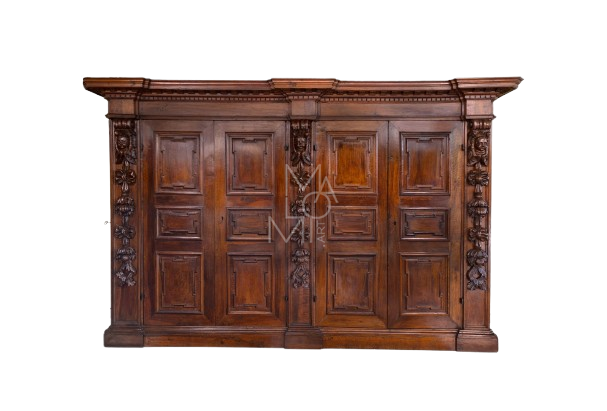
The austerity of splendor: morphology, structure, and territorial identity of lombard baroque furniture between the seventeenth and eighteenth centuries
Introduction: toward an aesthetic of the lombard baroque
In historiographical and critical discourse, the Italian Baroque is commonly associated with the plastic exuberance of papal Rome, the scenographic phantasmagoria of Venetian master carvers, or the gilded theatricality of the southern courts. Amid this landscape of intense formal dynamism, the furniture production of Lombardy stands out with an autonomous and, in certain respects, counter-current identity. Indeed, Lombard Baroque furnishings are distinguished by a peculiar interpretive synthesis, capable of declining the seventeenth-century demands for movement and chiaroscuro tensions within a framework of structural and expressive rigor deeply rooted in the territory. Where other regional schools yielded to the temptation of hyper-decorativism—dissolving the function of the object into its own ornamentation—Lombard cabinetmaking pursued an ideal of monumental composure. The objective of this essay is to demonstrate that this production does not constitute a peripheral or belated variation of Roman or French models, but rather an autonomous aesthetic expression founded upon the concepts of solidity, functionality, and a sober preciousness of the medium. Through an analysis of its geographical variants, a complex artistic landscape emerges, one capable of absorbing transalpine, Venetian, and Emilian influences, while invariably reconciling them with a principle of superior architectural equilibrium.
The historical-cultural substrate and patronage
The borromean imprint and the ethics of the counter-reformation
To comprehend the morphological genesis of seventeenth-century furniture in Lombardy, it is essential to trace the spiritual and cultural legacy of Saint Charles Borromeo and his cousin, Cardinal Federico. The rigid architectural and liturgical prescriptions dictated by the Instructiones Fabricae et Supellectilis Ecclesiasticae of 1577 were not confined to regulating sacred space; they exerted a pervasive and lasting influence over the entire artisanal production of the Duchy. The Milanese Counter-Reformation imposed a precise mandate upon the arts: absolute moral rigor, the rejection of ornamental frivolity, and a profound adherence to the structural truth of the material. In the residences of the nobility and the burgeoning mercantile bourgeoisie, furnishings were consequently not meant to translate into an ostentatious and ephemeral luxury, but rather to mirror the decorum and the economic and moral stability of the family. The pragmatic nature of the Lombard patron class found in furniture an expression of concrete permanence over time, privileging structural solidity over pomp for its own sake.
Geopolitics of the duchy: The contrast between foreign domination and courtly isolation
Unlike Savoyard Piedmont or the Republic of Venice—realities characterized by strong, indigenous courts capable of steering taste through grand ceremonial commissions—Lombardy experienced a complex transition under Spanish rule during the seventeenth century, followed at the dawn of the eighteenth century by the advent of Austrian influence. The absence of a local dynastic center inclined toward scenographic magnificence led to a fragmentation of patronage. Lombard cabinetmakers worked primarily for the great religious orders, magistrates of the nobility of the robe (nobiltà di toga), and the wealthy financial oligarchy. This political scenario favored the development of a "real" type of furniture, conceived for lived architectural interiors rather than courtly ostentation. Furnishings thus became a structural element of the domestic space, assuming proportions and volumes derived directly from contemporary civil architecture.
Technological aspects, wood species, and construction practices
The raw Material: the selection of walnut and the poetics of burls
The material of choice in Lombard carpentry is, almost exclusively, the wood of the walnut tree (Juglans regia), occasionally paired with chestnut or fir in the internal or structural components. Walnut was sought after for its intrinsic robustness, its compact finish, and its warm, dark coloration, which was ideal for enhancing the interplays of light typical of the Baroque aesthetic. Nevertheless, the true technical pinnacle of the Lombard school lies in the utilization of burls, particularly walnut and poplar burls. Local cabinetmakers understood that it was possible to impart dynamism to surfaces without resorting to complex sculptural carvings or invasive gilding. The application of thin sheets of burl veneer, with their tormented, asymmetrical, and shifting grain patterns, allowed them to animate the facades of the furniture through a natural, pictorial movement inherent to the material itself.
Geometric definition: the function of the ebanizzato molding
From a philological and constructive standpoint, the element that defines the identity of Lombard furniture between the late seventeenth and early eighteenth centuries more than any other is the presence of ebanizzato (ebonized) moldings. These consist of thin strips of hardwood (frequently pearwood or boxwood) dyed black to imitate precious and rare ebony. These elements were applied to profile drawers, delimit burl panels, and articulate the volumes of the piece. Their function was twofold: while on one hand they guaranteed structural stability to the veneering by preventing it from lifting, on the other they created a sharp chromatic contrast with the golden tone of the walnut. The black moldings acted as literal graphic vectors, capable of accentuating the geometric composition of the furniture and projecting crisp shadows, thereby heightening its tridimensionality.
The plastic expression of architectural carving
While the Roman or Genoese Baroque expressed itself through sculpture in the round—populating furniture with putti, telamones, and swollen acanthus leaves that altered its silhouette—Lombard carving maintained a strictly two-dimensional and architectural matrix. Low relief or carving applied to lateral pilasters and lesenes was decidedly preferred. During the early eighteenth century, this technique evolved into the elaboration of "swallowtail" cartouches: radial panels carved with extreme composure, extending symmetrically to enclose burl mirrors. Carving never subverted the straight line of the furniture; instead, it supported and decorated its structural points of junction.
Morphology of central furniture typologies
The chest of drawers and the genesis of the canterano
The furnishing that best embodies Lombard constructive virtues is the chest of drawers, frequently designated as a canterano in its seventeenth-century context. This piece evolved from a severe, solid, and purely parallelepiped form toward a progressive articulation of volumes. Usually structured with four drawers, the Lombard canterano features a facade articulated by lateral uprights that serve as supporting pillars. These uprights are often enriched with lesenes carved with motifs of festoons, fruits, or small cherub heads—elements that visually connected the base plinth to the upper top. The top, rigorously executed in solid walnut, displays thick, molded edges, lending the piece the detached, monumental appearance of a small domestic edifice.
The complexity of the slant-front bureau and the scarabattolo
In the course of the eighteenth century, as the requirements of private life and correspondence became more refined, the chest of drawers fused with the writing desk, giving rise to the slant-front bureau (the ribalta or bureau). This was a piece of extraordinary engineering and construction complexity. The lower section of drawers supports a recessed upper body, protected by a sloping fall-front flap which, when opened, serves as a writing surface. The true masterpiece of cabinetmaking is concealed within the scarabattolo (the internal cabinet): a dense, miniaturized architecture composed of small stacked drawers, open compartments, columns, and faux pilasters. Quite frequently, these structures hid the so-called segreti (secrets)—invisible double bottoms and compartments operated via concealed wooden levers, intended for the safekeeping of confidential documents and valuables.
The monumental wardrobe and structural tables
The Lombard wardrobe of the Baroque era represents a pinnacle of sacred and civil architectural cabinetmaking. Of ample proportions, it presents a front with two doors articulated by deep geometric panels in burl wood. The summit of the piece is crowned by a large molded cornice, at times broken or in the form of a pediment, which echoes the motifs of contemporary church facades. The feet, robust and protruding, assume a flattened onion shape or, in rare concessions to zoomorphism, the form of a lion's paw. Parallel to this, the production of tables long preserved the fratino (refectory) model or models featuring lyre-shaped (a lira) supports. The heavy walnut tops rested on lateral legs carved with large flat volutes, linked to one another by a sturdy wooden stretcher or by curved wrought-iron tie rods, uniting maximum stability with a sober and essential elegance.
Geography of style: insubria between Milan and Como
The milanese baroque and the classicism of institutions
Milan, in its capacity as the capital of the Duchy, codified the institutional style of Lombard furnishing. The production of the Milanese workshops is characterized by a rigorous submission of the furniture to the laws of symmetry and the golden ratio. The Milanese Baroque rejected eccentricity: chests of drawers maintained strictly straight and parallel sides, concentrating decorative attention exclusively on the composition of the front. The juxtaposition of blonde burls and extremely fine ebonized moldings reached an absolute level of formal cleanliness here. Even during the transition toward the mid-eighteenth-century Barocchetto, Milanese furniture did not dissolve its own structure; it limited itself to gently curving the front of the drawers, preparing the ground for that geometric perfection which, at the end of the century, would find its greatest Neoclassical interpreter in Giuseppe Maggiolini.
The comasco baroque: mechanical virtuosity and transalpine influences
Moving toward the Como area, the Baroque language underwent a profound metamorphosis. Geographical proximity to alpine passes and the constant migratory flow of artisans—the celebrated Maestri Comacini—brought local cabinetmakers into direct contact with the figurative culture of Central Europe, the Tyrol, and German-speaking lands. Comasco furniture detached itself from Milanese classicism to embrace a taste oriented toward microscopic technical complexity and visual surprise. Surfaces were decorated not by large mirrors of whole burl veneer, but by dense geometric marquetry achieved by juxtaposing contrasting local woods such as maple, yew, cherry, and olive, arranged in herringbone or cubic stellar motifs capable of generating three-dimensional optical effects. Furthermore, Como distinguished itself through the exceptional development of ironwork: locks, hinges, and plates in wrought iron or embossed bronze assumed monumental dimensions, invading the surface of the furniture with phytomorphic motifs and mascherons of a distinctly northern flavor.
The eastern provinces: the plastic contrast between Bergamo and Brescia
The bergamasco baroque: monumentality and the Fantonian influence
The territory of Bergamo, though culturally Lombard, constituted the westernmost frontier of the Republic of Venice, configuring itself as a borderland. This dual nature is reflected in a type of furniture of extraordinary material and volumetric power. The Bergamasco Baroque expresses the most muscular soul of Orobic cabinetmaking, characterized by generous thicknesses of walnut and the use of hardwoods such as chestnut and valley fir for the internal frameworks. The distinguishing feature of the Bergamasco canterano lies in the drawer panels, worked in high relief with rounded corners, commonly termed a biscotto (biscuit-shaped). These panels, veneered in very dark burls, are bound by thick, protruding black moldings that create a dramatic chiaroscuro. Upon the lateral uprights, figurative carving in high relief triumphs, populated by telamones, cariatids, and rich festoons of fruit. This pronounced aptitude for applied sculpture was directly influenced by the epic era of the Fantoni workshop of Rovetta, led by Andrea Fantoni, who knew how to transform wood into a supple material, profoundly influencing the local craft in both sacred and domestic furnishings.
The bresciano baroque: the sinuous line and the school of Rezzato
Brescia, also under the dominion of the Serenissima, chose a decorative path diametrally opposed to that of Bergamo, orienting itself toward the lightness and theatrical lightheartedness of Venice. Bresciano furniture attacks the space through the curvature of the structure itself, abandoning the flat front early on in favor of the a balestra (crossbow-shaped) or serpentine swelling. This sinuous progression required a refined technical mastery in the steam-bending of the core wood. Bresciano ornamentation rejected the sculptural heaviness of the Orobic telamones to concentrate instead on two-dimensional marquetry and slender stringing in light fruitwoods. The feet became slender brackets or cabriole supports (a capriolo) that raised the furniture from the ground, lightening its visual impact. An element of absolute significance is the constant dialogue with the prestigious school of stonecutters of Rezzato: many Bresciano chests of drawers were designed to accommodate tops in precious polychrome marbles, molded along the perimeter to faithfully follow the a balestra undulation of the wooden carcass, thereby marrying the warmth of the burl with the luster of the stone.
The southern shore: The padan influence in Cremona and Mantua
The cremonese baroque: Luthier Craft and chiaroscuro sensitivity
Cremona, nestled along the fluvial axis of the Po, felt the close cultural proximity of Emilia, particularly the Piacentino territory. Cremonese production is distinguished by an extreme attention to the executed quality of the surfaces—a phenomenon directly correlated with the contemporary golden age of local violin-making, dominated by the figures of Stradivari and the Guarneri family. Cremonese cabinetmakers transferred into furniture the same microscopic care reserved for musical instruments. Chests of drawers frequently feature broken or a ginocchio (knee-shaped) fronts, wherein the upper section juts out relative to the lower one, determining an articulated modulation of light. Inlays abandoned geometric rigidity to welcome delicate plant volutes and phytomorphic motifs in light woods like boxwood and pearwood. The finishes and varnishes, developed by exploiting the very same formulas based on natural resins employed in the luthiers' workshops, endowed the burls with a golden transparency and depth of color of an exceptional standard.
The mantovan baroque: courtly opulence and the Gonzaga legacy
Mantua represents a unique case within the Lombard artistic panorama. Despite the end of the Duchy of the Gonzagas at the beginning of the eighteenth century, the city maintained intact an atmosphere of a refined Renaissance court, transferring its thirst for magnificence into the grand Baroque furnishings destined for patrician palaces. Influenced by the splendor of Modena and Bologna, Mantovan cabinetmaking produced furniture characterized by an extraordinary plastic exuberance. Chests of drawers and slant-front bureaus present pronounced swelling and corner uprights angled at 45 degrees that protrude like literal architectural buttresses. Mantua is the only Lombard district that systematically yielded to the charm of water-gilding with pure gold leaf and lacquering, applied to emphasize the profiles of moldings, cabriole feet, and the lower aprons carved with large acanthus leaves. The monumental Mantovan bureaus, equipped with tiered upper shelves for the display of precious objects, enclose internal cabinets conceived as literal miniature theaters, complete with Solomonic columns and perspective galleries.
Conclusion: the lombard piece of furniture as a domestic monument
The comparative analysis of the diverse production districts demonstrates that the concept of "Lombard Baroque furniture" must not be understood as a monolithic stylistic corpus, but rather as a polycentric system of workshops capable of dialoguing with the different cultural influences of neighboring territories. Nevertheless, beyond the provincial variants—which see Milan devoted to rigor, Como to mechanical ingenuity, Bergamo to plastic force, Brescia to Venetian sinuosity, and the Padan area to Emilian pictorialism—there remains a common denominator that unifies the region's entire production. This cohesive element resides in the constant submission of the ornament to the logical structure of the furniture. The Lombard cabinetmaker, guided by a severe and pragmatic work ethic, knew how to welcome the demand for movement and dynamism typical of the European seventeenth century, taming it and constraining it within the boundaries of geometry and functionality. In the final analysis, Lombard furniture configures itself as a solid "domestic monument": an artifact of the highest artisanal value that never renounces its primary utilitarian purpose, elevating the composure of form and the sincere celebration of the material to an absolute aesthetic value.
Academic Bibliography
- Alberici, C. (1969). Il mobile lombardo. Milano: Görlich.
- Alberici, C. (1980). Il mobile veneto e lombardo del Seicento e del Settecento. Milano: Electa.
- Baccheschi, E. (1964). Mobili piemontesi, lombardi e veneti del Seicento. Milano: Görlich.
- Bossaglia, R. (Ed.). (1992). I Fantoni di Rovetta: ebanisti, intagliatori, scultori. Bergamo: Monumenta Bergomensia.
- Bossaglia, R., & Terraroli, V. (Eds.). (1995). Settecento bresciano: la pittura, la scultura, l'architettura, le arti applicate. Brescia: Grafo.
- Ciari, M., & de Guttry, I. (2001). Il mobile barocco in Italia: storia e stili regionali. Roma: Editori Riuniti.
- Colle, E. (2000). Il mobile barocco in Italia: arredi e decorazioni d'interni dal 1600 al 1738. Milano: Electa.
- Colombo, S. (1987). L'arte del mobile in Lombardia occidentale: ebanisti comaschi e milanesi tra Sei e Settecento. Como: New Press.
- Crippa, M. A. (1998). Le Instructiones di San Carlo Borromeo e l'artigianato artistico nel Ducato di Milano. Milano: Nuove Edizioni Duomo.
- Ferrari, V. (2004). Ebanisteria e liuteria a Cremona nel Sei e Settecento. Cremona: Camera di Commercio di Cremona.
- Levy, S. (1967). Il mobile laccato italiano. Milano: Görlich.
- Lualdi, A. (1995). Il mobile lombardo tra Barocco e Neoclassicismo. Milano: Antiquaria.
- Morazzoni, G. (1948). Il mobile barocco veneziano e lombardo. Milano: Görlich.
- Piva, R. (2011). Mobili e arredi mantovani dal Rinascimento al tramonto dei Gonzaga. Mantova: Editoriale Sometti.
- Sambonet, G. (1984). Studi sull'ebanisteria lombarda: maestranze milanesi e d'oltralpe nella Lombardia spagnola. Firenze: Centro Di.
- Schottmüller, F. (1921). Il mobile e l'abitazione del Rinascimento e del Barocco in Italia. Torino: d'Arte Illustrata.