The basilica of Santa Maria Maggiore in Bergamo: history and architecture
The Temple Reorchestrated: Architectural Stratification, Political Control, and Social Ritual in the Basilica of Santa Maria Maggiore in Bergamo
Introduction: The Civic Monument and Spatial Mutation
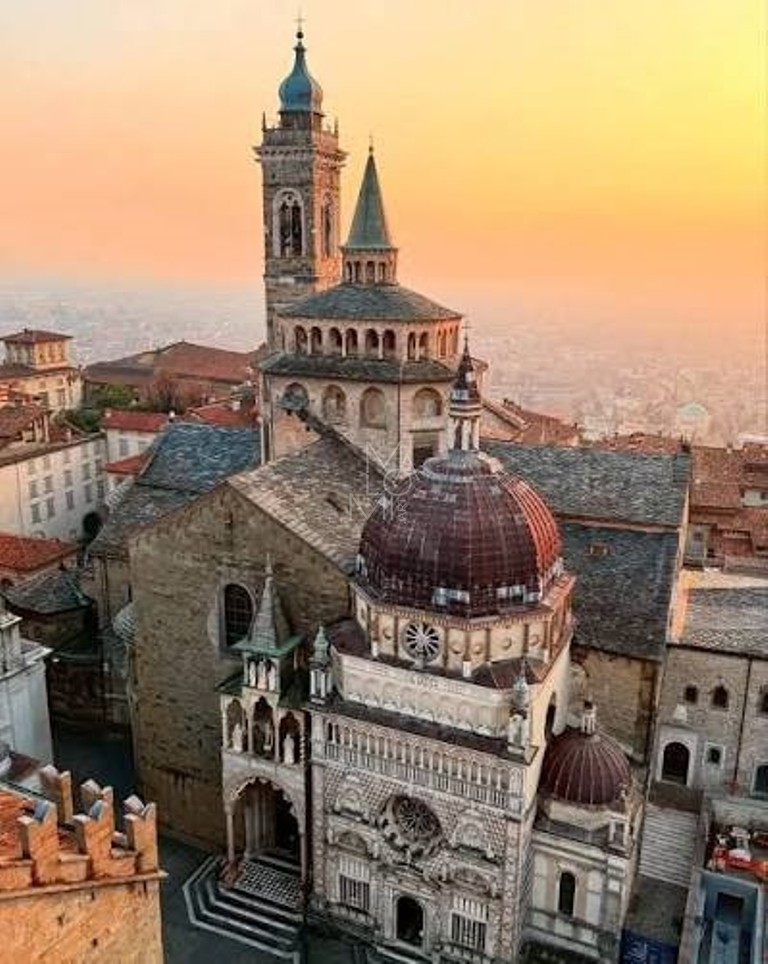
The Basilica of Santa Maria Maggiore in Bergamo stands as one of the most complex and historiographically dense examples of architectural stratification within the Lombard landscape. Although not tied to a single traditional monastic settlement, but rather configured from its origins as an ecclesia propria of the Municipality and a civic temple managed by the pious institute of the Misericordia Maggiore, the structure underwent dynamics of redesign, ornamental vestition, and liturgical reorganization that were identical to, and often more radical than, those of the great regular conventual churches of the Counter-Reformation. The monument offers an extraordinary visual contrast in which a distinctly Romanesque-Gothic external shell encloses an interior that represents a veritable explosion of gold, stuccowork, and Baroque theatricality. This metamorphosis was not a mere exercise in style; rather, it responded to precise historical and political urgencies, transforming the ancient medieval edifice into a monumental theater of faith and civic power. The architectural evolution of the monument unfolds across centuries like a palimpsest in which the requirements of popular devotion, the ambitions of the local nobility, and the control strategies of the Republic of Venice overlapped, leaving indelible marks in stone, wood, and stucco.
- The Romanesque Foundation and the Anomaly of Accesses
The origins of the fabric are rooted in the dramatic context of the twelfth century, when the construction of the basilica began, in eleven thirty-seven, as a collective vow of the Bergamasque citizenry to implore Marian protection during a devastating famine and plague that was decimating the Po Valley. Maestro Fredo designed a solid Romanesque structure on a Greek cross plan integrated into a three-nave absidal layout, crowned at the intersection of the transepts by an octagonal lantern tower. The first major architectural anomaly of the church, which would condition its entire subsequent urban evolution, lies in the total absence of a monumental western facade and a consequent central entrance portal on that side. Because that western elevation originally stood in immediate adherence to the complex of the episcopal palace, the builders were forced to invert the axis of penetration of the building, placing the entrances exclusively on the lateral flanks of the transept.
The northern flank, opening toward the Piazza del Duomo, was ennobled in the fourteenth century by Giovanni da Campione with the celebrated gate of the red lions, crafted from Verona red marble and sormounted by a monumental Gothic porch with three tiers of loggias that functioned as a monumental suspended edicule. On the opposite side, the southern flank facing the Piazza di Rosate symmetrically received the gate of the white lions, also a masterpiece of Campionese sculpture, which emphasized the role of the basilica as an urbanistic hinge between the spiritual power of the cathedral and the civil space of the upper city. This forced arrangement of the entrances created a unique internal fluidity, as worshippers did not enter along a straight line toward the altar, but instead penetrated the temple laterally, being immediately enveloped by a transversal perception of the sacred space.
- The Seventeenth-Century Fabric: The Spatial Reorchestration of Lorenzo Binago
With the advent of the seventeenth century and the necessity of adapting liturgical space to the dictates of the Council of Trent, the basilica of Bergamo became the object of an unprecedented structural metamorphosis. Unable to demolish the venerated medieval perimeter walls for reasons of civic identity and devotion, the craftsmen had to operate a profound internal restructuring that responded to the new demands of mass preaching and liturgical spectacularization. In sixteen fourteen, the direction of the works was entrusted to the Barnabite architect Francesco Maria Richini and, above all, to the geometric insights of his confrere Lorenzo Binago, a figure of the foremost importance in Lombard Counter-Reformation architecture. Binago focused his intervention on the geometric heart of the basilica, namely the intersection of the transept, where the ancient Romanesque octagonal lantern tower, heavy and poorly illuminated, was partially hollowed out and redesigned.
The Barnabite architect reinforced the central supporting pillars, transforming them into monumental Baroque piers capable of bearing a slender dome equipped with a lantern. This complex engineering operation did not merely alter the external silhouette of the monument; it radically transformed the internal illumination, as sunlight, captured from the top of the lantern, began to shower directly onto the presbytery and the high altar, creating that visual and psychological focal point explicitly demanded by Borromean instructions. An archival anecdote reveals Binago’s expertise, as he had to fight against local craftsmen who feared that the weight of the new dome would cause the underlying medieval structures to collapse; the architect responded by mathematically calculating the distribution of weights and demonstrating the stability of the work on site, while simultaneously guaranteeing that perfect acoustics required so that sermons could simultaneously reach both the popular naves and the galleries reserved for the authorities.
- The Baroque Vestition: From the Romanesque Shell to the Theater of Gold
While the structural intervention of the seventeenth century had reconfigured the volumes, the second half of the century was marked by a colossal operation of vestition and ornamental mimesi, aimed at erasing the stony severity of the medieval building to transform it into a resplendent anteroom to Heaven. Between sixteen sixty and sixteen ninety, the interior of the basilica was transformed into an immense workshop of Ticinese master stuccochias and Luganese framework-makers, guided by the artistic talent of Giovanni Angelo Sala. Every Romanesque surface was systematically clad, and the old grey stone pillars were encased in complex corner structures enriched with pilasters, Corinthian capitals, and monumental telamons in white and gold stucco. The soffits and vaults were covered by a dense decorative mesh based on putti, garlands of flowers, fruits, and acanthus leaves, eliminating any remaining flat surface and generating a continuous undulating motion that captured the light of the candles.
This plastic envelope was integrated by the open skies painted by the Milanese painter Stefano Maria Legnani, known as Il Legnanino, who frescoed the vault of the transept with apocalyptic visions and Marian triumphs. His figures, captured in daring perspective foreshortenings and floating in an artificial golden light, annulled the physical perception of the masonry roofs, translating into painting the mystical vertigo typical of the mature Baroque. An archival detail bears witness to the obsession for ornamental detail that dominated the commission of the Misericordia Maggiore: the master gilders utilized thousands of paper-thin leaves of pure gold, purchased thanks to the donations of local merchants, and the accounting ledgers meticulously record even the expense for the purchase of egg white, used as a natural binder to fix the gold to the stucco, a technical expedient that has allowed the gilding to maintain its original brilliance intact through the centuries.
- Applied Arts and Functional Space: The Great Tapestries and Wooden Furnishings
The Baroque redesign of Santa Maria Maggiore did not limit itself to the masonry and stuccowork, but involved the entire liturgical and functional furnishings, conceived as an integral part of a single total work of art (Gesamtkunstwerk). To mitigate the austerity of the walls that remained devoid of frescoes and, at the same time, to thermally isolate the sacred space from the rigid winter drafts of the upper city, the regents of the Misericordia Maggiore commissioned a monumental cycle of seventeenth-century tapestries from the most prestigious Flemish and Florentine manufactories. These imposing hangings, depicting stories of the life of the Virgin and scenes from the Old Testament, were hung along the pillars and lateral naves, transforming the basilica into a luxurious textile gallery capable of dampening acoustic reverberation during major sermons.
Simultaneously, the interior space was redefined by masterpieces of wood carving executed by the sculptor Andrea Fantoni and his celebrated workshop. Fantoni conceived the great Baroque confessionals and the details of the choir as dynamic micro-architectures, where the walnut and boxwood were carved until they assumed the fluidity of fabric, populating the risers with weeping angels, telamons, and foliated volutes that dialogued directly with the stuccowork of the vaults above. In the papers of the Fantoni workshop, one discovers a curiosity related to the choice of materials: the sculptor personally selected the walnut trunks in the woods of the Val Seriana, demanding that the wood be seasoned for over seven years in the shade of the belfries to guarantee its absolute immunity from woodworms and cracking, thus permitting the execution of those microscopic carvings that even today simulate the softness of human skin and the robes of the saints.
- Renaissance Marquetry and Baroque Mimesis: An Anecdote of Forced Coexistence
The seventeenth-century evolution of Santa Maria Maggiore, however, raised complex problems of conservation and artistic coexistence, since the basilica guarded one of the most precious treasures of the Lombard Renaissance, namely the extraordinary wooden intarsias of the choir, designed by Lorenzo Lotto between fifteen twenty-four and fifteen thirty-two and carved with expertise by Giovan Francesco Capoferri. When the Baroque master builders initiated the total decorative transformation of the presbytery area, the integrity of these delicate works faced serious danger due to construction dust and structural alterations. A curious archival anecdote reveals the pragmatic foresight of the regents of the Misericordia Maggiore, who, in order to preserve Lotto’s marquetry without renouncing the Baroque pomp demanded by new ecclesiastical fashions, designed an ingenious system of mobile protective panelling in oak wood.
During the long months of stuccoing and gilding the vaults above, the precious Renaissance stalls were entirely encased and shielded from the surrounding environment. Furthermore, when it came to redefining the visual layout of the choir, the seventeenth-century cabinetmakers decided not to destroy the preexisting sixteenth-century frames, but to integrate them within a monumental Baroque casing enriched with mirrors and gilded carvings, achieving a rare and successful example of respect and museographical mimesi ante litteram, where the Lottesque Renaissance was literally set like an antique jewel inside the new and overwhelming Baroque scenery, demonstrating that seventeenth-century modernity knew how to dialogue with the past when the latter represented the summit of civic identity.
- The Socio-Political Context of a Frontier City: Bergamo in the Baroque Seventeenth Century
To understand the monumental evolution and opulenza of the Basilica of Santa Maria Maggiore in the seventeenth century, it is indispensable to situate the city of Bergamo within the geopolitical dynamics of Baroque Europe. Separated from the State of Milan by the course of the Adda River, Bergamo constituted the westernmost extremity of the Republic of Venice, a frontier outpost wedged into the dominions of the Catholic Monarchy of the Spanish Habsburgs. This position of "middle ground" conferred a double identity upon the city, since while on the political and military level it depended on the decrees of the Venetian Senate and the vigilance of the rectors sent by San Marco, on the cultural and spiritual level the attraction toward the model of Borromean Milan remained extremely powerful. The Bergamasque nobility thus found themselves constantly negotiating their loyalty to Venice with the desire to emulate the pageantry, fashions, and Counter-Reformation severity of the Spanish court of Milan. The Bergamasque Baroque became the mirror of this tension, configuring itself as an ostentatious language utilized by local oligarchies to legitimize their rank both in the face of the Venetian rulers and toward their powerful Milanese neighbors.
The seventeenth century in Bergamo was a period marked by profound social fractures and collective dramas that rewrote the demographic framework of the city. The first half of the century was dominated by violent feuds between the great aristocratic families of the upper city, such as the Suardi, the Colleoni, the Terzi, and the d'Alzano, who vied for control of municipal magistracies and charitable institutions. These tensions were abruptly frozen by the catastrophic plague of sixteen thirty, which mowed down nearly half of the city's population, disarticulating the manufacturing system linked to the production of woolen cloths and silk. From the trauma of the epidemic emerged a more compact and deeply clericalized oligarchy, which identified religion and the control of pious institutions as the principal instrument for the maintenance of public order and social pacification. The religious orders, and in particular the great lay confraternities, became the mediators of this new stability, channeling the wealth accumulated by the surviving noble families toward the sacred reconstruction of the city, the highest expression of which was precisely the fabric of the civic basilica.
- The Temple of the People: The Social and Anthropological Significance of the Basilica from Colleoni to the Napoleonic Era
The bond between the people of Bergamo and the Basilica of Santa Maria Maggiore possesses a unique anthropological density, as the building was never perceived as a space of episcopal power, but rather as the material and spiritual home of the entire community. This sense of collective ownership was severely tested in fourteen sixty-two by an event that left a deep wound in the city's memory, when the celebrated condottiero Bartolomeo Colleoni, captain general of Venice and a man of immense power, decided to build his private mausoleum by forcibly demolishing the northern minor apse of the basilica. The erection of the Colleoni Chapel represented an act of violent feudal prevarication, in which a single individual mutilated the civic temple of the people to celebrate his own dynastic glory. The reaction of the people and of the regents of the Misericordia Maggiore unfolded over the following decades through a form of cultural resistance; if the condottiero had imposed the immortality of his flesh on the exterior of the church, the people would respond by transforming the interior of Santa Maria Maggiore into a space so sfarzoso as to eclipse the albeit splendid Colleoni tomb, reaffirming the supremacy of collective devotion over the pride of the individual soldier.
During the Baroque era, the significance of the basilica for the Bergamasque people went far beyond simple liturgical attendance. Managed entirely by laymen through the Consortium of the Misericordia Maggiore, Santa Maria Maggiore was the hub of a total welfare system. In an era devoid of state social buffers, citizens knew that the basilica was the place where dowries were distributed for poor girls, subsidies were organized for bankrupt artisans, and stores of grain and wood were accumulated during famines. The great Baroque celebrations, such as the Forty Hours' Devotion or the ostensions of relics, were total popular festivals in which class barriers were temporarily suspended under the mantle of the Virgin. The people actively participated in the golden vestition of the church, not only admiring the works of the great master stuccochias, but financing the works with microscopic but unceasing micro-donations. Beautifying Santa Maria Maggiore meant for the cobbler, the weaver, and the porter of the upper city elevating their own social condition, making their common home more splendid than the private palaces of the nobles.
This visceral bond had to face its most dramatic crisis in the late eighteenth century, when the winds of the Enlightenment and the reforms of Emperor Joseph II of Austria, which although governing Milan influenced the policies of neighboring Venice, began to threaten the autonomy of ecclesiastical entities. The definitive blow arrived, however, with the fall of the Republic of Venice and the establishment of the Cisalpine Republic under the control of the Napoleonic armies in seventeen ninety-seven. The French decrees of suppression dismantled almost all of the Bergamasque convents, confiscating their assets and dispersing their artistic heritages. Even in this dramatic transition, the people of Bergamo rallied around their basilica, and the foundation of the Misericordia Maggiore, thanks to its laic and eminently civic legal nature, succeeded in defending Santa Maria Maggiore from total state confiscation. Despite the loss of part of its historic capital and the end of the Ancien Régime, the basilica traversed the Napoleonic storm transformed but intact in its essence, confirming itself in the consciousness of nineteenth-century Bergamasques no longer as the stage of Baroque pageantry, but as the inseparable bulwark of the identity, memory, and resilience of an entire people.
- The Liturgy of Power: The Political Role of Venice in the Regulation of Baroque Processions
While Bergamasque Baroque spirituality looked to Milan for devotional models, the management of public space and the staging of power remained under the iron control of the Republic of Venice. For the Serenissima, religion and its external manifestations were not merely matters of faith, but formidable instruments of social disciplining and political legitimization. The great urban processions that wound through the tortuous streets of the upper city, converging toward the monumental pole of Santa Maria Maggiore, were planned in agreement with the Venetian rectors, namely the Podestà and the Captain, who decreed their hierarchical order, routes, and even the ephemeral apparatus. In solemn ceremonies, such as the feast of Corpus Domini or the feast day of San Marco, the procession was transformed into a veritable visual map of the constituted power. The cortege was not led by the clergy, but rather by the Venetian civil magistracies; the rectors proceeded in robes of scarlet velvet and patrician toghe, escorted by the soldiers of the garrison and followed, in strict order of rank, by the members of the municipal Major Council, by the representatives of the trade guilds, and only finally by the religious orders. This sacred choreography served to reiterate a fundamental political truth to the people, demonstrating that the social and economic order guaranteed by the Lion of San Marco was a direct emanation of divine will, and obedience to the Republic was inseparably fused with Catholic orthodoxy.
Baroque ritual in Bergamo, however, moved along a tightrope, since the spectacularization of worship constantly risked turning into a stage for familial feuds or for the autonomist drives of the local nobility. Aware of this danger, Venice exercised police surveillance over the Forty Hours and extraordinary processions. The laws of the Venetian Senate strictly forbade the carrying of weapons, even hidden ones, under penitential robes and punished with immediate exile anyone who broke the sacredness of the procession with cries or gestures of defiance. A celebrated archival anecdote from the seventeenth century, preserved in the dispatches that the rectors regularly sent to Venice, describes a dispute that broke out on the church square of Santa Maria Maggiore during the Good Friday procession. Two factions of the Bergamasque nobility, the Suardi and the Colleoni, entered into a violent verbal altercation to establish which of the two families had the right of precedence in holding the cords of the sacred canopy. The Venetian Podestà, discerning the risk of a bloodbath that would set the upper city on fire, intervened militarily with his schiavoni, the Dalmatian mercenary soldiers loyal to Venice. He not only seized the canopy, entrusting it provisionally to the lay members of the Consortium of the Misericordia Maggiore, but forced the heads of the two factions to march side by side, disarmed and under close escort, for the entire urban route. The episode demonstrated in a plastic way how the Republic knew how to bend Baroque liturgy to the demands of its own ragion di Stato, transforming a potential feudal tumult into a public submission to the authority of San Marco that extinguished at birth any temptation of aristocratic rebellion.
- Academic Bibliography and Historiographical Pathways
The study of the architectural evolution and socio-political role of the Basilica of Santa Maria Maggiore in Bergamo requires a multidisciplinary approach capable of establishing a dialogue between art history and the institutional history of Ancien Régime republics. In the twentieth-century historiographical tradition, the analysis of medieval masonry structures and their subsequent Baroque metamorphoses found a methodological turning point in the works of scholars who knew how to interpret the sacred fabric as a living political document. The consultation of archival sources kept at the foundation of the Misericordia Maggiore and the State Archives of Bergamo has allowed for the decoding of the complex dynamics of lay patronage that removed the basilica from the direct dependence of episcopal power, transforming it into the identity monument of the Bergamasque people and the stage for the choreographic strategies of the Republic of Venice. For a systematic study path according to the formal rules of the Chicago Manual of Style, the fundamental texts that traced the guidelines of this research are indicated below:
- Angelini, Luigi. Santa Maria Maggiore in Bergamo. Bergamo: Istituto italiano d'arti grafiche, 1959. A pioneering and indispensable volume for the analysis of architectural surveys and for the visual reconstruction of the transition from Maestro Fredo's Romanesque core to the Baroque insertions.
- Belotti, Bortolo. Storia di Bergamo e dei bergamaschi. Vol. 4, Il Seicento e il Settecento. Bergamo: Bolis, 1989. Belotti's monumental work constitutes the foundational historical framework for understanding the socio-political context of Bergamo as a Venetian frontier land close to the Spanish State of Milan.
- Binago, Lorenzo. L'architettura religiosa della Controriforma in Lombardia. Edited by Stefano Della Torre. Milano: FrancoAngeli, 1992. An essential critical essay for mapping the activity of the Barnabite architect Lorenzo Binago and understanding the geometric redesign of the seventeenth-century dome of the basilica.
- Fiaschini, Fabrizio. "Cultura e religione nella Milano del Seicento: le metamorfosi della tradizione 'borromaica' nel secolo barocco." In Studia Borromaica: saggi e documenti di storia religiosa e civile della prima età moderna, 13:121–145. Milano: Vita e Pensiero, 2001. A fundamental theoretical contribution for deciphering how the Borromean precepts on visual persuasion and mass control crossed the Adda River, influencing the Bergamasque building works.
- Meli, Angelo. Le tarsie di Lorenzo Lotto in Santa Maria Maggiore a Bergamo. Bergamo: Congregazione della Misericordia Maggiore, 1962. An archival monographic study centered on the protection and the ingenious system of Baroque panelling that saved Lotto's choir from the dust of the seventeenth-century works.
- Venturi, Franco. Settecento riformatore: l'Italia dei lumi, 1764-1790. La Lombardia delle riforme. Vol. 5, tomo 1. Torino: Einaudi, 1987. The milestone for the study of Josephinism and the crisis of traditional pious institutions, useful for understanding the impact of Napoleonic decrees on the secularization of the foundation of the Misericordia Maggiore at the end of the eighteenth century.
- Zarri, Gabriella. Recinti sacri: siti e storie di monasteri femminili in Italia tra Rinascimento e Controriforma. Roma: Viella, 2000. A reference methodological text for the study of tensions and dynamics related to enclosure and social disciplining in the Baroque Po Valley area.