The balmetti of Borgofranco d’Ivrea: an anthropic and geophysical study of vernacolar architecture
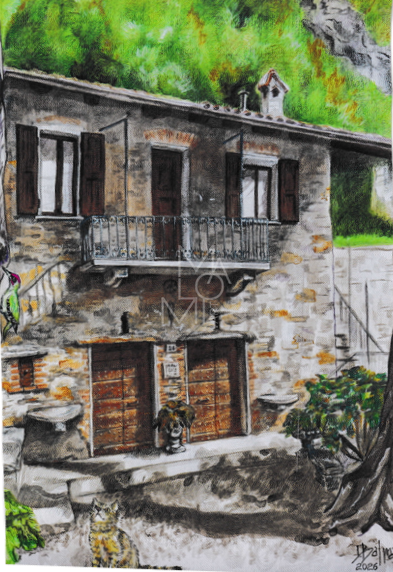
The balmetti of Borgofranco d’Ivrea
represent an extraordinary example of sustainable vernacular architecture integration within the Ivrea Morainic Amphitheater. This complex of over two hundred rock-hewn cellars utilizes the òre—constant subsurface thermodynamic airflows (7-8 °C) descending from the Mombarone fractured micaschist slopes. Originating in the 17th century as a functional response to valley flooding, the site expanded during the 19th-century industrial revolution to host the De Giacomi brewery and thermal tourism. Throughout the early 20th century, it served as a key logistical stronghold for anti-fascist partisan resistance, evolving into a living monument of community resilience, geoclimatic engineering, and cultural heritage.
The architecture of the wind: an anthropic and geophysical study of the balmetti of Borgofranco d’Ivrea
Introduction
Within the framework of spontaneous architecture and anthropic strategies for environmental adaptation, the balmetti of Borgofranco d’Ivrea represent a scientific and cultural unicum of extraordinary interest. Located in the Ivrea Morainic Amphitheater, along the ancient route of the Via Francigena, this complex of over two hundred hypogean and sub-divided cellars demonstrates a flawless synthesis of glacial morphology and rural ingenuity. This essay aims to analyze the balmetti from a geological, architectural, and socio-anthropological perspective, highlighting how a microclimatic anomaly structured the material and immaterial fabric of the local community, evolving over centuries from mere subsistence storehouses into hubs of socialization and even strategic strongholds during the darkest moments of twentieth-century history.
Geological genesis and the thermodynamic mechanism of the òre
The breath of the Mombarone massif
The scientific foundation of the balmetti lies in the Quaternary evolution of the Dora Baltea river basin. During the last glaciation, known as the Würm, the massive Balteo Glacier sculpted the slopes of the Mombarone massif, leaving behind roche moutonnée structures and imposing piles of unstable morainic debris. The subsequent retreat of the glacial mass triggered complex macro-structural decompression phenomena. Relieved from the immense weight of the ice, the mountain underwent a form of geological relaxation that generated a dense network of diaclases, joints, and deep underground cavities. It is within this subterranean labyrinth that the phenomenon of the òre is generated—a dialectal term derived from the Latin aura, signifying a breeze or a breath of air.
The thermodynamic mechanism governing this phenomenon is regulated by the thermal and barometric gradient established between the heart of the mountain and the outside atmosphere. During the summer regime, the warmer, lighter outdoor air tends to ascend through the natural chimneys on the upper slopes of the rocky relief. This ascent creates a low-pressure draft that draws out the cool air stored within the bowels of the mountain, which escapes at the base through rock fissures at a constant temperature of approximately seven to eight degrees Celsius. Conversely, during the winter regime, the cycle tends to stabilize or partially invert, mitigating the harsh temperatures of the Canavese region and preventing the internal chambers from freezing. This continuous airflow guarantees not only seasonal homeothermy but also perfect hygrometric control, converting the natural cavities into genuine zero-energy refrigerators.
The mineral purity of the rock filter
The stability and purity of the air emitted by the òre are by no means accidental, but derive directly from the chemical-physical and lithological composition of the rocky substrate. The Mombarone massif belongs to the complex Ivrea-Verbano Zone, a geological unit predominantly composed of high-pressure metamorphic rocks and deep igneous rocks, including micaschists, gneisses, and eclogites. Unlike limestone or gypsiferous karst complexes, where water and air interact with soluble carbonatic rocks—releasing a musty odor or decomposition gases—the rocks of the balmetti are silicatic and chemically inert. The prevalence of quartz and feldspars prevents gaseous contamination resulting from chemical degradation, while the total absence of sulfurous emissions keeps the atmosphere of the cellars completely odorless, a factor that would prove essential for oenological refinement.
The escaping air completes a subterranean journey of several kilometers through a dense cobweb of micrometric fissures. The landslide debris acts as a gigantic mechanical filter of progressive density. Furthermore, the micaschists are rich in platy minerals such as biotite and muscovite, whose cleavage planes possess natural micro-electrical charges capable of retaining, through physical adsorption, micro-dust, pollen, and suspended organic particles. This mechanical purification is coupled with the marked acidity of the soil, typical of terrains derived from silicatic parent rocks. This chemically acidic environment, combined with the constant low temperature, creates a highly hostile habitat for the proliferation of harmful fungal spores and bacteria. The air entering the balmetti is therefore microscopically purified and sterile, providing an ideal airflow for food preservation.
Historical development and the encounter with industrialization
Seventeenth-century origins and the eighteenth-century land registry
Although viticulture in the hamlet of Biò and across the Eporediese area is documented since the twelfth century, the earliest written records of a systematic and structured use of the balmetti date back to the seventeenth century. Due to the alluvial and unstable nature of the Borgofranco valley floor, which was regularly affected by the meandering of the Dora Baltea, constructing underground domestic cellars was complex and unhealthy, as the rooms routinely flooded, compromising food reserves. The community therefore chose to relocate their storage facilities to the northern rocky belt. In this era of political instability and troop movements within the Duchy of Savoy, the balmetto had a purely utilitarian subsistence function, configuring itself as a fortified vault where peasants defended their wine and cheeses.
The eighteenth century brought greater political stability under the Kingdom of Sardinia and the launch of the first major Savoyard land registry reforms. The balmetti ceased to be perceived as precarious shelters or wild caves and officially entered the property registers of local families. The facade walls were regularized, and ownership of a balmetto became a cornerstone of family heritage, passed down from generation to generation. In parallel, the specialization of viticulture on morainic terraces—characterized by typical pergolas known as topion—experienced a significant qualitative boost. The balmetto was definitively designated as a temple of wine, and Canavese winegrowers empirically refined the management of the air vents to guide the aging of local grape varieties such as Nebbiolo and Erbaluce.
The industrial epic of the De Giacomi brewery
A chapter of extraordinary historical and industrial importance opened in 1862 with the arrival of the De Giacomi family in Borgofranco d’Ivrea. Originally from Valchiavenna, a Lombard territory famous for its crotti—which constitute the geological analogues of the Piedmontese balmetti—the De Giacomi brothers immediately recognized the potential of the Canavese cryosphere. They decided to establish the Fabbrica di birra Borgofranco (Borgofranco Brewery), building an imposing industrial plant adjacent to the row of balmetti. This proximity allowed them to channel the cool air currents of the òre directly into the massive storage and maturation warehouses of the brewery.
Before the Great War, the facility produced over twenty thousand hectoliters of beer annually, marking the transition from an economy of pure subsistence to a proto-industrial district closely integrated with the natural ecosystem. The introduction of brewery capitalism disrupted the old socio-cultural balance of the town. Many farmhands and winegrowers were absorbed as salaried factory workers, blending the rhythms of the earth with those of the production line. A curious local legend tells that the workers tasked with moving the beer barrels used the balmetti not only for labor but also as a place for minor distractions and cold-endurance challenges, consolidating an indissoluble link between the industrial archeology of the complex and the daily life of the village.
Vernacular engineering and architectural morphology
The fluid dynamics of the foghét
The efficacy of the balmetti does not rely solely on the fortuitous presence of geological fractures, but on the refined capturing system developed by local craftsmen over the centuries. Building a balmetto required adherence to precise rules of vernacular engineering necessary to govern the airflow. Craftsmen regularized the rock face using manual splitting methods, leaving the rear wall in bare stone and unplastered to facilitate moisture breathability and maximize radiant thermal exchange. The heart of this system is represented by the intake vents, locally called foghét. These short horizontal channels were built into the thickness of the dry-stone masonry that sealed the broader rocky cavities, featuring rectangular sections lined with smooth gneiss slabs to reduce air friction.
Since the airflow is continuous, uncontrolled intake during the winter risked excessively lowering internal temperatures, while in summer it could generate undesirable turbulent convective motions. For this reason, mechanical flow control devices were integrated, such as guillotine valves consisting of wooden or iron frames inside of which slid a stone slab (losa). In months of complete inactivity, secondary fissures were sealed with a damp mixture of clay and straw, which could be easily removed when necessary. Furthermore, many ducts were built with a slightly converging section toward the interior to exploit the Venturi effect, increasing the velocity of the air intake for a given flow rate. On the opposite wall or near the vault, small extraction chimneys were carved out, expelling stale air and excess moisture in a continuous and laminar fashion, stabilizing the relative humidity around seventy to eighty percent.
Spatial articulation and facade aesthetics
The architecture of the balmetti stands as an admirable example of spontaneous building. The structures do not follow a preordained urban plan but lean against one another for about five hundred meters along the pedemontane road, following the sinuous contour of the rock. Typological analysis reveals a constant spatial articulation divided into multiple levels. The hypogean floor, or the balmetto proper, constitutes the most intimate and protected environment, characterized by the presence of the foghét and dedicated to the aging of products. Above this chamber lies the upper floor, antechamber-like structures built of load-bearing masonry covered by a gabled roof with timber framing and a cladding of local stone tiles (lose) or Canavese clay tiles. This upper level typically houses a fireplace or a putagè, the classic cast-iron stove, transforming the storeroom into a rural social space.
Finally, the outdoor area is bounded by simple wrought-iron or wooden gates, often shaded by grape pergolas that mitigate summer solar radiation on the facade. Over the course of the nineteenth century, the aesthetic appearance of these facades underwent a major evolution. Owners began to embellish the exterior prospects with colored plaster and frescoes depicting rustic scenes, dionysian allegories, or portraits of historical figures. Alongside the paintings, popular mottoes in Piedmontese or Latin maxims appeared, celebrating friendship and good wine, demonstrating that the structure was no longer perceived as a mere agricultural outbuilding, but as a showcase of the family’s prestige and hospitality.
The socio-cultural and anthropological dimension
Horizontal sociability and nineteenth-century thermal tourism
During the nineteenth century, the balmetto assumed an extraordinary value of democracy and social cohesion. While the urban fabric of the town reflected the rigid class hierarchies of the era, the row of balmetti presented itself as a thoroughly horizontal and egalitarian meeting space. Over a glass of wine, winegrowers agreed on grape prices, exchanged labor for the harvest, and managed minor community conflicts outside official institutional channels. It was within this atmosphere that the use of a goliardic toponymy became established, naming the alleys of the complex with evocative names such as Via del Buonumore (Good Humor Way), Vico di Bacco (Bacchus Alley), or Via della Coppa (Cup Way)—a clear attempt by popular culture to sacralize the space of leisure time in contrast to the harshness of daily toil in the fields or factories.
Toward the end of the century, the discovery and promotion of the mineral springs of Biò integrated Borgofranco into the circuit of elite thermal tourism. The establishment of the hydrotherapeutic facility attracted a transient population of physicians, scientists, aristocrats, and members of the wealthy bourgeoisie from Turin and Milan. This elite tourism generated a fruitful cultural shock. The holidaymakers, who had arrived to be treated by the mineral-rich waters, discovered an exotic and picturesque attraction in the balmetti. Thus was born a rich culinary tradition tied to visits to the cellars, where city gentlemen were invited to taste potato salami, alpine cheeses, and the typical ciambella of Borgofranco—a dry ring-cake meant to be dunked in passito wine directly within the cool hypogean rooms.
Gaseous isolation from the mines of Biò
The proximity of the balmetti to the mining district of Biò—where silver, lead, and especially native arsenic were extracted—raised questions regarding air safety for a long time. The mineralized veins of the deep tunnels featured a complex association of sulfides and sulfosalts, including freibergite and arsenolite, a highly toxic alteration product. Despite this proximity, the air of the balmetti remained uncontaminated thanks to a strict geological compartmentalization and an acute anthropic awareness. The mineral veins were hosted within the deep, compact rocky core, isolated by faults that confined the hydrotermal circulation. The system of the balmetti, on the other hand, developed exclusively within the superficial belt of macro-clastic landslide debris.
The two circulatory systems were separated by massive curtains of healthy metamorphic rock that acted as natural sealing barriers. Moreover, the air of the òre was not a gaseous emanation from the depths, but external atmospheric air that entered from the top of the mountain and percolated through the debris, maintaining a dynamic, constantly washed circuit. During the period of peak mining activity in the nineteenth century, the community imposed strict advancement limits on mining excavations. The tunnels were driven in a north-easterly direction, deliberately moving away from the vertical axis of the balmetti, and the water inflows inside the mines were channeled toward the lower valley floor of the Dora Baltea, preventing arsenic-rich solutions from polluting the condensation zones that fed the cryosphere of the cellars.
The twentieth century and the balmetti as a stronghold of freedom
Working-class leisure and oral culture
The twentieth century opened under the sign of a profound political and social maturation of the Canavese working classes. In the first thirty years of the century, the Borgofranco Brewery reached its commercial peak before yielding to competition from major national industrial groups, but it left behind a highly cohesive and unionized social fabric. Between the two world wars, the balmetto definitively consolidated its role as the favorite site for working-class leisure. On weekends, families moved en masse to the cellars along the pedemontane road, where they cooked polenta and shared the products of the land in a dimension of authentic conviviality.
This widespread attendance represented a popular, self-managed response to the need for recreation, often standing in direct opposition to the official recreational structures imposed by the fascist regime. Within the balmetti, a rich heritage of oral culture developed, consisting of folk songs, hunting tales, and local legends, such as that of the ghost of the old master brewer who was said to wander among the rocks on nights of strong wind to check that the òre were blowing with the correct intensity. The balmetto thus became a custodian of collective memory, a place where community identity could be expressed freely outside institutional social control.
The logistical role in the partisan struggle
During the Second World War, the geological conformation and terraced layout of the balmetti proved to be strategically crucial for the partisan formations of the 76th Garibaldi Brigade and the 6th Giustizia e Libertà Division. Situated in a commanding position over the state highway and the railway line leading to the Aosta Valley, the cellars and deep rocky recesses were transformed into clandestine depots for weapons, ammunition, and propaganda material, as well as safe havens during Nazi-Fascist roundups.
The diaries and oral testimonies of the partisans, including the accounts of Commander Luigi Viano (known by the battle name Bellandy) and Commander Mario Pelizzari (Alimiro), describe the balmetti as vital logistical hubs. The absence of thermal fluctuations was ideal for preserving light weapons and plastic explosives—stolen from railway convoys—from moisture and rust. The civilian population protected this secret with an impenetrable silence, providing food and medical assistance to wounded young rebels who found a makeshift infirmary inside the cellars, protected by the pure air of the mountain. This collective solidarity culminated in the support given during the strategic withdrawal phases that followed the famous sabotage of the railway bridge over the Dora Baltea in Ivrea on Christmas Eve, 1944—an epic action that saved the city from Allied bombings and saw many combatants find salvation among the protective shadows of the balmetti.
Conclusions
In conclusion, the balmetti of Borgofranco d’Ivrea tangibly demonstrate that vernacular architecture is not the result of formal fortuity or simple peasant improvisation, but the outcome of a profound, continuous, and centuries-old empirical codification of the territory. By intercepting Würmian diaclases and regularizing the air currents of the òre, local builders transformed a geophysical and hydrogeological constraint into an extraordinary economic, social, and cultural resource. From a seventeenth-century subsistence storehouse to an engine of industrialization in the nineteenth century, and finally to a bastion of solidarity and freedom during the Resistance, this complex has traversed Italian history while keeping its identity intact. Today, the preservation and enhancement of the balmetti stand not only as a duty of monumental preservation, but as a crucial piece for understanding historical strategies of energy resilience and for conserving the anthropological memory of the entire Canavese area.
If you wish, we can further expand this research into specific comparative studies with other Alpine hypogean structures or analyze the preservation policies currently implemented by the Ecomuseum.