History of Murano glass: from medieval origins to 20th-century design
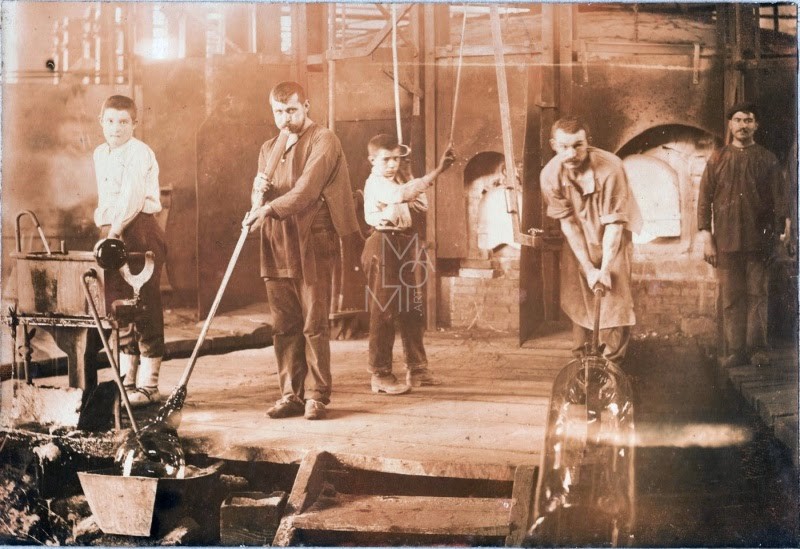
A comprehensive academic essay exploring the history of Murano glassmaking, from its early medieval roots and the state-enforced relocation of 1291 to the avant-garde design revolution of the 20th century. This work provides an interdisciplinary analysis combining socio-economic evolution, the Venetian Republic's industrial secrecy, chemical breakthroughs (such as the invention of cristallo and lattimo), and landmark artistic collaborations (Carlo Scarpa, Venini, Picasso). Complete with a detailed technical glossary and an APA-formatted reference bibliography.
The Art of Fire and the Lagoon: A Social, Chemical, and Economic History of Murano Glass (English Version)
Methodological Note and Archival Sources
The historiographical reconstruction of Murano glassmaking relies upon a profoundly rich documentary corpus, preserved primarily at the State Archives of Venice (Archivio di Stato di Venezia) and the Historical Archives of the Municipality of Murano (Archivio Storico del Comune di Murano). Among the primary sources of greatest significance are the registers of the Mariegole (the guild matriculations), the decrees of the Great Council (Maggior Consiglio) and the Council of Ten (Consiglio dei Dieci), and the island’s podestaic records. For the contemporary era, this study draws upon the historical archives of the historic furnaces—most notably the Venini fund and the Barovier & Toso archive—as well as the official catalogues of the Venice Art Biennales. The intersection of legal-administrative documentation with lagoon archaeological excavation data has allowed scholarship to transcend the mythographic dimension of tradition, revealing instead the history of an industrial district governed by rigid economic rationale and state-controlled chemical secrets.
Abstract
This essay offers a comprehensive historical, socio-economic, and chemo-technological analysis of the Murano glassmaking district from its medieval origins to the late twentieth century. By examining Venetian archival sources, this study maps the island's evolution from a state-segregated manufacturing hub in 1291 to an international center for modern design during the twentieth century. The paper investigates pivotal technological turning points—ranging from Angelo Barovier’s fifteenth-century invention of vetro cristallo to the avant-garde experiments of Carlo Scarpa and the international Studio Glass movement—highlighting the complex dialectic between the rigid protection of industrial secrets and bold formal innovation. Finally, it analyzes the chemical evolution of glass batches, demonstrating that Murano’s historical resilience lies in its unique capacity to translate a millennia-old artisanal expertise into contemporary design lexicons.
Keywords: Murano Glass, Economic History, Cristallo, Carlo Scarpa, Materials Technology, Venetian Republic.
Introduction
The history of Murano glass represents one of the most compelling chapters of artistic craftsmanship and European economic history. Born from the intersection of Eastern technical expertise and Venetian commercial enterprise, this tradition developed over centuries into a perfect ecosystem of art, industrial secrecy, and diplomacy. The island of Murano was not merely a site of production, but a veritable avant la lettre industrial district, capable of protecting its intellectual property while constantly reinventing itself to meet the shifting demands of international luxury markets. An analysis of its evolution reveals how a humble raw material, sand, was transformed into a global symbol of prestige and refinement.
Chapter I: Origins and the Coerced Relocation (5th–13th Century)
Early medieval roots and Byzantine influence
The origins of glassmaking in the Venetian lagoon are rooted in the Early Middle Ages, with archaeological evidence dating back to the 7th and 8th centuries, particularly on the islands of Torcello and Malamocco. Local artisans acquired foundational techniques through commercial contacts with the Byzantine Empire and the Near East, where Roman glassmaking arts had survived and evolved. Venice quickly established itself as a hub for the trade and refinement of these skills, leveraging its strategic geographical position and mercantile fleet. Initially, production focused on utilitarian domestic wares and mosaic tesserae destined for the decoration of major basilicas, such as St. Mark’s.
The decree of 1291 and the birth of the Muranese district
The decisive turning point for Venetian glass occurred at the end of the 13th century. In 1291, the Republic of Venice issued a formal decree ordering the relocation of all active glass furnaces from the historic center of the city to the island of Murano. This political and economic decision was driven by two main factors. The first was public safety: the continuous fires from the furnaces posed a constant threat to Venetian housing, which was predominantly constructed of wood at the time. The second, more strategic reason was the need to isolate and monitor the artisans, thereby preventing the leakage of technical knowledge and manufacturing secrets beyond the borders of the State.
Chapter II: The Golden Age and the Invention of Cristallo (14th–16th Century)
The guild system and the status of master glassmakers
With the concentration of activities on Murano, the glassmaking art established a rigid, protected organizational structure governed by the Mariegola, the constitution of the glassmakers' guild. The masters of Murano enjoyed an exceptional social and economic status within Venetian society. They were granted unique privileges, including the right for their daughters to marry into the patrician nobility without their offspring losing noble status. In exchange for this prestige, the Republic imposed severe restrictions: glassmakers were strictly forbidden from leaving Venice to take their skills abroad, under penalty of property confiscation and, in extreme cases, extrajudicial execution by the State's secret services.
Angelo Barovier and the revolution of transparent glass
The 15th century marked the technological and artistic zenith of the island, largely due to the work of Angelo Barovier, a master glassmaker descended from an ancient Muranese lineage. Around 1450, Barovier developed a purification process for raw materials that yielded an extraordinarily clear glass, free of parasitic coloration, which was named vetro cristallo (crystal glass) for its resemblance to rock crystal. Until then, medieval glass had been opaque and tinged with green or yellow. The invention of cristallo, alongside that of lattimo—an opaque white glass mimicking Chinese porcelain—propelled Murano to the absolute pinnacle of the global luxury market.
Chapter III: The Century of Decoration and Foreign Competition (17th–18th Century)
The triumph of the Baroque and the invention of chandeliers
During the 17th and 18th centuries, Muranese masters responded to the aesthetic challenges of the Baroque and Rococo eras by pushing the plasticity and complexity of glass to its limits. It was during this period that the production of the celebrated Murano chandeliers was consolidated, characterized by scrolling arms, polychrome floral elements, and pendants that refracted light in unprecedented ways. These monumental lighting fixtures became indispensable furnishings for European noble palaces, from Versailles to St. Petersburg. Alongside chandeliers, the manufacture of Venetian mirrors developed, finely engraved and framed with glass leaves and flowers, representing genuine status symbols of the era.
Artisan exodus and the decline of the Republic
Despite the severe penalties prescribed by Venetian law, the allure of foreign courts prompted many master craftsmen to flee Murano. This phenomenon gave rise to the façon de Venise (Venetian style) glass movement across various European centers, particularly in Flanders, France, and England. Over the course of the 17th century, competition grew fierce, especially following the market introduction of English lead crystal and Bohemian potash crystal, which were heavier and better suited to wheel-cutting and engraving than the lightweight Muranese cristallo. This loss of commercial monopoly, coupled with the progressive political decline of the Republic of Venice, plunged the artistic glass industry into a profound crisis.
Chapter IV: From Napoleonic Crisis to Revival (19th Century)
The fall of the Republic and the dissolution of guilds
The lowest point in Murano’s history coincided with the fall of the Republic of Venice in 1797 at the hands of Napoleon Bonaparte. With the subsequent Austrian domination and the formal suppression of the craft guilds in 1806, the traditional system of knowledge transmission collapsed. Many furnaces closed permanently, the secret formulas of ancient glass batches were lost, and the island's activity was drastically reduced to the production of common tableware and trade beads, known as conterie, destined for colonial markets. The island seemed destined to lose its artistic identity, transforming into a marginal industrial outpost.
Philological recovery and the work of Antonio Salviati
The 19th-century revival was spearheaded by a movement of archaeological and philological recovery of ancient techniques, championed by visionary figures such as Abbot Vincenzo Zanetti, founder of the Glass Museum and the Drawing School for Glassworkers. However, the primary architect of the economic relaunch was the Vicentine lawyer Antonio Salviati. Understanding the commercial potential of Muranese mosaics and historical techniques, Salviati founded a new manufactory that achieved immense success at the 1862 London International Exhibition. The glassworkers of Murano re-learned how to master filigrana, reticello, and murrine, capturing the interest of the rising international bourgeoisie and repositioning the island as the capital of art glass.
Chapter V: The Twentieth Century and the Modern Design Revolution
Overcoming historicism and the post-WWI Art Biennales
The opening of the 20th century found Murano in a state of creative stagnation, still profoundly anchored to the philological reproduction of the Renaissance and Baroque models that had driven the 19th-century revival. Breaking this historicist academicism was largely due to the establishment of the Venice Art Biennales, which offered island craftsmen a direct platform of engagement with Secessionist avant-gardes and the emerging currents of European modernism.
The ideal turning point occurred in 1921, the year the Milanese lawyer Paolo Venini and the Venetian antiquarian Giacomo Cappellin founded Vetri Soffiati Muranesi Cappellin Venini & C.. The two partners made a revolutionary choice for the time: they entrusted the artistic direction to a painter outside the traditional Muranese milieu, the Venetian Vittorio Zecchin. Zecchin imposed a radical decorative purging, drawing inspiration from the pure lines of glass vessels depicted in the 16th-century canvases of Paolo Veronese. This resulted in the famous Veronese Vase in monochrome, transparent blown glass, entirely devoid of hot-applied decorations—a piece that became the manifesto of 20th-century glass renewal and marked the transition from the concept of an "art object" to that of a "design object."
A famous anecdote from the period illustrates the initial skepticism of local craftsmen toward this minimalist direction. It is said that the old master glassmakers, accustomed to forging complex chandeliers rich with intricate flowers and leaves, considered Zecchin's linear vases "lacking in work" and almost an insult to their technical skill. It was only the overwhelming commercial success achieved at the International Exhibition of Decorative Arts in Monza in 1923 that convinced the workforce that extreme thinness and purity of form demanded, in reality, an even more rigorous control of breath and symmetry than Baroque exuberance.
The era of Carlo Scarpa and autarkic experimentation in the 1930s
Following the separation between Cappellin and Venini, the latter assumed sole leadership of the furnace, inaugurating a season of collaborations that would permanently alter both the chemistry and aesthetics of glass. Between 1932 and 1947, the artistic direction of Venini was entrusted to the young Venetian architect Carlo Scarpa. Scarpa’s approach was almost scientific: he did not confine himself to drawing forms on paper but spent entire nights in the furnace alongside the celebrated master Arturo Biasutto (known as Boboli), studying the thermal behavior of glass masses and the reaction of metallic oxides.
Together with Biasutto, Scarpa reinvented Murano’s material vocabulary by introducing revolutionary techniques such as Sommersi, Granulari, Battuti, and Corrosi. The latter technique involved immersing the finished object in hydrofluoric and hydrochloric acids to strip the glass of its natural sheen, imparting a matte, organic, almost archaeological appearance that recalled Roman glass vessels buried for centuries.
During the 1930s, furnace operations also had to contend with the economic directives of the Fascist regime, which imposed autarkic policies and restricted the import of essential raw materials for glass coloration, such as cobalt and cadmium. Necessity sharpened Muranese chemical ingenuity: the use of Pulegoso glass intensified—originally devised by Napoleone Martinuzzi in 1928—characterized by thousands of air bubbles obtained by introducing gas-producing substances (such as sodium bicarbonate or even petroleum) into the molten batch. This intentionally "imperfect" and very thick glass leveraged autarkic constraints to forge a new brutalist, sculptural aesthetic, which found its ultimate expression in the monumental figures of animals and plants sculpted by Martinuzzi.
Post-WWII: The Fucina degli Angeli and dialogue with global art
The post-WWII period consecrated Murano as a nerve center for international artistic debate. The island was no longer merely a site of manufacturing craftsmanship, but an essential destination for protagonists of global avant-garde painting and sculpture. The primary architect of this union was Egidio Costantini, who in 1950 founded the Fucina degli Angeli (The Angels' Forge), an artistic association aimed at translating the drawings of the greatest artists of the time into three-dimensional glass forms.
It was the writer Jean Cocteau who coined the name "Fucina degli Angeli," having been entranced by the ability of Muranese masters to give volume to his poetic visions. Through Costantini, artists of the caliber of Pablo Picasso, Marc Chagall, Max Ernst, Jean Arp, and Alexander Calder arrived in Murano.
The intermingling of these personalities gave rise to memorable workshop anecdotes. It is said that when Pablo Picasso sent his first sketches for glass sculptures, the master glassmakers were perplexed by lines that defied the gravitational laws of fluid material. Picasso insisted on traveling to the island in person, spending whole days watching master Aldo Fuga shape his cubist lines. The Spanish artist was so captivated by the speed of execution required by incandescent glass—which permits no second thoughts—that he described the furnace work as a form of «bullfight against time».
Within this same fervent climate, Fulvio Bianconi revolutionized Venini with the creation of the Pezzati vases (1950) and his famous Commedia dell'Arte figures, where color was no longer a solid tint but a mosaic of fused polychrome tesserae, anticipating Pop Art sensibilities. Meanwhile, the Barovier & Toso glassworks, under the brilliant guidance of Ercole Barovier, developed over twenty thousand distinct chemical formulas, patenting the Vetro Autonomo senza Fusione (Autonomous Glass without Fusion) technique and creating textures like Barbaretti and Rostrati, which heightened light reflection via individual points of molten glass applied to the object's surface.
The late twentieth century: The rise of Studio Glass and technical globalization
In the final decades of the century, Murano's technical monopoly underwent an epochal transformation due to the birth of the international Studio Glass movement, led by American artist Dale Chihuly. Chihuly arrived in Murano in 1968 on a Fulbright fellowship and was welcomed into the Venini furnace. He was the first foreign designer permitted to freely observe the masters at work, learning the secrets of team-based production (the furnace piazza) and large-scale blowing techniques.
Chihuly’s return to the United States and the subsequent founding of the Pilchuck Glass School marked the beginning of a progressive global dissemination of Muranese techniques, which until then had been protected by a strict island secrecy. Many Muranese masters, lured by American university chairs and significant financial compensation, began traveling to teach the secrets of reticello, zanfirico, and the use of the cannetta outside the lagoon.
This phenomenon initially sparked bitter controversy within Murano, where the glassmaking community accused the migrating craftsmen of "betrayal" for violating the pact of secrecy which, though no longer enforced by the ancient laws of the Republic, remained an unwritten ethical code. However, this transoceanic exchange proved bidirectional: the late 20th century witnessed the birth of monumental works where millenary Muranese technical expertise merged with the conceptual audacity of contemporary global art, preparing the district for the market challenges of the 21st century.
Chapter VI: Chemical Evolution and Materials Technology
From a strictly archaeometric and chemical perspective, Murano’s success is tied to the transition from medieval fluxing agents derived from the ashes of halophytic marsh plants (allume catino or Syrian soda, rich in sodium and magnesium) to highly purified systems. The invention of cristallo (c. 1450) relied on eliminating iron and manganese impurities by washing and recrystallizing the plant ashes, combined with using pulverized quartz pebbles from the Ticino River rather than common coastal sand.
The introduction of manganese dioxide as a decolorizer (historically termed "glassmaker's soap") neutralized the greenish-blue tint caused by trace iron impurities. For lattimo, opacification was originally achieved using calcium phosphate (from bone ash) or lead arsenate, later replaced in the 20th century by fluorine compounds (fluorosilicates) and tin dioxide. The 20th-century chromatic palette saw the introduction of rare earth and transition elements: cadmium and selenium for brilliant reds and oranges, neodymium oxide for dichroic glass (shifting from purple to blue depending on natural versus artificial light), and uranium (in minimal safety percentages for uranium glass) to produce fluorescent luminescences.
Conclusion
The historical trajectory of Murano glass demonstrates the resilience of a technical tradition capable of surviving radical political shifts, economic crises, and revolutions in taste. From the protective relocation of 1291 to the contemporary challenges of globalization, the island has maintained a unique equilibrium between the jealous custody of its past and bold aesthetic innovation. Today, despite issues tied to furnace energy costs and global counterfeiting, the Murano glass trademark remains the definitive symbol of a millenary expertise, where fire and human skill continue to transform unformed matter into visual poetry.
Appendix A: Technical Glossary of Murano Glassmaking
- Battuto (Battered/Beaten): A cold-working technique executed using an abrasive wheel to carve small geometric incisions across the glass surface, stripping its shine to simulate hammered metal.
- Cannetta (Glass Cane): A solid or hollow cylinder of monochrome or multi-colored glass, obtained by drawing out a molten glass mass. It forms the structural baseline for creating filigree and murrine.
- Corroso (Corroded): A decorative technique achieved by treating the surface of the finished object with a mixture of hydrofluoric and sulfuric acids, creating a rough, matte texture reminiscent of natural weathering.
- Filigrana (Filigree): A Renaissance-era hot-working technique utilizing glass canes containing smooth or twisted threads of white (lattimo) or colored glass, arranged parallel to one another and incorporated into a transparent body.
- Lattimo (Milk Glass): An opaque white glass invented in Murano around 1450 to imitate imported Chinese porcelain, historically produced by adding tin and lead calcine or bone ash to the batch.
- Murrina (Murrine / Mosaic Glass): A technique involving the cross-sectional slicing of multicolored glass canes with geometric or floral patterns, which are then fused together under heat to form a cohesive glass fabric before blowing or molding.
- Pulegoso: A semi-transparent glass type invented in the 20th century, characterized by an extremely high density of microscopic air bubbles (puleghe) artificially generated by introducing volatile substances into the melt.
- Reticello (Net Filigree): A complex variant of filigree where canes with internal threads are crossed in a double-weave pattern, trapping a symmetrical minute air bubble at the center of each resulting geometric diamond.
- Rostrato: A 20th-century patent by the Barovier manufactory consisting of applying a series of sharp, multi-faceted pyramidal points to a hot glass surface, pulled out individually by the master using pincers (bòssolo).
- Sommerso (Submerged): A 20th-century technique consisting of dipping a pre-formed, often colored blown glass object into a crucible containing a different color or thickness of transparent glass, creating distinct chromatic layers.
- Zanfirico (or Retortoli): A type of filigree characterized by using canes in which the threads of lattimo or colored glass have been pre-twisted into complex spirals inside the cane itself prior to final assembly.
Appendix B: Reference Bibliography (APA 7th Edition Model)
Barovier Mentasti, R. (1982). Il vetro di Murano dalle origini ad oggi. Mondadori.
Barovier Mentasti, R., Tonini, F. & Carboni, S. (2002). Il vetro veneziano e l'Egitto: Contatti e influenze tecniche e artistiche. Arsenale Editrice.
Carlson, J. H., Thornton, J. & Dove, S. (1998). The chemistry and technology of Murano glass production: From the Renaissance to the industrial era. Journal of Glass Studies, 40, 83-102.
Deboni, F. (2007). I vetri Venini (2 vols.). Allemandi.
Gallo, L. (2012). Politica e segreto industriale nella Venezia dei Dogi: Il caso delle corporazioni muranesi (XIV-XVI sec.). Deputazione di Storia Patria per le Venezie.
Moretti, C. & Hreglich, S. (2005). La chimica del vetro antico e le ricette dei maestri muranesi del Settecento. Stazione Sperimentale del Vetro, 35(2), 45-59.
Salviati, A. (1864). On the manufactured glass of Murano: Its history, decline, and revival. Journal of the Society of Arts, 12(591), 273-281.
Scarpa, C. (2000). Carlo Scarpa: I vetri di Murano 1927-1947 (M. Barovier, Ed.). Electa.
Zanetti, V. (1874). Il Museo Civico di Murano e le sue collezioni di vetri. Tipografia del Rinnovamento.
Zecchin, L. (1987-1990). Vetro e vetrai di Murano (3 vols.). Arsenale Editrice.